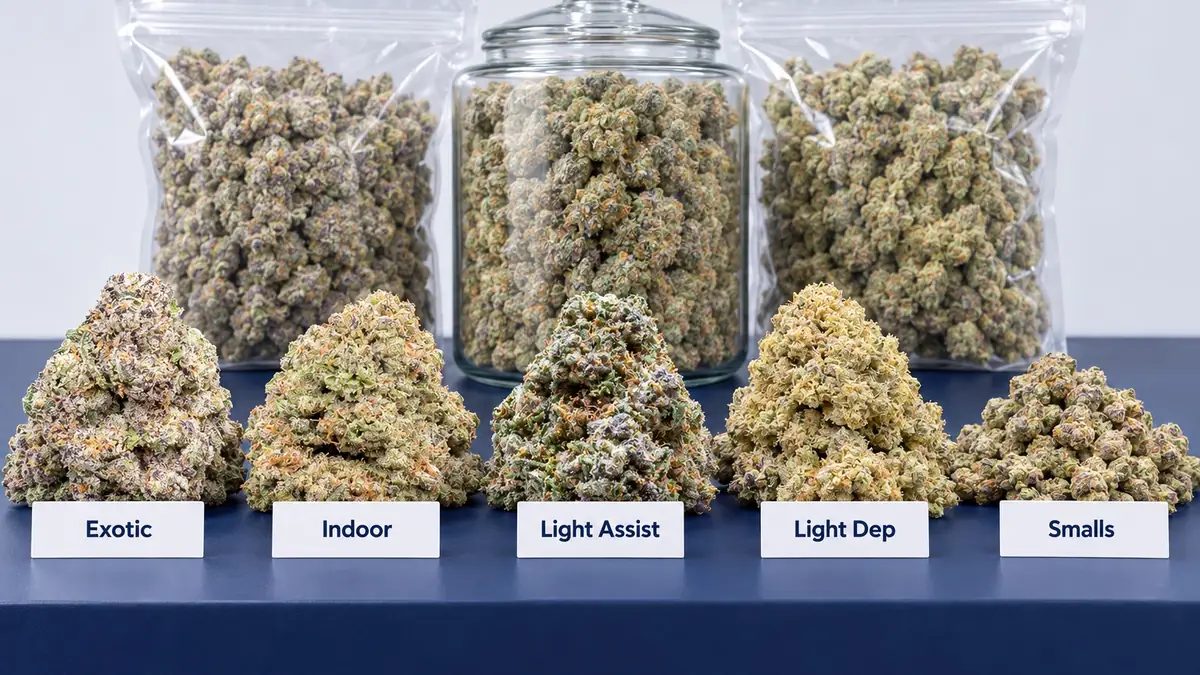
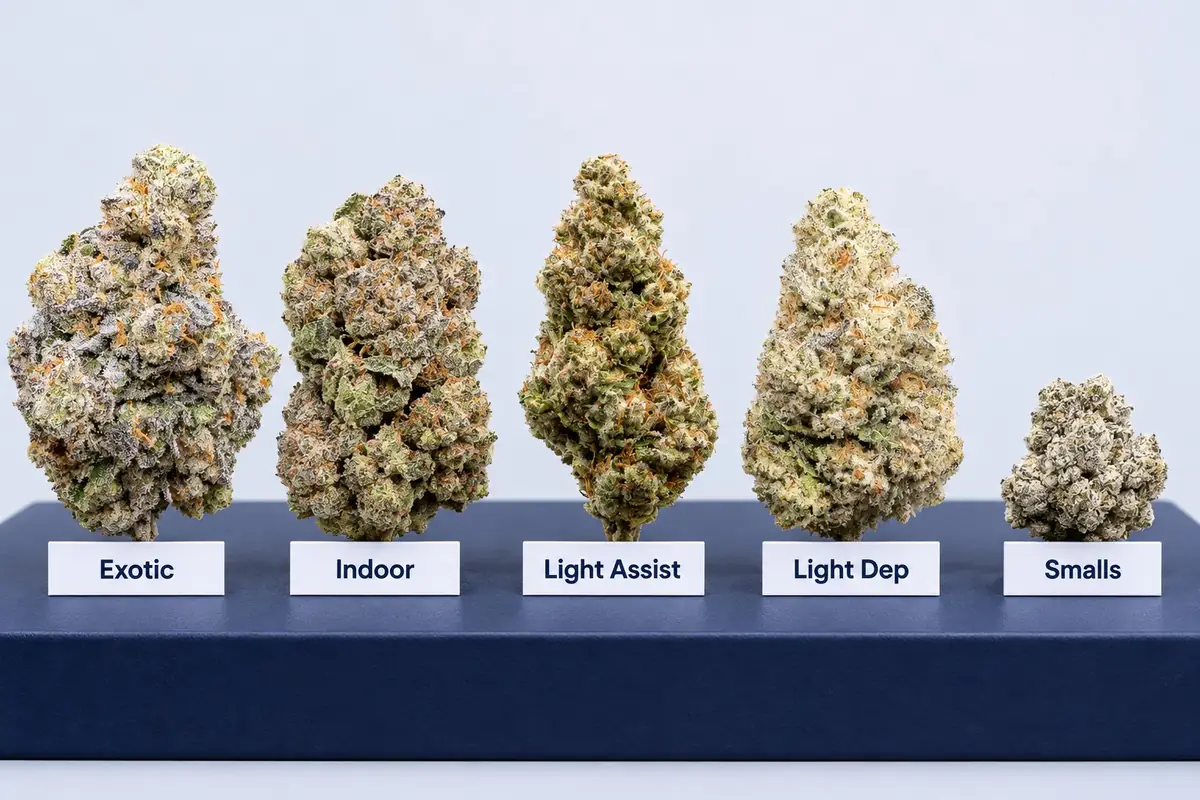
THCA flower grades are the market's shorthand for how hemp flower was grown and sorted: exotic, indoor, light assist, light dep and outdoor describe growing method and quality, while smalls and trim describe the size and type of material. Grade names are not standardized, and they do not measure strength: an exotic strain can test lower in THCA than an indoor one. For anyone buying THCA hemp flower by the pound, a grade tells you where to start looking, and the COA, the buds and the cost per gram of THCA finish the decision. This guide explains each grade, shows how much they overlap on THCA, and gives a simple way to match a grade to your shelf or production line.
| Grade | What it describes | THCA on BCD representative COAs | Relative price per pound | Usually bought for |
|---|---|---|---|---|
| Exotic | Top-shelf quality and in-demand genetics | 20% to 32% | Highest | Flagship jars, premium pre-rolls |
| Indoor | Grown under lights in a climate-controlled room | 22% to 32% | High | Core premium menu |
| Light assist | Greenhouse flower with added lighting | 20% to 30% | Middle | Everyday retail, pre-roll lines |
| Light dep | Greenhouse flower covered to control its light cycle | 22% to 26% | Value to middle | Value retail, infused pre-rolls |
| Smalls | Bud size, from any growing tier | 20% to 30% | Below full bud of the same tier | Value jars, pre-roll fill |
| Trim | Sugar leaf and small leaf from trimming | 12% to 22% | Lowest | Extraction, pre-roll blends |
In This Guide
- What are THCA flower grades?
- Growing tiers: exotic, indoor, light assist, light dep and outdoor
- Indoor vs light dep vs light assist
- Sorted material: full bud, smalls and trim
- Does a higher grade mean more THCA?
- How to compare grades on cost per gram of THCA
- How to judge flower beyond the grade name
- How to choose a grade
- Frequently asked questions
What Are THCA Flower Grades?
THCA flower grades are working labels that growers and wholesalers use to group flower for pricing and sale. No regulator or industry body defines them, so two menus can use the same word for different flower. "Exotic" on one menu may be "top shelf" or "AAAA" on another, and greenhouse flower with added lights may be sold as light assist, mixed light or simply greenhouse.
Most of the confusion goes away once you see that the labels answer two separate questions:
- How was it grown, and how good is it? That is the growing tier: exotic, indoor, light assist, light dep or outdoor.
- What part of the harvest is it? That is the material: full bud, smalls or trim.
The two combine. "Exotic smalls" means small buds from exotic flower, and "light assist trim" means trimmings from light assist flower.
Growing Tiers: Exotic, Indoor, Light Assist, Light Dep and Outdoor
Exotic THCA flower
Exotic is the top of the ladder, and it is a quality and demand tier more than a growing method. It usually points to newer or sought-after genetics, strong aroma, dense and well-trimmed buds and heavy trichome coverage. Menus also call it top shelf, boutique, or AAAA. Because it is partly a judgment call, it is the grade where looking at the actual flower matters most. See how the tier is listed on our exotic THCA flower collection.
Indoor THCA flower
Indoor flower grows in a sealed room where the grower controls light, temperature, humidity and airflow from start to finish. That control tends to produce even, dense buds and steady results from one harvest to the next, and it can run all year. It also takes the most power and equipment, which is a large part of why it costs more. Indoor THCA flower is the usual base of a premium menu.
Light assist THCA flower
Light assist, also called mixed light, is greenhouse flower that gets its main light from the sun with electric lights added when needed. Good light assist can come close to indoor in appearance at a lower cost per pound, which makes it a common everyday choice. Our light assist THCA flower collection sits in the middle of the range.
Light dep THCA flower
Light dep is short for light deprivation. Growers pull blackout covers over a greenhouse to shorten the plants' day, which starts flowering on the grower's schedule instead of the season's. That allows more than one harvest a year on sunlight, so production costs stay lower. Results can move more from crop to crop than indoor because weather still plays a part. Light dep THCA flower is the value end of full bud.
Outdoor or full-term flower
Outdoor flower grows in the field under natural light and usually comes in once a year. It tends to be the lowest cost per pound of the whole-bud options, with looser buds and more variation. Buyers mostly use it for extraction and budget lines. We do not list outdoor THCA flower at this time.
Indoor vs Light Dep vs Light Assist
These three get compared most, and the differences come down to control and cost. All three can produce strong flower, so treat this as what to expect, not a rule.
| Factor | Indoor | Light assist | Light dep |
|---|---|---|---|
| Light source | Electric only | Sun plus electric | Sun, with blackout covers |
| Climate control | Full | Partial | Partial |
| Typical buds | Dense and even | Fairly dense | Good, with more variation |
| Crop-to-crop consistency | Highest | Moderate | Depends more on season |
| Production cost | Highest | Middle | Lower |
| Good fit | Jars sold on looks | Everyday menu | Value menu, pre-rolls |
One caution: menus do not draw these lines the same way, and wholesale tiers often reflect overall quality and price as well as the growing room. Ours do too. Use the tier to narrow your list, then decide on the strain.
Sorted Material: Full Bud, Smalls and Trim
After drying and trimming, a harvest gets sorted by size and type. A simple version looks like this:
Full bud
Full bud, sometimes called bigs or A buds, is the larger, better-looking flower that goes in jars. A shape that holds together and shows well is what you pay extra for.
Smalls
Smalls, also called popcorn buds or B buds, are real buds that are simply small. Some growers sort them with screens, and a common cutoff is around half an inch across, roughly the size of a dime, though every grower sets its own. Mids sometimes sit between full bud and smalls.
Size is the main difference. On our listings, full bud and smalls of the same strain often show the same representative result: Gas Face Exotic and Gas Face Smalls Exotic both list 27.7% THCA, yet the smalls run roughly a third less per pound. That is why THCA smalls are popular for value jars and pre-roll fill. The trade-offs are less shelf appeal, more surface area that can dry out sooner, and sometimes more stem.
Trim
Trim is the sugar leaf and small leaf removed when flower is manicured. It is not bud, and it should not be priced or labeled as bud. It holds less THCA, generally 12% to 22% on our representative COAs, and costs far less per pound. Extraction labs use it as input for concentrates, and pre-roll producers blend it into fill. Georgia Pie Exotic Indoor Trim, for example, lists 16.7% THCA. Compare the range on the bulk THCA trim collection.
Shake is different again: loose, broken pieces that collect in handling. Ask what you are getting if a listing uses the word, since it can mean anything from clean broken bud to floor sweepings.
Building a menu across grades?
You can mix strains and tiers in one order, with a 1 lb minimum. We confirm your order first and email the payment link afterward, and the batch COA ships with what you buy. Tell us what you need or call (303) 339-0343.
Does a Higher Grade Mean More THCA?
No. Look at the at-a-glance table again: exotic starts at 20% on our representative COAs and light dep runs 22% to 26%, so a light dep strain can test above an exotic one. Inside the same tier the spread is just as wide. Black Ice Exotic lists 20.4% THCA and Gas Face Exotic lists 27.7%, at the same price per pound.
Grades mostly price things a THCA number does not capture: aroma, bud structure, trim quality, color and demand for the strain. If you sell jars, those things drive sell-through. If you extract, they matter much less, and the THCA number matters more.
Two more points when you read the numbers:
- Total THC is not the THCA figure. Total THC is (THCA x 0.877) + Delta-9 THC, the formula in the USDA hemp rule. A flower with 27.7% THCA and 0.14% Delta-9 THC works out to about 24.4% total THC. Our total THC guide walks through more examples.
- Listed results are not guarantees. Cannabinoid values vary by batch. Our listed COAs are representative, and your batch COA comes with your order.
How to Compare Grades on Cost per Gram of THCA
Price per pound hides what you are paying for the cannabinoid. If the flower is an input rather than a jar, compare cost per gram of THCA:
Cost per gram of THCA = price per pound / (454 x THCA percentage)
These round example prices are for the math only, not quotes:
| Example | Price per lb | THCA | THCA per lb | Cost per gram of THCA |
|---|---|---|---|---|
| Indoor full bud | $1,000 | 28% | 127 g | $7.87 |
| Light dep full bud | $600 | 24% | 109 g | $5.51 |
| Trim | $200 | 15% | 68 g | $2.94 |
This is a comparison tool, not a yield forecast, since real extraction recovers only part of what is in the plant and handling costs differ. It also does not apply to a jar buyer, whose customer is paying for the flower itself. For jars, work from your shelf price instead: decide what the jar has to sell for, then find the highest grade that still leaves your margin.
Pro Tip: Buy One Pound of Each Before You Commit
Grade names will not tell you how a strain looks in your jars or runs in your machine. A 1 lb order is the practical way to test on flower, and it gives your staff or customers something real to react to. Try two or three tiers side by side, then put your volume on what sells.
How to Judge THCA Flower Beyond the Grade Name
When you have the flower or good photos in front of you, these checks say more than the label does:
- Aroma. Strong and clearly tied to the strain is what you want. A hay or musty smell suggests a poor dry or cure.
- Structure. Dense, intact buds hold up in shipping and on the shelf. Airy flower looks larger but weighs less per jar.
- Trim. Neatly manicured buds with few stray leaves point to a higher grade. Hand trimming and machine trimming can look quite different.
- Trichomes and color. Heavy, intact trichomes are a good sign. Rough handling knocks them off and leaves dust at the bottom of the bag.
- Dryness. Flower should bend a little and then snap. Moisture of about 10% to 12% and water activity of about 0.55 to 0.65 are common targets where the lab reports them. Damp flower raises mold risk, and overdry flower crumbles.
- Stems and seeds. Both add weight you cannot sell, so check for them, especially in smalls.
Then read the COA. Look for THCA and Delta-9 THC as separate lines, a strain name that matches the listing, and the contaminant results the panel includes, such as pesticides, heavy metals, microbials and mycotoxins. Our guide on how to read a hemp COA covers the full report.
Storage matters after you buy, too. THCA slowly converts to Delta-9 THC with heat, light and time, and terpenes fade the same way. Keep flower sealed, cool and dark, and buy what you can sell through.
How to Choose a THCA Flower Grade
- Start with the use. Decide whether the flower goes in jars, pre-rolls or extraction, since that decides how much appearance is worth.
- Set your numbers. Work back from your shelf price for jars, or use cost per gram of THCA for inputs.
- Shortlist two or three tiers. Use the table below as a starting point.
- Compare strains inside each tier. Check the listed THCA, the strain type and the photos, and remember that results overlap across tiers.
- Test with a small order. Buy 1 lb of each finalist, and check the batch COA that arrives with it.
- Reorder what sells. Flower menus change often, so keep a backup strain in the same tier.
| If you are making... | Start with | Why |
|---|---|---|
| A top-shelf jar line | Exotic, indoor | Customers can see and smell the difference |
| An everyday retail menu | Light assist, indoor | Good appearance at a workable margin |
| A value jar | Smalls, light dep | Lower cost, with real bud in the jar |
| Single-strain pre-rolls | Smalls | Bud size stops mattering once it is ground |
| Budget or blended pre-rolls | Trim with smalls | Trim lowers fill cost, and smalls keep the flavor up |
| Concentrates or extracts | Trim | Priced for input, with appearance irrelevant |
If you want something past flower, our THCA Snow Caps and the THCA concentrates collection cover the options beyond plain flower.
Compliance Note: This guide is general information and not legal advice. Rules on THCA flower differ by state and change often, so check the rules wherever you sell before you order.
How BCD Sells THCA Flower
Bulk CBD Distributors works with many manufacturers and suppliers across the industry so we can carry a wide choice of flower. We list exotic, indoor, light assist, light dep and smalls strain by strain, with trim alongside them.
- Sizes: sold by the pound from 1 lb, and you can mix strains across an order. Ask for a quote on larger volumes.
- Testing: each listing shows THCA and Delta-9 THC from a representative third-party COA, and the batch COA ships with every order.
- Samples: we do not offer samples on flower or trim, so a 1 lb order is the way to try a strain.
- Ordering: add your strains to your cart and place the order. Once it is confirmed, we email a payment link, and most flower ships by air the same or next day after payment.
See the Grades Side by Side
Compare strains, THCA results and photos on the THCA flower collection, or send us your use and volume and we will suggest a starting mix.
Frequently Asked Questions
What are the grades of THCA flower?
The common growing tiers are exotic, indoor, light assist, light dep and outdoor. Material is then sorted into full bud, smalls and trim. The names are not standardized, so ask each supplier what its grade means.
What is the best grade of THCA flower?
Exotic and indoor sit at the top for appearance and aroma, but the best grade is the one that fits your use. A pre-roll maker or extractor can get better value from smalls or trim than from top-shelf bud.
What is the difference between indoor and light dep THCA flower?
Indoor grows entirely under electric lights in a climate-controlled room. Light dep grows in a greenhouse on sunlight, with blackout covers controlling the light cycle. Indoor is usually more even and costs more, and light dep is usually the lower-cost choice.
What is the difference between light assist and light dep?
Light assist adds electric light to a greenhouse crop, while light dep takes light away with covers to trigger flowering. Both use the sun as the main light source, and many greenhouses use both methods. Menus may also use the two names as price tiers.
What does exotic THCA flower mean?
Exotic is a label for top-shelf flower, usually in-demand genetics with strong aroma, dense buds and a careful trim. It is a quality and demand tier, not a measured standard, and it does not guarantee the highest THCA.
Are THCA smalls lower quality?
Not necessarily. Smalls are smaller buds, often from the same harvest as full bud, and on our listings they often show the same representative THCA result as the full-bud version. They cost less mainly because they look less impressive in a jar.
What is the difference between smalls and trim?
Smalls are actual buds. Trim is the sugar leaf and small leaf cut away during manicuring, and it usually holds less THCA. Smalls suit jars and pre-rolls, while trim mainly suits extraction and pre-roll blends.
Does a higher grade mean higher THCA?
No. THCA ranges overlap across tiers, and exotic strains can test lower than indoor or light dep ones. Grades mostly reflect appearance, aroma, growing method and demand, so check the COA for the number.
What THCA percentage should I look for?
Most full-bud listings on our site show about 20% to 32% on representative COAs, and trim about 12% to 22%. A higher number is useful, but for jar sales aroma and appearance often matter as much.
Which grade is best for pre-rolls?
Smalls are the usual choice because bud size no longer matters once flower is ground. Trim can lower the cost of a blend. Premium pre-roll lines may use exotic or indoor flower for a stronger strain story.
Can I mix grades in one BCD order?
Yes. You can mix strains across your order, with a 1 lb minimum. Trim is listed separately and ships within 2 to 3 business days once payment is received.