What is CBN? CBN (cannabinol) is a cannabinoid that forms when THC oxidizes as cannabis and hemp material ages or is exposed to heat, light, and air, so living plants contain very little of it. For manufacturers and brands, CBN is a specialty ingredient sold as 99%+ isolate, 80 to 95% distillate, and 45 to 60%+ crystal resistant distillate, and it may remain federally legal, though its status under Section 781 is less settled, because most commercial CBN is converted from other cannabinoids and the FDA's similar-effects list is still pending. This guide covers CBN chemistry, the forms you can buy, the specs to require, handling, market demand, and the regulatory points to track.
What Is CBN, Chemically?
CBN is a phytocannabinoid with the molecular formula C21H26O2 and a molecular weight of 310.4 g/mol, as listed by PubChem. Compared with THC (C21H30O2), it has four fewer hydrogen atoms, because oxidation converts one of THC's rings into a fully aromatic ring. That aromatic structure is the chemical signature of CBN and is why it is described as a degradation or aging product rather than a primary plant cannabinoid.
Most familiar cannabinoids, such as CBD and CBG, are made by plant enzymes from the precursor CBGA. CBN is different. No enzyme makes it directly. It forms after THCA is decarboxylated to THC and that THC is then oxidized by air, light, and heat over time. Old or poorly stored plant material accumulates CBN for exactly this reason. For buyers, this chemistry explains three things: why CBN supply depends on conversion and purification capacity rather than on cultivars, why CBN must be protected from light and oxygen once purchased, and why its regulatory position sits closer to the THC side of the discussion than CBD or CBG do. For a broader overview of how CBN compares with other minor cannabinoids, see our minor cannabinoids guide.
How Is Commercial CBN Produced?
Because fresh hemp contains only trace CBN, commercial supply relies on controlled conversion of hemp-derived cannabinoid material followed by purification. The general sequence is:
- Extraction of USA-grown hemp with ethanol or CO2, then winterization to remove fats and waxes.
- Controlled conversion under managed heat and oxidation conditions to raise CBN content.
- Distillation by short-path or wiped-film equipment to concentrate the CBN fraction.
- Remediation where needed, using chromatography to reduce residual THC so the material meets total THC limits.
- Crystallization for isolate, followed by washing, vacuum drying, and milling into a powder.
- Third-party testing of each batch before release.
The conversion and remediation steps are where quality differs most between suppliers. They determine how much residual THC, partially converted material, and other byproducts remain, which is why the COA review described below matters more for CBN than for most cannabinoids.
CBN Forms and Specifications
CBN is sold in the same families of forms as CBD and CBG. The figures below are typical specifications; the batch COA governs each lot.
| Form | Typical CBN content | Appearance | Common product formats |
|---|---|---|---|
| Isolate | 99%+ | White to off-white crystalline powder | Exact-dose tinctures, capsules, edibles, topicals |
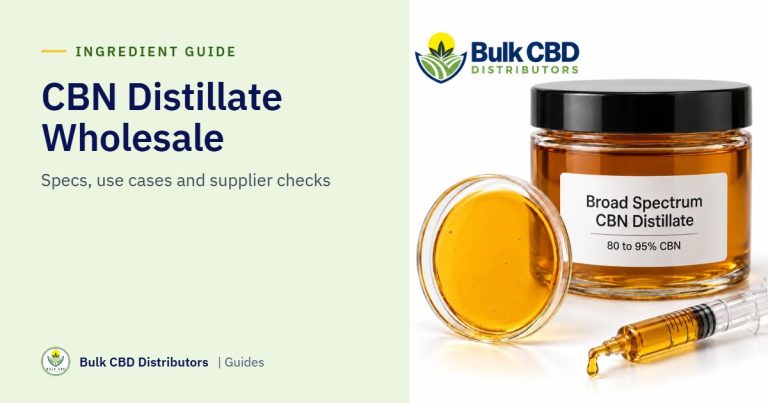
| Broad spectrum distillate | 80 to 95% | Viscous gold to amber oil | Tinctures, softgels, edibles |
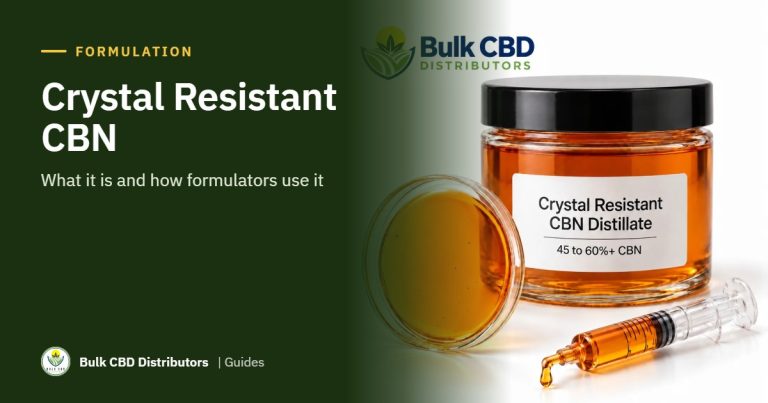
| Crystal resistant distillate | 45 to 60%+ | Flowable oil | Vape cartridges, liquid formulas |
| Water soluble | Around 20% | Liquid or powder | Beverages, drink mixes, gummies, shots |
CBN isolate is the choice when you need exact milligram control and a flavor-neutral input. It dissolves into warmed carrier oils with stirring. Distillate keeps other hemp cannabinoids alongside CBN and is usually lower cost per gram of total cannabinoid. Crystal resistant CBN distillate exists because high-concentration CBN tends to crystallize in liquids; its controlled 45 to 60%+ CBN balance keeps it flowable in cartridges and liquid formulas. Our companion guide on CBN distillate wholesale specs goes deeper on the oil forms. You can see every format in the CBN category.
What Should a CBN COA Show?
Every CBN lot should come with a lot-specific COA from an ISO 17025-accredited, DEA-registered third-party laboratory. Review these items before you accept a lot.
- CBN potency that matches the form you ordered: 99%+ for isolate, 80 to 95% for distillate, 45 to 60%+ for crystal resistant distillate.
- Total THC calculated as Delta-9 + Delta-8 + (THCA x 0.877). Because CBN is made from THC, residual THC is the most important number on a CBN COA. A COA that reports only Delta-9 is not enough.
- Full cannabinoid panel showing what else is in the material. Unidentified peaks or a large gap between CBN and total cannabinoids deserve a question to the supplier.
- Residual solvents, heavy metals, pesticides, and microbials, each with individual analyte results.
- Lot match: the sample ID on the COA must match the lot you receive.
Our step-by-step guide to reading a hemp COA walks through each section.
Storage and Handling
CBN is itself an oxidation product, and it is still sensitive to further degradation. Handle it as a light- and air-sensitive ingredient.
- Store sealed, cool, dry, and dark. Sealed CBN distillate typically holds an 18 to 24 month shelf life under proper conditions.
- Limit headspace and air exposure once a container is opened. Reseal promptly; consider inert gas blanketing for partial containers held long term.
- Warm distillates gently to pour, using a water bath or controlled oven, and avoid repeated hard heating cycles that darken the oil.
- Watch for crystallization in high-potency distillate and in finished liquids stored cold. Use crystal resistant distillate where flow matters.
- Re-test potency if material is held past its documented shelf life or stored outside recommended conditions.
Is CBN Legal Under Section 781?
CBN may remain federally legal, though its status under Section 781 of P.L. 119-37 is less settled, because most commercial CBN is converted from other cannabinoids rather than extracted as a naturally occurring cannabinoid. When Section 781 takes effect, the federal hemp definition moves to a total THC standard and caps finished consumer products at a per-container limit for THC and for any cannabinoids that the FDA lists as having effects similar to THC. The FDA has not yet published that similar-effects list; its deadline passed in February 2026. Until it does, CBN's final position cannot be confirmed. The Congressional Research Service summary of Section 781 describes the framework.
On terminology: BCD makes no effects claims for CBN, and its status depends partly on the FDA list. That is a different category from CBD, CBG, and CBC, which are generally described as non-intoxicating. Practical steps for buyers:
- Keep total THC documentation for every lot and every finished batch.
- Avoid long single-ingredient CBN production runs that you could not adjust if the FDA list includes CBN.
- Read our 2026 hemp law guide for the full timeline and watch for FDA publication.
- Check state rules where you sell, since some states regulate minor cannabinoids separately.
Market Demand and Product Formats
CBN demand comes mainly from brands building multi-cannabinoid product lines and from brands that want a distinct cannabinoid on the label beyond CBD. In bulk trade, CBN shows up most often in tinctures, softgels and capsules, gummies and other edibles, beverages through water soluble forms, vape cartridges through crystal resistant distillate, and topicals. Typical topical loadings are 0.5 to 3% by weight.
Supply is steady but can tighten quickly, because CBN depends on conversion capacity rather than on harvest volume. When demand jumps, lead times and prices respond faster than they do for CBD. Pricing is driven by form (isolate carries crystallization and purification cost), by remediation needs, and by lot size. As with any cannabinoid, compare quotes on cost per gram of CBN using the batch COA potency rather than price per kilogram.
Marketing claims are the area to manage most carefully. Describe CBN on labels and in sales materials by what it is: its name, amount per serving, form, and testing. Avoid structure or function claims, and have your regulatory advisor review labels and marketing copy before launch.
What This Means for Your Business
CBN is a workable specialty ingredient for manufacturers who manage three things well: specification, documentation, and regulatory timing. Choose isolate for exact dosing, distillate for multi-cannabinoid oils, and crystal resistant distillate for anything that must stay flowable. Make total THC the first line you read on every CBN COA. Store the material sealed, cool, and dark. And plan production so you can adjust quickly once the FDA publishes its similar-effects list. Brands that handle those steps can add CBN to a product line without taking on avoidable compliance risk.
Compare Current CBN Specs and COAs
Current specs and representative COAs are on the CBN isolate and crystal resistant CBN distillate pages, and every format is listed in the CBN category. At BCD, the batch COA ships with every order, MOQs are 100g to 1kg depending on the product, and most orders ship within a few days. If you have questions about which form fits your formula, we are glad to help.
Frequently Asked Questions
What is CBN?
CBN (cannabinol) is a cannabinoid that forms when THC oxidizes with exposure to air, light, and heat over time. Its formula is C21H26O2, per PubChem.
Is CBN the same as CBD?
No. CBD is made by plant enzymes from CBGA. CBN forms from the oxidation of THC. They have different structures, different supply chains, and a different regulatory position.
How is bulk CBN made?
Hemp extract is put through controlled conversion to raise CBN content, then distilled, remediated for THC where needed, and crystallized for isolate. Each batch is third-party tested.
What forms of CBN can I buy wholesale?
Isolate at 99%+, broad spectrum distillate at 80 to 95%, crystal resistant distillate at 45 to 60%+, and water soluble CBN at around 20%, varying slightly per batch.
Is CBN legal under Section 781?
CBN may remain federally legal, though its status under Section 781 is less settled, because most commercial CBN is converted from other cannabinoids. The FDA has not yet published its similar-effects list, so its final status will be confirmed once that list appears.
Is CBN intoxicating?
BCD makes no effects claims for CBN. Its regulatory status depends partly on the FDA similar-effects list. It is not grouped with CBD, CBG, and CBC.
What is the most important line on a CBN COA?
Total THC, calculated as Delta-9 + Delta-8 + (THCA x 0.877). Because CBN is made from THC, residual THC is the key compliance check.
Why does CBN distillate crystallize?
CBN at high concentration tends to form crystals in liquids. Crystal resistant CBN distillate uses a controlled 45 to 60%+ CBN balance to stay flowable.
How should I store CBN?
Sealed, cool, dry, and away from light, with minimal air in the container. Sealed CBN distillate is listed at an 18 to 24 month shelf life under proper conditions.
What is BCD's minimum order for CBN?
MOQs run 100g to 1kg depending on the product. Most orders ship the same or next day once payment is received.