Full spectrum CBD keeps the hemp plant's whole cannabinoid profile, including its natural THC. Broad spectrum CBD keeps CBD and the minor cannabinoids with THC reduced to 0.3% or less, or to non-detect. CBD isolate is 99%+ pure cannabidiol with everything else removed. For B2B buyers, the right choice depends on the finished product: how much CBD goes into each container, whether any THC is acceptable, and how the 0.4 mg per container total THC cap in Section 781 of P.L. 119-37 applies from December 11, 2026. This guide covers both versions of full spectrum (Standard and Compliant), both broad spectrum options, the per-container THC math for tinctures, gummies, capsules, topicals, beverages and pet products, and what the entourage effect does and does not mean for your formulas and labels.
What Are Full Spectrum, Broad Spectrum and CBD Isolate?
Full spectrum CBD
Full spectrum CBD distillate is a hemp extract that keeps the plant's native cannabinoid profile. CBD runs 75 to 85%+, with CBG, CBN, CBC and other minor cannabinoids, varying terpene levels (distillation removes many of them) and the plant's own THC. Real full spectrum keeps that THC, so it usually tests above 0.3% Delta-9 THC. That is why it comes in two versions:
- Standard: natural full spectrum, typically above 0.3% Delta-9 THC. It is in-process material for buyers who will process or remediate it further, not a direct ingredient for finished hemp products.
- Compliant: full spectrum remediated to 0.3% Delta-9 THC or less, keeping the minor cannabinoid profile. This is the version for finished products, subject to the per-container math below.
Broad spectrum CBD
Broad spectrum CBD distillate starts from the same extract and goes through a THC remediation step, usually chromatography, that pulls THC down while keeping CBD and minor cannabinoids. CBD runs 80 to 95%. It also comes in two options:
- Standard: 0.3% Delta-9 THC or less, and some lots test non-detect.
- Non-Detect THC: specified and tested as non-detect THC, for products and buyers that need a zero-THC result on the COA.
CBD isolate
CBD isolate is cannabidiol at 99% or higher purity, made by crystallizing CBD out of distillate. It is a white to off-white crystalline powder with no terpenes, no minor cannabinoids and non-detect THC, and no flavor or odor. It gives the most predictable dosing of the three.
A fourth input, crystal resistant CBD distillate (typically 45 to 60%+ CBD), is formulated to stay pourable and often has terpenes added back. See CBD distillate specs and grades for how the distillate grades compare.
Full Spectrum vs Broad Spectrum vs Isolate: Comparison Table
| Attribute | Full spectrum | Broad spectrum | CBD isolate |
|---|---|---|---|
| CBD content | 75 to 85%+ | 80 to 95% | 99%+ |
| Delta-9 THC | Standard: typically above 0.3%. Compliant: 0.3% or less | Standard: 0.3% or less, some lots non-detect. Non-Detect THC option | Non-detect |
| Minor cannabinoids | CBG, CBN, CBC and others | CBG, CBN, CBC and others | None |
| Terpenes | Native, often reduced by distillation | Retained in part, often reduced | None |
| Form and flavor | Amber viscous oil, hemp-forward | Amber viscous oil, milder hemp | White powder, neutral |
| Per-container THC planning | Most demanding | Run the math on Standard; simplest on Non-Detect | Simplest |
| Price per kg | Lowest processing cost | Premium for remediation | Most CBD per kg |
| Best for | Whole-plant positioning, low-dose and single-serve SKUs | Most multi-cannabinoid finished products | Non-detect THC, precise dosing, flavor-neutral products |
Full Spectrum CBD: Standard vs Compliant
Full spectrum is the most complete expression of the plant's cannabinoid profile, and it suits product lines built on whole-plant positioning. The THC it carries is native to the plant, not an additive. The practical questions for a buyer are which version to buy and how much THC it adds to each finished container.
- Choose Standard if you are a processor who will remediate, refine or formulate the material under your own controls. Confirm handling and shipping requirements for in-process material before you order.
- Choose Compliant if the distillate goes into a finished product. It keeps the minor cannabinoid profile with Delta-9 THC at 0.3% or less, and you still need to check total THC per container.
Total THC is Delta-9 THC plus THCA x 0.877, plus Delta-8 and the other THC isomers counted under Section 781 of P.L. 119-37. The COA should report each input so you can check the math.
Broad Spectrum CBD: Standard vs Non-Detect THC
Broad spectrum is the most widely used distillate in B2B formulation because it keeps the multi-cannabinoid profile with far less THC than full spectrum. The remediation step adds cost, so it carries a premium over full spectrum, and it slightly concentrates the CBD fraction (80 to 95%).
- Standard tests at 0.3% Delta-9 THC or less, and some lots are non-detect. Because "0.3% or less" can still add measurable THC to a large container, run the per-container calculation on the lot's actual COA result.
- Non-Detect THC is the option to choose when your retailer, market or label needs a zero-THC result, or when you want the container math to be a formality. Check the lab's limit of quantitation (LOQ) on the COA.
CBD Isolate: When Purity Wins
Isolate removes the profile question entirely. At 99%+ CBD with non-detect THC, it gives consistent potency per gram, no flavor contribution and a straightforward COA. That makes it the default for high-volume precision work such as gummies at 10 mg per piece, capsules and flavor-neutral tinctures. The trade-off is that isolate is a single compound. If you want a defined multi-cannabinoid ratio with no THC, blend isolates: for example CBD isolate with CBG isolate. For a deeper look at grades and specs, see What Is CBD Isolate?
"Format mislabeling was one of the most common problems in the early wholesale CBD market: broad spectrum that still had more THC than the buyer expected, full spectrum stripped of its profile, and isolate that tested at 97 or 98% and was sold as 99%+. A format claim on a website means nothing without a current-lot COA confirming what is actually in the material. Anchor every format decision in what the COA shows, not what the label says."
John Piccone, Founder, Bulk CBD Distributors
How Do You Calculate THC per Container?
From December 11, 2026, Section 781 limits finished hemp-derived cannabinoid products to 0.4 mg of total THC per container. The cap counts the whole jar, bottle or can, not each serving. Three steps tell you whether a SKU fits:
- Distillate per container (mg) = CBD per container (mg) divided by the CBD fraction of the distillate.
- THC per container (mg) = distillate per container (mg) x the total THC fraction on the batch COA.
- Compare to 0.4 mg. Above 0.4 mg, the SKU needs less distillate, a lower-THC lot or a different input.
Working backward gives a ceiling: the most distillate a container can hold is 0.4 mg divided by the THC fraction. The table uses 80% CBD distillate.
| Lot total THC | Max distillate per container | Max CBD per container |
|---|---|---|
| 0.3% | About 133 mg | About 107 mg |
| 0.1% | 400 mg | 320 mg |
| 0.05% | 800 mg | 640 mg |
| Non-detect | Set by the lab's LOQ | Usually not a constraint |
Always use the total THC on the batch COA for the lot you will produce with, not a spec sheet maximum. A lot at 0.08% gives far more headroom than one at 0.28%. The same math applies to Standard broad spectrum, because 0.3% or less is not zero.
Which Input Fits Each Product Format?
Tinctures
Tinctures carry the most CBD per container, so they are the hardest fit for full spectrum. A 30 mL bottle at 1,000 mg CBD made with 80% distillate needs 1,250 mg of oil. At 0.3% total THC that is about 3.8 mg of THC; at 0.1% it is about 1.3 mg. Both exceed the cap. Compliant full spectrum works only for low-strength or small bottles: a 15 mL bottle at 100 mg CBD from a 0.3% lot lands near 0.38 mg, right at the edge. For standard strengths, use Non-Detect THC broad spectrum for a multi-cannabinoid tincture or isolate for a flavor-neutral one. Recalculate fill weights each time the batch COA changes.
Gummies
The cap applies to the whole jar. Thirty gummies at 10 mg CBD hold 300 mg CBD; with 80% full spectrum at 0.3% THC the jar carries about 1.1 mg THC, well over the cap. A 10-count pouch at 10 mg each lands near 0.38 mg. Most gummy makers use isolate, which also avoids the earthy flavor distillate adds, or Non-Detect THC broad spectrum.
Capsules and softgels
Bottles of 30 to 60 units at 25 mg or more put 750 to 1,500 mg CBD in one container, far beyond what full spectrum can support. Broad spectrum (Non-Detect THC) or isolate in a carrier oil is the standard softgel fill, and isolate suits dry-fill capsules because it is a free-flowing powder.
Topicals and cosmetics
Topicals commonly carry 100 to 1,000 mg CBD per 1 oz unit, and inputs are chosen mostly on texture, odor and color. Isolate adds no color or hemp aroma to balms and butters. Broad spectrum suits products positioned on a multi-cannabinoid profile and can add a mild amber tint. Full spectrum brings the strongest hemp character; above about 100 mg CBD per unit, a 0.3% lot exceeds 0.4 mg per container. Settle how the per-container limit applies to a specific topical with your regulatory counsel before launch.
Beverages and single-serve formats
Beverages are where full spectrum math can work, because each can is usually one serving. A can at 25 mg CBD using 80% distillate at 0.3% THC carries about 0.09 mg THC. The constraint is solubility: distillate and isolate are oil-soluble, so beverage makers use water soluble CBD, and the THC calculation runs on the emulsion's own COA. Multi-serve bottles and drink mix tubs change the math again, because the cap counts the whole container. See our water soluble CBD guide for more.
Pet products
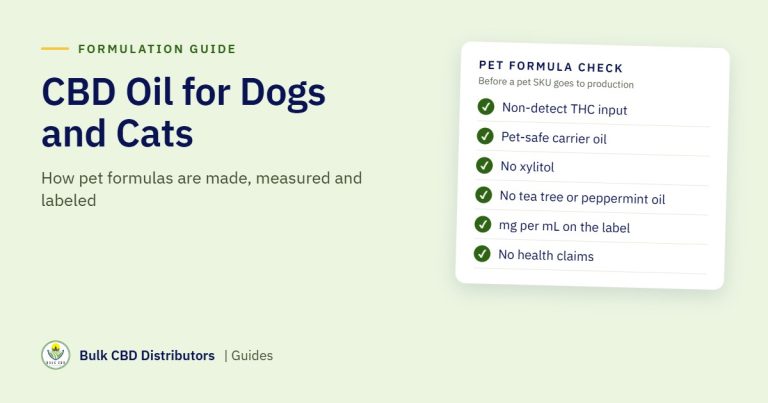
Pet tinctures and chews follow the same container math: a 30 mL pet tincture at 300 mg CBD from a 0.3% full spectrum lot carries about 1.1 mg THC. Many pet brands and retailers also require non-detect THC inputs, and state rules on hemp in animal products vary, so most pet lines use isolate or Non-Detect THC broad spectrum. Keep pet labels to ingredient and content facts.
Format Selection Matrix
| Format | Typical CBD per container | Compliant full spectrum fit | Usual input |
|---|---|---|---|
| Tincture, 30 mL | 500 to 3,000 mg | Poor | Broad spectrum (Non-Detect THC) or isolate |
| Gummy jar | 150 to 750 mg | Poor | Isolate or broad spectrum (Non-Detect THC) |
| Capsules, softgels | 750 to 1,500 mg | Poor | Broad spectrum (Non-Detect THC) or isolate |
| Topical, 1 oz | 100 to 1,000 mg | Limited; confirm applicability | Isolate or broad spectrum |
| Single-serve beverage | 10 to 50 mg | Good | Water soluble (any spectrum) |
| Pet tincture or chews | 100 to 1,000 mg | Poor | Isolate or broad spectrum (Non-Detect THC) |
Fit ratings assume 80% CBD distillate at 0.1 to 0.3% total THC. A lower-THC lot widens the window; always run the numbers with your batch COA.
What Is the Entourage Effect?
The entourage effect is a hypothesis that cannabinoids, terpenes and other hemp compounds may behave differently together than any one of them does alone. The term entered cannabinoid research in 1998 to describe compounds in the body's own endocannabinoid system that changed the activity of a related compound, and it was later applied to plant cannabinoids and then to terpenes.
In commercial use the term has drifted into shorthand for "contains more than one cannabinoid," and sometimes into an implied promise. For B2B buyers it is more useful to read it narrowly: it explains why a formulator might choose a multi-compound ingredient. It is not a specification, and it is not a claim you can put on a label.
Is the entourage effect proven?
No. The research is mixed. Some laboratory studies report interactions between cannabinoids and terpenes, others find none for the compounds and conditions they tested, and many terpenes appear in finished products at far lower levels than those used in laboratory work. Well-controlled studies in people that isolate the effect of a multi-compound profile are limited. It is accurate to say a product contains a multi-cannabinoid and terpene profile, and that the entourage effect is a hypothesis under study. It is not appropriate to say or imply that a product delivers any outcome because of it.
Why does it drive demand for full and broad spectrum?
- Category expectations: shelves and marketplaces sort CBD products by spectrum, so brands need inputs that genuinely fit each category.
- Sensory profile: terpenes add aroma and flavor; some brands want that hemp character and others mask it.
- Differentiation: a documented minor cannabinoid and terpene profile gives a brand something concrete to show on its COA and product page, separate from any claim.
How Do You Specify and Document a Multi-Cannabinoid Profile?
If your product is positioned on its profile, write that profile into your ingredient specification so every lot can be checked against it:
- Primary cannabinoid range: for example, CBD 80 to 95% for broad spectrum distillate.
- Named minor cannabinoids: list each one you want present (such as CBG, CBN and CBC) with a minimum level or "present above LOQ."
- THC limit: for full spectrum, which version (Standard or Compliant) and a total THC limit; for broad spectrum, Standard (0.3% or less) or Non-Detect THC with the lab's LOQ stated.
- Terpene requirement: "terpene panel required, report all analytes," or named terpenes with minimums if your formula depends on them. Distillation can strip terpenes, so do not assume they are there.
- Blend ratios: if you build your own profile from isolates, state the target ratio in mg per serving and test the finished product.
Then check these points on every ingredient and finished-product COA:
- Full cannabinoid panel: at least CBD, CBDA, CBG, CBGA, CBN, CBC, Delta-9 THC, THCA and Delta-8 THC.
- LOQ for each analyte: "ND" without an LOQ tells you little.
- Total THC shown with its inputs: Delta-9 plus THCA x 0.877 plus other THC isomers. A COA showing only Delta-9 THC is not enough for any spectrum.
- Terpene panel when terpenes are claimed, with each analyte and result.
- Lab credentials: ISO 17025 accredited, DEA-registered third-party laboratory, with the batch number matching your lot. How to Read a Hemp COA walks through each section.
How should brands talk about spectrum and the entourage effect?
Describe composition and leave outcomes out. Acceptable framing looks like this:
- "Contains CBD, CBG and CBC, plus naturally occurring hemp terpenes, as shown on the batch COA."
- "Made with broad spectrum hemp extract. THC non-detect." (only on Non-Detect THC lots)
- "The entourage effect is a hypothesis researchers are still studying."
Avoid wording that ties the profile to how a product makes someone feel or what it does for the body. Words such as "enhanced," "amplified" or "more effective" imply an outcome and belong off labels, product pages and sales materials.
How Do You Choose the Right Input?
- Is any THC acceptable in the finished product? If not, use isolate or Non-Detect THC broad spectrum.
- Does the positioning rely on a multi-cannabinoid profile? If so, use Compliant full spectrum or broad spectrum, or blend isolates to a set ratio.
- Is flavor neutrality required? If so, use isolate; distillate of either kind needs masking.
- Does the SKU clear the 0.4 mg per container cap? Run the three-step calculation with the batch COA for every SKU that uses full spectrum or Standard broad spectrum.
- Where will it be sold? Export markets set their own limits. Japan, for example, limits residual Delta-9 THC by product type (10 ppm for oils and powders), so Japan-bound products are built on isolate or Japan-compliant inputs. See wholesale CBD for Japan.
Section 781 Considerations by Input
- Full spectrum, Standard: above the 0.3% hemp threshold as sold; in-process material for further processing or remediation.
- Full spectrum, Compliant: 0.3% Delta-9 THC or less at the ingredient level; finished products must clear the 0.4 mg per container cap, which most multi-serving formats will not.
- Broad spectrum, Standard: 0.3% or less, some lots non-detect; run the container math on the lot's actual result.
- Broad spectrum, Non-Detect THC: negligible contribution to the container cap at a low LOQ.
- CBD isolate: non-detect THC; the simplest posture of the five.
Section 781 also excludes synthetic cannabinoids that cannot be naturally produced by the cannabis plant from November 12, 2026, and most of its other provisions take effect December 11, 2026. Our guide to what the 2026 hemp law means for bulk buyers covers the dates and definitions.
What This Means for Your Business
Start from your SKU list, not from the extract. For each product, write down the CBD per container and run the three-step THC calculation against the 0.4 mg cap with the batch COA you will actually buy. Most multi-serving formats point to isolate or Non-Detect THC broad spectrum. Single-serve formats such as beverages and shots are where Compliant full spectrum still has room. Standard full spectrum belongs with processors who will remediate it. Standardizing on fewer inputs also simplifies purchasing, COA management and quality control: many brands use broad spectrum for multi-cannabinoid lines, isolate for flavor-neutral lines and full spectrum for a few low-dose SKUs. For supplier checks before you buy, see How to Source Wholesale CBD and Choose a Bulk Supplier.
Compare Current Full Spectrum, Broad Spectrum and Isolate Specs
Current versions, sizes and representative COAs are on the full spectrum CBD distillate, broad spectrum CBD distillate and CBD isolate pages. Minimums run 100g to 1kg depending on the product, and most orders ship within a few days. If you send your formats and target mg per container with a quote request, we can match them to current lot COAs.
Frequently Asked Questions
What is the difference between full spectrum and broad spectrum CBD?
Full spectrum keeps the plant's whole cannabinoid profile, including its natural THC. Broad spectrum keeps CBD and the minor cannabinoids with THC reduced to 0.3% or less, or to non-detect on the Non-Detect THC option.
Does full spectrum CBD have more than 0.3% THC?
Real full spectrum usually does. Standard full spectrum typically tests above 0.3% Delta-9 THC and is in-process material. The Compliant version is remediated to 0.3% Delta-9 THC or less for use in finished products.
Does broad spectrum CBD contain any THC?
It can. Standard broad spectrum tests at 0.3% Delta-9 THC or less, and some lots are non-detect. If you need a zero-THC result on every lot, specify the Non-Detect THC option and check the LOQ on the COA.
What is CBD isolate and how does it differ from distillate?
Isolate is 99%+ pure CBD with non-detect THC and no terpenes or minor cannabinoids. Distillate keeps more of the profile: broad spectrum runs 80 to 95% CBD and full spectrum 75 to 85%+.
Does the 0.4 mg THC limit apply per serving or per container?
Per container. A jar of gummies or a bottle of capsules is measured as a whole, which is why multi-serving formats are the hardest fit for full spectrum.
How do I calculate total THC in a finished product?
Divide CBD per container by the distillate's CBD fraction to get distillate mass, then multiply by the total THC fraction on the batch COA. Total THC is Delta-9 plus THCA x 0.877, plus Delta-8 and other THC isomers.
Can I still make full spectrum tinctures under Section 781?
Only at low CBD loads. With a 0.3% THC lot of 80% distillate, a container can hold about 107 mg of CBD before reaching 0.4 mg THC. Most standard-strength tinctures exceed that.
Which CBD input is best for gummies?
Isolate or Non-Detect THC broad spectrum. Isolate gives neutral flavor and simple dosing. Full spectrum rarely fits a full jar under the container cap.
Can I use full spectrum CBD in beverages?
Often yes for single-serve containers with low CBD loads, such as a can at 25 mg CBD. You need a water soluble emulsion and a THC calculation based on that emulsion's COA.
Is the entourage effect proven?
No. It is a hypothesis that hemp compounds may behave differently together than alone. Research is mixed, and brands should describe it as a hypothesis under study, not tie it to any outcome.
Can I mention the entourage effect on a product label?
Describing composition is the safer approach. If you mention the term, present it as a research hypothesis and do not link it to any effect for the user.
Do full spectrum distillates always contain terpenes?
Not always. Distillation can remove much of the native terpene content. Ask for a terpene panel if terpenes matter to your product.
Can I build a multi-cannabinoid blend from isolates?
Yes. Combining CBD isolate with CBG or CBC isolate gives precise, repeatable ratios with no THC. Confirm the finished ratio with a finished-product COA.
Can I switch from full spectrum to broad spectrum without reformulating?
Usually with only small changes. Broad spectrum assays slightly higher in CBD, so you need a little less oil per unit. Recalculate fill weights from the new batch COA and check flavor.
Which input should I use for products sold in Japan?
Japan limits residual Delta-9 THC by product type, so Japan-bound products are usually built on CBD isolate or Japan-compliant inputs. Ask for the test method, the LOQ and the ppm result, plus export documentation, before you commit to a lot.
Related Reading
- How to Source Wholesale CBD and Choose a Bulk Supplier: The 2026 B2B Guide
- What Is CBD Isolate? The Complete B2B Manufacturer's Guide
- CBD Distillate: Specs, Grades and How to Buy in Bulk
- Broad Spectrum CBD Oil Wholesale: A Formulator's Buying Guide
- Full Spectrum CBD Oil Wholesale Sourcing Guide for B2B Buyers
- How to Read a Hemp COA: A Step-by-Step Guide for B2B Buyers