What is CBC? CBC (cannabichromene) is a non-intoxicating cannabinoid that hemp produces from the same precursor as CBD and THC, and it is sold to manufacturers mainly as CBC distillate and CBC isolate. It occurs at low levels in most hemp, generally under 1% by dry weight, so it is a specialty ingredient that formulators buy by specification rather than by the drum. This guide covers CBC chemistry, the forms you can buy, typical purity ranges, handling, applications by product format, supply and regulatory status.
What Is CBC and How Does Hemp Make It?
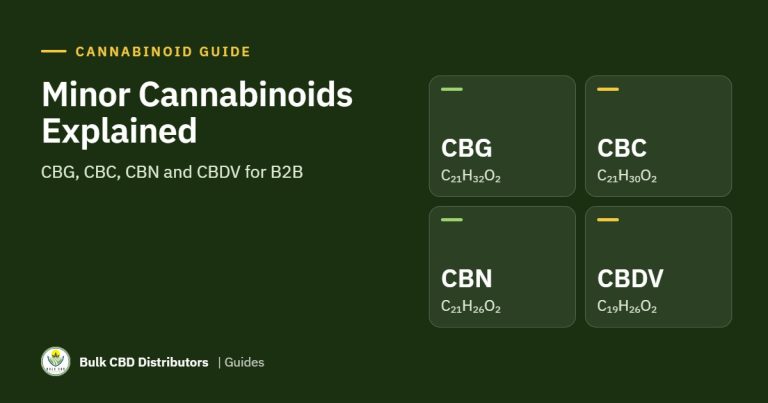
CBC, short for cannabichromene, is a phytocannabinoid with the molecular formula C21H30O2 and a molecular weight of about 314.5 g/mol, according to PubChem. That is the same formula as CBD and Delta-9 THC. The three compounds are isomers: they contain the same atoms arranged in different structures, and those structures give each one different physical behavior and a different regulatory profile.
In the living plant, CBC does not start as CBC. Hemp builds most of its major cannabinoids from one precursor, cannabigerolic acid (CBGA). Different plant enzymes convert CBGA into CBDA, THCA or CBCA. The enzyme that produces CBCA is called CBCA synthase. CBCA is the acid form, and it carries an extra carboxyl group that makes it heat sensitive.
When hemp is dried, extracted and processed with heat, CBCA loses that carboxyl group in a step called decarboxylation, and the result is neutral CBC. This is the same chemistry that turns CBDA into CBD during extraction. For a buyer, the practical point is that a CBC ingredient on a COA is reported as CBC, sometimes with a small CBCA line, and total CBC is calculated the same way total CBD is: neutral CBC plus the acid form adjusted by a factor of 0.877.
CBC is generally described as non-intoxicating, which places it in the same commercial group as CBD and CBG rather than with THC. That status, together with its scarcity, is why most brands use CBC as a labeled minor ingredient alongside CBD or CBG rather than as a stand-alone product. If you are building a multi-cannabinoid line, see our guide to CBG for wholesale buyers for the closely related precursor story.
How Much CBC Is in Hemp?
Commercial hemp cultivars are bred for CBD or CBG, not CBC. In standard CBD cultivars, CBC usually shows up at well under 1% of dry weight, often a small fraction of the CBD figure on the same COA. Some younger plants and specific genetics show higher CBC ratios, but there is no large, established acreage of CBC-dominant hemp the way there is for CBD and CBG.
That low natural abundance shapes the whole supply chain. To produce one kilogram of CBC distillate, a processor has to move a large volume of extract through distillation and chromatography to separate the CBC fraction from CBD, CBG and other cannabinoids. Yield losses at each step add cost. That is the main reason CBC costs more per kilogram than CBD distillate and why available volume can be tighter than for CBD or CBG.
| Material | Typical CBC content | Physical form | Main buyer |
|---|---|---|---|
| Hemp biomass | Under 1% dry weight | Plant material | Extraction labs |
| CBC distillate | 80 to 90%+ (lot dependent) | Viscous oil | Tincture, softgel and edible makers |
| CBC isolate | Above 90% | Oil, not a crystalline powder | Precision-dose formulators |
| Water soluble CBC | Around 20% | Liquid or powder | Beverage and drink mix brands |
CBC Forms: Isolate, Distillate and Water Soluble
CBC Distillate
CBC distillate is the most common wholesale form. It is produced by extraction, winterization, short-path distillation and further refinement that concentrates the CBC fraction. BCD lists typical CBC content of 80 to 90%+, with the balance made up of other cannabinoids and minor plant compounds. Delta-9 THC ranges from non-detect to 0.3% or less by dry weight depending on the lot. Distillate is the economical choice when CBC is one of several cannabinoids in a blend. For a full spec breakdown, see our CBC distillate wholesale guide.
CBC Isolate
CBC isolate is purified above 90% CBC, with premium lots reaching higher. Unlike CBD isolate, which is a white crystalline powder, CBC isolate is an oil at room temperature. Our earlier post on CBC isolate for formulation rosters covers isolate specs in depth.
Water Soluble CBC
Water soluble CBC is CBC processed into an emulsion so it disperses in water based products. It regularly runs around 20% CBC, varying slightly per batch, so the dose math differs from oil-based forms. It is the fit for beverages and drink mixes.
How Should CBC Be Handled and Stored?
CBC behaves differently from CBD in the warehouse and on the production floor. Because CBC does not form a stable crystal at room temperature the way CBD does, both CBC distillate and CBC isolate arrive as oils. They can soften further in a warm room, so plan storage and weighing around temperature control.
- Storage temperature: keep sealed containers in a cool, dry, dark area. BCD recommends 15 to 22 C (59 to 72 F) for working stock and refrigeration at 4 to 8 C for longer holds.
- Warming before use: gentle, even warming makes viscous CBC easier to pour and weigh. Avoid direct high heat, which can degrade cannabinoids.
- Light and air: minimize headspace and exposure to light once a container is opened. Transfer to smaller amber containers if you will use the lot over several weeks.
- Shelf life: sealed material typically holds spec for 18 to 24 months under proper conditions. Retest potency if a lot is held near the end of that window.
- Weighing: weigh by mass rather than volume. Viscosity changes with temperature, so volumetric dosing of CBC oils is less accurate.
We do not publish a melting point for CBC here because PubChem does not list an experimental value for it. If your process depends on a specific thermal property, ask your supplier for lot data or run your own test on a retained sample.
CBC Applications and Supply by Product Format
Most brands use CBC as one labeled cannabinoid in a multi-cannabinoid formula. The format determines which CBC form works best.
- Tinctures: CBC distillate or isolate dissolves directly in MCT and other carrier oils. In blended tinctures, CBC is commonly a small share of the cannabinoid total, often in the 5 to 15% range of the blend.
- Softgels and capsules: oil-based CBC blends fill well into softgels. Confirm flow at your fill temperature.
- Gummies and chocolates: distillate or isolate is added to the fat or oil phase. Water soluble CBC is an option for gummy systems built around aqueous phases.
- Beverages: water soluble CBC is the practical choice; oil forms do not disperse in water.
- Topicals and cosmetics: CBC blends into warm oil phases of balms and creams. Typical inclusion is low, often 0.5 to 3% of the formula.
Whatever the format, build the dose from the lot COA, not from the typical range. A lot at 72% CBC and a lot at 84% CBC require different weights to hit the same milligrams per serving.
What Does CBC Supply Look Like?
CBC supply is real but narrower than CBD or CBG supply. Fewer processors run the separation steps needed to concentrate CBC, so lot sizes are smaller and availability can shift between quarters. Buyers planning a launch should:
- Confirm current lot availability at the volume you need, not general availability.
- Ask how the CBC was produced. Plant-extracted and chromatographically separated CBC is the profile buyers should document, because Section 781 excludes cannabinoids synthesized or manufactured outside the plant.
- Request the batch COA for the specific lot and compare it with the representative COA you approved.
- Plan reorders early for recurring SKUs so that a short lot gap does not stall production.
Is CBC Legal Under Section 781?
CBC is a naturally occurring, non-intoxicating hemp cannabinoid, and hemp-derived CBC ingredients meeting the federal hemp definition are generally understood to remain lawful. When Section 781 of P.L. 119-37 takes effect, the hemp definition will measure total THC, including THCA, at no more than 0.3% on a dry weight basis. It also caps final consumer products at 0.4 mg combined total per container of total THC and cannabinoids with similar effects, and it excludes cannabinoids synthesized or manufactured outside the plant.
For CBC buyers, three points matter. First, the THC content of the CBC ingredient itself matters for your finished product math, so check total THC on every lot. Second, FDA has been directed to publish lists of cannabinoids, and those lists have not been published yet, so watch for them. Third, document that your CBC is plant derived. Our 2026 hemp law guide covers the rules in more detail.
What This Means for Your Business
CBC is a specialty ingredient with clear chemistry, a non-intoxicating profile and limited supply. For most brands it works best as a labeled minor cannabinoid that differentiates a CBD or CBG product line. Choose distillate when CBC is one part of a blend and cost matters, isolate when you need a precise CBC number, and water soluble CBC for beverages. Build doses from lot COAs, control storage temperature, and document the production method.
Compare Current CBC Specs and COAs
Current specs and representative COAs from ISO 17025-accredited third-party laboratories are on the CBC distillate and CBC isolate pages. If you have questions about matching a lot to your formula, we are glad to help. MOQs are 100g to 1kg depending on the product, and most orders ship within a few days.
Frequently Asked Questions
What is CBC in hemp?
CBC (cannabichromene) is a non-intoxicating hemp cannabinoid with the formula C21H30O2. The plant makes it as CBCA from the precursor CBGA, and heat converts CBCA to CBC during processing.
Is CBC the same as CBD?
No. CBC and CBD share the same molecular formula but have different structures. They behave differently physically: CBD isolate is a crystalline powder, while CBC isolate is an oil.
Is CBC intoxicating?
CBC is generally described as non-intoxicating, which puts it in the same commercial group as CBD and CBG.
How much CBC does hemp contain?
Standard hemp cultivars usually contain well under 1% CBC by dry weight. That low abundance is why CBC is more expensive and less available than CBD.
What purity is CBC distillate?
CBC distillate typically tests at 80 to 90%+ CBC, depending on the lot. The batch COA for the specific lot states the exact figure.
What purity is CBC isolate?
CBC isolate tests above 90% CBC. It remains an oil at room temperature rather than forming a powder.
What is the minimum order for CBC?
MOQs are 100g to 1kg depending on the product. Contact our sales team for current lots and volume pricing.
How should I store CBC distillate?
Store sealed containers cool, dry and away from light. BCD suggests 15 to 22 C for working stock and refrigeration for longer holds. Typical shelf life is 18 to 24 months sealed.
Is CBC legal after Section 781 takes effect?
Plant-derived CBC from compliant hemp is generally understood to remain lawful. Finished products must still meet the total THC and per-container limits, and FDA has not yet published its cannabinoid lists.
Which products use CBC?
CBC is used mainly in multi-cannabinoid tinctures, softgels, gummies, topicals and, in water soluble form, beverages. It is most often a labeled minor ingredient alongside CBD or CBG.