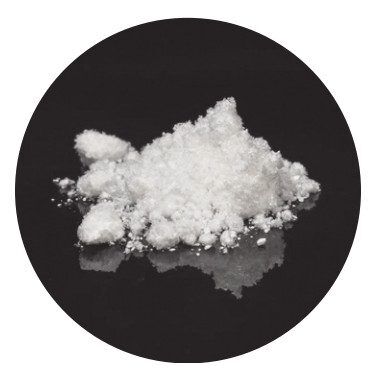
CBD isolate is hemp-derived cannabidiol refined to 99% or higher purity, with the terpenes, minor cannabinoids, waxes, chlorophyll and THC removed. It is sold as a white crystalline powder that is flavorless, odorless and non-detect for THC. For B2B manufacturers it is the most predictable CBD ingredient: a stable potency baseline for exact mg-per-unit dosing, no hemp flavor to mask and the simplest THC documentation of any CBD input. This guide covers how isolate is made, standard and premium grades, powder specs such as particle size and moisture, carriers and dosing math, packaging and shelf life, what to check on the COA, and how to source Japan-compliant CBD isolate.
What Is CBD Isolate?
CBD isolate is the most refined form of hemp-derived cannabidiol. Quality isolate for manufacturing has four defining attributes: 99.0% or higher CBD by dry weight on HPLC, non-detect THC across Delta-9 THC, Delta-8 THC and THCA, neutral flavor and odor, and full solubility in oils. It differs from broad spectrum distillate, which keeps minor cannabinoids, and full spectrum distillate, which keeps the whole plant profile including its THC. When THC must be non-detect, CBD isolate is the starting material.
Is CBD isolate powder the same as CBD crystals?
Yes, at different processing stages. Crystals are the unmilled output of crystallization. Isolate powder is the same crystals milled to a fine, uniform particle size, which dissolves faster in carrier oils, blends more evenly in dry mixes and doses more consistently. Most B2B buyers want milled powder, so confirm whether a supplier ships powder or large crystals that need milling at your facility.
How Is CBD Isolate Made?
Isolate is made from hemp biomass (typically 8 to 12% CBD) in seven steps. Each one affects the final purity, the analytical profile and the residual solvent result.
- Extraction: supercritical CO2 or food-grade ethanol produces crude oil at about 50 to 70% CBD.
- Winterization: the extract is dissolved in ethanol and chilled, commonly to -20 degrees Celsius or colder, and the precipitated waxes and lipids are filtered off.
- Decarboxylation: heating to about 110 to 120 degrees Celsius converts CBDA to CBD.
- Primary distillation: short-path or wiped-film distillation produces a distillate at about 70 to 90% CBD.
- Secondary distillation: a second pass pushes CBD to about 90 to 95%.
- Crystallization: the distillate is cooled slowly in a light hydrocarbon solvent such as pentane or heptane, and CBD crystallizes out of solution.
- Washing, drying and milling: crystals are washed with cold solvent, dried under vacuum, milled to powder and tested before release.
CBD Isolate Grades and Specifications
| Specification | Standard grade | Premium grade |
|---|---|---|
| CBD purity (HPLC) | 99.0 to 99.5% | 99.5 to 99.9%+ |
| Total THC | Non-detect | Non-detect |
| Moisture | Below 0.5% | Below 0.2% |
| Residual solvents | Within USP 467 limits | Non-detect preferred |
| Melting point | About 66 to 67 degrees Celsius for pure CBD; a large deviation suggests impurities | |
| Typical use | Tinctures, gummies, capsules, topicals | Pharma-adjacent work, clinical supply, export to regulated markets |
Any lot below 99% does not meet commercial isolate specifications. Choose the grade on your documentation requirements as well as your formula: premium grade is the usual choice when a customer or export market expects above-99.5% purity and non-detect residual solvents.
Particle Size and Flow
Milling produces a range of particle sizes, and the range differs by mill and supplier, so request d50 data for each lot if it matters to your process. Particle size drives how fast isolate dissolves in carrier oil, how evenly it blends in dry mixes and how it behaves in high-speed capsule fillers. For dry blends, match the isolate's size range to the other ingredients to avoid segregation during mixing and transport.
Solubility, Carriers and Dosing Math
CBD isolate is lipophilic: it dissolves in oils and fats but not in water. MCT oil (fractionated coconut oil) dissolves it fastest, stays liquid at room temperature and has the longest shelf life. Hemp seed oil needs slightly more heat and keeps for less time, and olive oil is thicker with a stronger flavor. For beverages and other water-based products, use water soluble CBD, which is often built on isolate through nano-emulsification.
Potency formula: mg/mL of CBD = (grams of isolate x purity as a decimal x 1,000) divided by the total mL of finished product. Example: 5 g at 99.5% gives 4,975 mg CBD; made up to 500 mL, that is 9.95 mg/mL. Work backward to find the isolate mass for a target strength, and use the purity on the batch COA, not the spec sheet.
How Is CBD Isolate Used in Manufacturing?
Tinctures and oil drops
One gram of isolate made up to 100 mL with MCT oil gives about 10 mg/mL, or roughly 300 mg per 30 mL bottle, with very little batch-to-batch variance. Warm the carrier to about 40 to 55 degrees Celsius, depending on the oil, and stir until the solution is fully clear.
Gummies and edibles
Isolate goes into the warm gummy mass. Its neutral flavor removes the earthy notes distillate adds, which cuts flavor-masking work, and its fixed purity makes per-piece dosing simple.
Capsules and softgels
Isolate dissolved in a carrier oil is a standard softgel fill, and milled powder works in dry-fill capsules. Non-detect THC matters for supplement brands whose customers face zero-tolerance THC policies.
Topicals and cosmetics
Isolate mixes into anhydrous balms, salves and body butters, typically at 100 to 1,000 mg per 1 oz unit, without adding color or hemp aroma.
Beverages and functional foods
Raw isolate will not disperse in water, but it is the usual input for water soluble CBD ingredients.
Custom multi-cannabinoid blends
Combining CBD isolate with CBG isolate or CBC isolate gives a precise, repeatable cannabinoid ratio with no THC. Confirm the finished ratio with a finished-product COA.
Packaging, Storage and Shelf Life
Isolate absorbs little water, but a damaged seal in transit or storage can still let humidity in and cause clumping, which is a real problem in automated filling and blending. A clean COA does not tell you how the material was packed or stored, so ask about nitrogen flushing and seal integrity.
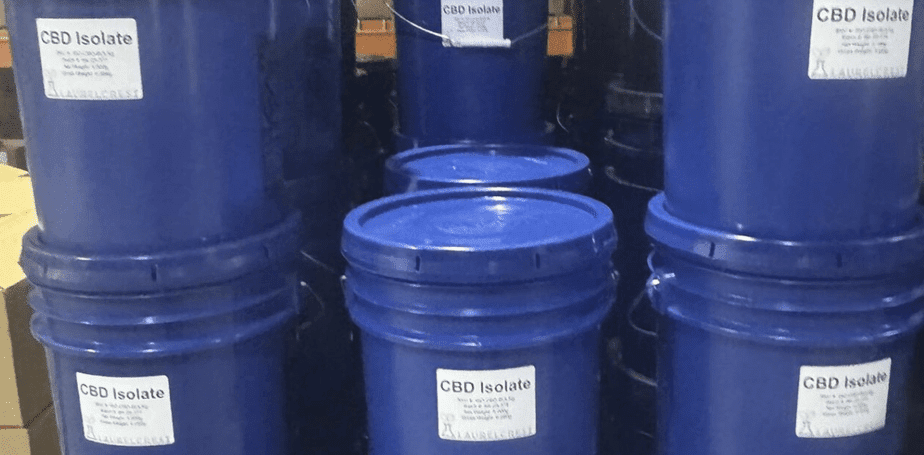
- Packaging: sealed foil pouches or food-grade HDPE containers with nitrogen flush for 1 kg units; foil-sealed bags or fiber drums with a food-grade liner for 5 to 10 kg; bulk drums for 25 kg and above.
- Storage: below 25 degrees Celsius, dry and away from UV light. Re-seal promptly, and consider nitrogen backfill for large containers opened repeatedly.
- Shelf life: typically 18 to 24 months from production in the original sealed container. Confirm the production date on the COA before a large order.
"Isolate's category-specific risk is the purity ceiling claim: spec sheets that say 99.5% or 99.9% on material that tests at 99.1% lot to lot. The gap sounds small, but in precision-dosed products it compounds over a production run. The only protection is per-lot COA verification from an independent accredited lab, not trust in a spec sheet."
John Piccone, Founder, Bulk CBD Distributors
What Should a CBD Isolate COA Show?
- CBD purity by HPLC: 99.0% or higher, with the peak correctly identified as CBD.
- THC, every fraction: Delta-9 THC, Delta-8 THC and THCA all non-detect, with the lab's limit of quantitation (LOQ) stated. A COA that shows only Delta-9 THC is not enough.
- Residual solvents per USP 467: Class 2 solvents within their individual limits (hexane at or below 290 ppm, for example) and Class 3 solvents such as pentane, heptane and ethanol at or below 5,000 ppm.
- Heavy metals: lead, arsenic, cadmium and mercury within USP limits.
- Pesticides: a multi-residue screen with every detected compound below its action level.
- Microbials: total aerobic count, yeast and mold, Salmonella and E. coli within limits.
- Moisture: below 0.5% for standard grade, below 0.2% for premium.
- Lab and lot: an ISO 17025 accredited, DEA-registered third-party laboratory, with the lot number matching the container.
How to Read a Hemp COA walks through each section in detail.
How to Evaluate a CBD Isolate Supplier
- Lot-specific COA from an independent, accredited lab, matched to the lot you receive.
- Purity history: COAs from two or three recent lots, so you can see whether the stated purity holds.
- Powder form and particle size suited to your equipment.
- Packaging that protects against moisture in transit.
- A first order you can verify: bulk isolate is usually sold from 100g to 1kg upward, so a smaller first order lets you test a lot in your own lab before you scale.
- A written exchange policy for material that tests out of spec in your own lab.
For the full supplier checklist, see How to Source Wholesale CBD and Choose a Bulk Supplier.
CBD Isolate vs Broad Spectrum vs Full Spectrum
| Factor | CBD isolate | Broad spectrum | Full spectrum |
|---|---|---|---|
| CBD | 99%+ | 80 to 95% | 75 to 85%+ |
| Delta-9 THC | Non-detect | Standard: 0.3% or less, some lots non-detect. Non-Detect THC option | Standard: typically above 0.3%. Compliant: 0.3% or less |
| Minor cannabinoids | None | CBG, CBN, CBC | Full native profile |
| Flavor and odor | Neutral | Mild hemp | Hemp-forward |
| Best for | Non-detect THC products, precise dosing, export | Multi-cannabinoid products | Whole-plant positioning, low-dose SKUs |
For the full comparison, including THC-per-container math by product format, see Full Spectrum vs Broad Spectrum vs CBD Isolate.
Japan-Compliant CBD Isolate
Japan's revised Cannabis Control Act, in force since December 12, 2024, sets residual Delta-9 THC limits by product type: 10 ppm (0.001%) for oils, fats and powders, 0.1 ppm for water-based liquids and 1 ppm for other products. CBD isolate is a powder, so it falls under the 10 ppm limit, and any finished product it goes into must meet the limit for that product's own type.
The detail that trips up exporters is the lab's LOQ. "Non-detect" only proves THC is below the LOQ, and an LOQ of 0.01% equals 100 ppm, ten times Japan's powder limit. Japan-compliant isolate is tested by a method sensitive enough to show the actual limit is met. When a supplier calls a lot Japan-compliant, ask for the test method, the LOQ and the ppm result. See wholesale CBD for Japan for the documentation importers usually need.
Is CBD Isolate Legal Under Section 781?
Yes. Under Section 781 of P.L. 119-37, cannabidiol is a non-intoxicating cannabinoid that remains within the federal hemp definition. Synthetic cannabinoids that cannot be naturally produced by the plant are excluded from November 12, 2026, and from December 11, 2026 finished products are capped at 0.4 mg total THC per container. Plant-derived isolate with non-detect THC is the simplest input to document against both rules, but manufacturers should still confirm total THC in each finished product. For federal program guidance, see the USDA AMS Hemp Program.
What This Means for Your Business
CBD isolate is the right starting ingredient when you need non-detect THC, exact mg-per-unit dosing and a flavor-neutral input across the widest range of formats, and it is the cleanest base for export markets such as Japan. Specify the grade on your documentation needs, check purity, THC fractions and LOQ, residual solvents and moisture on every lot COA, and treat packaging as part of quality.
Compare Current CBD Isolate Specs and COAs
Current grades, sizes and the representative COA for CBD isolate are on the product page. Minimums run 100g to 1kg depending on the product, and most orders ship within a few days. If you export to Japan, ask for the Japan documentation with your quote.
Frequently Asked Questions
What is CBD isolate?
Hemp-derived cannabidiol refined to 99% or higher purity with all other plant compounds removed. It is a white to off-white powder that is flavorless, odorless and non-detect for THC.
What is CBD isolate powder?
The same isolate milled into a fine, uniform powder. Milled powder dissolves faster in carrier oils and blends more evenly than unmilled crystals.
What purity should bulk CBD isolate be?
99.0% or higher on HPLC. Standard grade runs 99.0 to 99.5% and premium grade 99.5 to 99.9%+. Any lot below 99% does not meet commercial isolate specifications.
Does CBD isolate contain THC?
No. Properly refined isolate is non-detect for Delta-9 THC, Delta-8 THC and THCA. Confirm all three on the current-lot COA, along with the lab's LOQ.
What is the difference between CBD isolate and broad spectrum CBD?
Broad spectrum keeps minor cannabinoids alongside CBD, with THC at 0.3% or less or non-detect. Isolate removes everything except CBD, for maximum formulation control and flavor neutrality.
What is the difference between CBD isolate and full spectrum CBD?
Isolate is only cannabidiol at 99%+. Full spectrum keeps the plant's cannabinoid profile and natural THC, and it comes in two versions: Standard (typically above 0.3% Delta-9 THC) and Compliant (0.3% or less).
How do I calculate CBD isolate potency in a tincture?
Multiply grams of isolate by purity as a decimal and by 1,000 to get mg of CBD, then divide by total mL. For example, 5 g at 99.5% in 500 mL gives 9.95 mg/mL.
How do I dissolve CBD isolate in carrier oil?
Weigh the isolate for your target strength, add it to carrier oil warmed to about 40 to 55 degrees Celsius depending on the oil, and stir until the solution is fully clear.
Can CBD isolate be added to water-based beverages?
Not directly. Isolate does not dissolve in water. Use a water soluble CBD ingredient, which is often made from isolate by nano-emulsification.
What is the shelf life of CBD isolate?
Typically 18 to 24 months from production when kept sealed, dry, below 25 degrees Celsius and away from UV light. Check the production date on the COA.
What should a CBD isolate COA include?
HPLC purity, non-detect results for every THC fraction with the LOQ, residual solvents per USP 467, heavy metals, pesticides, microbials and moisture, from an accredited third-party lab with a matching lot number.
Is CBD isolate legal under Section 781?
Yes. Cannabidiol remains within the federal hemp definition under Section 781 of P.L. 119-37. Plant-derived isolate with non-detect THC is the simplest CBD input to document.
How is Japan-compliant CBD isolate tested?
By a method with an LOQ low enough to show residual Delta-9 THC is below Japan's 10 ppm limit for powders. Ask for the test method, the LOQ and the ppm result, not just a "non-detect" line.
What is the minimum order for bulk CBD isolate at BCD?
Minimums run 100g to 1kg depending on the grade and format, with larger volumes by bulk quote. BCD does not offer free samples.