To source wholesale CBD, pick the format your product needs, then qualify the supplier before you talk price: get the COA for the exact lot you will receive, confirm an ISO 17025 accredited lab independent of the seller, check total THC and plant origin under Section 781 of P.L. 119-37, and get MOQs, lead times and terms in writing. This guide covers the seven sourcing steps and the ten questions to ask any bulk CBD supplier, with what a good answer looks like and the red flags that should end the conversation. It is written for manufacturers, brands, formulators and distributors buying hemp-derived cannabidiol by the kilogram.
What Is Wholesale CBD?
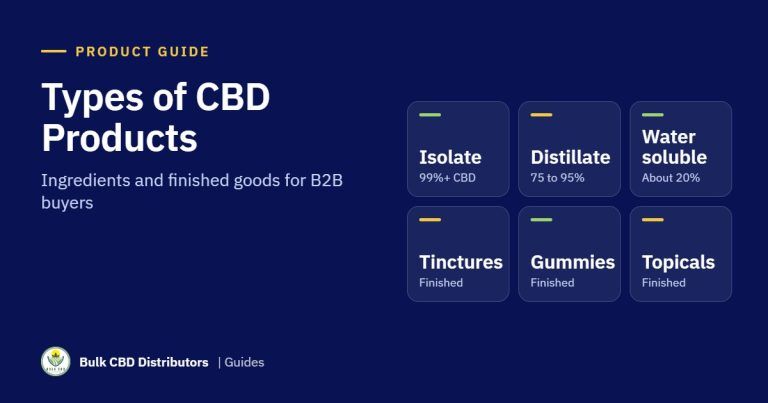
Wholesale CBD is hemp-derived cannabidiol bought in bulk, raw ingredient form, before it is formulated into a finished product. Buyers usually purchase by the kilogram at pricing tiers that fall as volume rises, and every lot should arrive with a lot-specific Certificate of Analysis (COA). The main formats are:
| Format | Typical CBD | Delta-9 THC | Best for |
|---|---|---|---|
| CBD isolate | 99%+ | Non-detect | Precise dosing, flavor-neutral and non-detect THC products |
| Broad spectrum distillate | 80 to 95% | Standard: 0.3% or less, some lots non-detect. Non-Detect THC option available | Multi-cannabinoid formulas without meaningful THC |
| Full spectrum distillate | 75 to 85%+ | Standard: natural, typically above 0.3%. Compliant: remediated to 0.3% or less | Whole-plant cannabinoid profile |
| CBD crude oil | 50 to 70% | Varies by lot | Lowest cost per mg; needs further refining |
| Water soluble CBD | Varies by grade | Depends on the input | Beverages and other aqueous products |
About full spectrum THC: real full spectrum distillate keeps the plant's natural THC, so Standard full spectrum typically tests above 0.3% Delta-9 THC. It is in-process material for buyers who will process it further. The Compliant version is remediated to 0.3% Delta-9 THC or less. Always confirm which version a COA covers before you buy.
The 7-Step Sourcing Process at a Glance
- Format: choose isolate, broad spectrum, full spectrum, crude or water soluble.
- Documents and lab: lot-specific, full-panel COA from an independent ISO 17025 accredited lab.
- Compliance: total THC, plant origin and per-container limits under Section 781.
- MOQs and pricing: written minimums and tiers, compared on cost per milligram of CBD.
- Lead times and shipping: stated ship times and packaging suited to the product.
- First order and exchanges: a starting size you can verify, and a written exchange policy.
- Shipping compliance: a destination review for every order, US or export.
A supplier who cannot satisfy steps 2 and 3 should not reach a price conversation.
Step 1: Identify the CBD Format You Need
Start from the finished product. Isolate suits gummies, capsules and anything that must test non-detect for THC. Broad spectrum gives a multi-cannabinoid profile with THC held at 0.3% or less (or non-detect on the Non-Detect THC option). Full spectrum gives the whole-plant profile; choose the Compliant version if the ingredient goes straight into a finished product. Crude oil is a refining input, and water soluble CBD is for beverages. For the full comparison, including how much THC each format adds per container, see Full Spectrum vs. Broad Spectrum vs. CBD Isolate.
Step 2: Verify the Lab and the COA
- Lot-specific COA: the lot number on the COA must match the label on the container you receive.
- Independent, accredited lab: ISO 17025 accredited and independent of the seller.
- Full panel: potency, total THC, residual solvents (USP 467), heavy metals, pesticides, mycotoxins and microbials. A supplier who cannot provide a full panel should be disqualified.
If you are new to COAs, How to Read a Hemp COA walks through each section, and BCD posts representative results on its lab results page.
Step 3: Confirm Hemp Compliance
Total THC is Delta-9 THC plus THCA x 0.877, plus Delta-8 and the other THC isomers counted under Section 781 of P.L. 119-37. Federal hemp stays at or below 0.3% total THC on a dry weight basis. Synthetic cannabinoids that cannot be naturally produced by the cannabis plant are excluded from November 12, 2026. Most other provisions, including the total THC rule and a 0.4 mg per container cap on total THC and similar cannabinoids in finished consumer products, take effect December 11, 2026. CBD and other non-intoxicating cannabinoids are affected the same way: they stay within the hemp definition only when they are plant derived and meet the total THC and per-container limits.
Ask for a hemp compliance statement, a COA showing every THC input, and written confirmation that the cannabinoids are plant derived. Our guide to what the 2026 hemp law means for bulk buyers covers the dates and definitions.
Step 4: Evaluate MOQs and Pricing
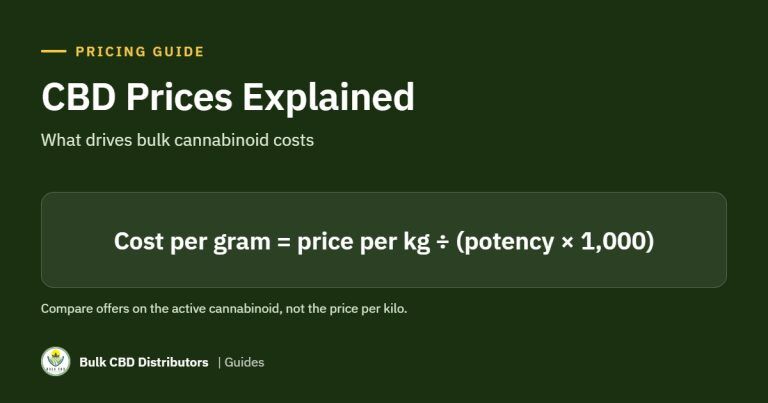
Compare suppliers on cost per milligram of CBD, not price per kilogram. Divide the price per kilogram by the CBD purity as a decimal to get the effective price per kilogram of CBD. A 99% isolate delivers 990 mg of CBD per gram; an 80% distillate delivers 800 mg. Bulk CBD is usually sold from 100g to 1kg upward depending on the product, with larger volumes and standing orders quoted per buyer.
Be cautious of prices far below the market. An unusually low price usually has to be recovered somewhere, often in testing or in the material itself.
"The most common pattern I see is buyers who skip straight to pricing. They find a supplier who looks credible, they like the price, and they decide before verifying the lab or the compliance paperwork. Price is the easiest thing to evaluate and the least important thing to evaluate first. A supplier who cannot satisfy your lab and compliance requirements should never reach a price conversation."
John Piccone, Founder, Bulk CBD Distributors
Step 5: Review Lead Times, Shipping and Packaging
Confirm whether the format you need is in stock or made to order; in-stock material ships in days, while made-to-order runs can take weeks. Get the stated ship time in writing, and ask how heat-sensitive material is packed: acid-form cannabinoids such as CBDA need conditions that protect them in transit.
Step 6: Size Your First Order and Check the Exchange Policy
A credible supplier lets you start at a size you can verify with your own lab before you scale, and puts its exchange policy for out-of-spec material in writing. Free samples are uncommon in bulk ingredients, so a first order of 100g to 1kg depending on the product is the usual way to test a lot. Ask for a current-lot COA before you order.
Step 7: Check Shipping Compliance for the Destination
State rules change often, so a careful supplier reviews shipping compliance case by case for each order rather than relying on a static banned-state list. Export buyers need the same care. Japan, for example, sets residual Delta-9 THC limits by product type (10 ppm for oils and powders), so ask for Japan-compliant material and the export documentation package with your quote. See wholesale CBD for Japan for details.
How to Choose a Bulk CBD Supplier: 10 Questions to Ask
The seven steps tell you what to check. These ten questions are how you check it. They are ordered roughly by how quickly they eliminate a poor supplier, so start at the top and ask for every answer in writing.
| # | Question | A good answer |
|---|---|---|
| 1 | Can I see the COA for the lot I will receive? | A lot-specific COA, matched to the container label |
| 2 | Who tests the product? | An ISO 17025 accredited lab independent of the seller |
| 3 | What is the total THC, and how is it calculated? | Delta-9 plus THCA x 0.877, with other THC isomers reported |
| 4 | Is the product plant derived? | Yes, with the source and process explained in writing |
| 5 | Where is the hemp grown and how is it made? | US-grown, licensed hemp; cGMP-compliant production |
| 6 | Is quality consistent from lot to lot? | Recent lot COAs with stable potency and clean panels |
| 7 | What are the MOQs and volume tiers? | Written MOQs, with reduced pricing at higher volume |
| 8 | What are the ordering and payment terms? | The lot and availability confirmed before payment |
| 9 | How fast does it ship, and how is it packed? | Stated lead times and packaging suited to the product |
| 10 | How will you support me after the sale? | A named contact, reachable by phone and email |
1. Can I see the COA for the lot I will receive?
The COA is the primary evidence that separates a verified ingredient from an unverified one. Ask for the COA tied to your lot, not a generic sheet or one from months ago. Red flag: a COA only after payment, or one that cannot be tied to a lot.
2. Who tests the product?
Look for an ISO 17025 accredited laboratory independent of the seller, named on the report itself. Many buyers also prefer a DEA-registered third-party lab as an added layer of assurance. In-house testing by the seller is not independent verification. Red flag: no lab name on the COA, or an accreditation you cannot verify.
3. What is the total THC, and how is it calculated?
The COA should show Delta-9 THC, THCA and the other THC isomers so you can check the math yourself. Ask for the THC lines even on products sold as THC-free; isolate is typically non-detect, but your file should prove it. Red flag: a COA that reports only Delta-9 THC, or a "total THC" figure without its inputs.
4. Is the product plant derived?
Section 781 excludes synthetic cannabinoids that cannot be naturally produced by the cannabis plant from November 12, 2026. Ask for written confirmation that the cannabinoids are extracted from hemp, with the process explained, especially for anything beyond CBD. Red flag: vague answers about production, or a refusal to put them in writing.
5. Where is the hemp grown and how is it made?
Traceability starts in the field. Ask whether the hemp comes from licensed cultivation and whether extraction and refining happen in a cGMP-compliant facility. Red flag: "proprietary" as the answer to every sourcing question.
6. Is quality consistent from lot to lot?
One good COA proves one lot; consistency proves a process. Compare COAs from two or three recent lots for potency, minor cannabinoid profile and contaminants. For distillates, ask whether the profile is held steady, because your formula and label depend on it. Red flag: only one COA available, or wide swings with no explanation.
7. What are the MOQs and volume tiers?
Get minimums and tiers in writing and ask how pricing changes as you scale. For a deeper look at checking a supplier's legitimacy, see How to Find and Vet a Legitimate B2B Supplier. Red flag: pricing hidden until late, or tiers that change after you commit.
8. What are the ordering and payment terms?
A sound process confirms the lot and availability before payment is taken, so you know exactly what you are buying. Ask whether the order is a binding purchase or a request the supplier confirms first. Red flag: payment demanded before the lot is confirmed.
9. How fast does it ship, and how is it packed?
Lead time drives your production calendar, and packaging protects heat-sensitive material. A good supplier raises both before you order, not after. Red flag: no stated lead time, or no plan for temperature-sensitive products.
10. How will you support me after the sale?
Documents, reorders and compliance questions continue after delivery. Ask who your contact will be and whether they can be reached by phone and email. Red flag: slow answers during the quote stage, which is usually the best service you will ever get.
How Do You Compare Suppliers Side by Side?
Score each supplier from 0 to 2 on every question: 0 for no answer or a red flag, 1 for a partial answer, 2 for a clear written answer backed by paperwork. Count questions 1 to 4 twice, because documentation and compliance failures are the hardest to recover from. The maximum is 28. Price is the tiebreaker, not the starting point. Keep the completed scorecard with your supplier qualification records.
What Extra Questions Should You Ask by Product Type?
| Product | Extra question to ask |
|---|---|
| CBD isolate | Is purity 99% or higher, and are THC and THCA non-detect? |
| CBD distillate | Which grade and version is it (full spectrum Standard or Compliant, broad spectrum Standard or Non-Detect THC, crystal resistant), and what is the cannabinoid profile? |
| CBD crude oil | Is it priced on tested CBD content, and what are the residual solvent results? |
| CBD flower and biomass | What are the tested potency, total THC at harvest and moisture level? |
| Minor and rare cannabinoids | Is it plant derived, and how is it produced? |
What This Means for Your Business
The right wholesale CBD supplier can prove what you are buying: lot-specific COAs from an independent accredited lab, a clear answer on THC and plant origin, repeatable quality, written terms and a person to call. Run every candidate through the seven steps and the ten questions, score them honestly and keep the answers on file. The cost of a non-compliant ingredient is always higher than the price gap between a compliant source and a cheap one.
Compare current CBD specs and COAs
Current sizes and representative COAs are on the CBD isolate, broad spectrum CBD distillate and full spectrum CBD distillate pages. If you are qualifying BCD, we are happy to answer the ten questions in writing. MOQs run 100g to 1kg depending on the product, and most orders ship within a few days.
Frequently Asked Questions
How do I source wholesale CBD?
Choose the format you need, then qualify the supplier: lot-specific COA, an independent ISO 17025 accredited lab, total THC and plant origin confirmed under Section 781, and written MOQs, lead times and terms. Compare price only after those checks pass.
What should I look for in a bulk CBD supplier?
Lot-specific COAs from an independent accredited lab, full total THC reporting, plant-derived product, consistent lots, written MOQs and terms, stated lead times and a reachable contact.
What is the minimum order quantity for wholesale CBD?
It varies by supplier. Bulk CBD minimums commonly run 100g to 1kg depending on the product, with larger volumes quoted per order.
How do I verify a CBD COA is real?
Check that the lot number matches the container, the lab is named and ISO 17025 accredited, the report is dated and complete, and the lab is independent of the seller. You can ask the lab to confirm the report.
What is total THC and why does it matter?
Total THC is Delta-9 THC plus THCA x 0.877, plus Delta-8 and other THC isomers counted under Section 781. Federal hemp must stay at or below 0.3% on a dry weight basis.
Is full spectrum CBD distillate always under 0.3% THC?
No. Real full spectrum keeps the plant's natural THC and typically tests above 0.3% Delta-9 THC; that Standard version is in-process material. A Compliant version is remediated to 0.3% Delta-9 THC or less. Confirm the version on the COA.
What is the difference between CBD isolate and CBD distillate?
Isolate is 99%+ pure CBD with non-detect THC. Distillate keeps more of the cannabinoid profile: broad spectrum runs 80 to 95% CBD and full spectrum 75 to 85%+. See Full Spectrum vs. Broad Spectrum vs. CBD Isolate.
How do I compare wholesale CBD prices across suppliers?
Compare cost per milligram of CBD. Divide price per kilogram by CBD purity as a decimal. A 99% isolate gives 990 mg of CBD per gram; an 80% distillate gives 800 mg.
Should I choose the cheapest CBD supplier?
No. Prices far below market often reflect weaker testing or lower quality material. Use price as a tiebreaker after documentation, compliance and consistency checks.
Does BCD offer free samples?
No. First orders start at 100g to 1kg depending on the product, which works as a trial order you can verify with your own lab. Ask sales for a current-lot COA before you order.
What documents should come with a wholesale CBD order?
A current-lot, full-panel COA from an accredited third-party lab, a hemp compliance statement, a Certificate of Origin, a Safety Data Sheet and a Technical Data Sheet.
How long do bulk CBD orders take to ship?
It depends on whether the material is in stock or made to order. In-stock lots usually ship within a few days, while made-to-order runs can take weeks. Export orders need extra lead time for documentation.
Can I buy Japan-compliant CBD in bulk?
Yes. Japan-compliant CBD and CBG ingredients are made to Japan's residual Delta-9 THC limits, which are set by product type (for example 10 ppm for oils and powders). See the Japan page for the export documentation buyers usually need.