CBD crude oil is the first extracted form of hemp, produced when raw plant material is processed with a solvent (typically ethanol or CO2) to pull cannabinoids, terpenes, waxes, chlorophyll, and other plant compounds into a single concentrated extract. It is not a finished product; it is a starting material. Extraction labs, toll processors, and manufacturers who perform in-house refining buy CBD crude as feedstock for decarboxylation and distillation, transforming it into distillate, isolate, or finished oil. Sourcing crude correctly takes more due diligence than almost any other cannabinoid ingredient, which is why most of this guide is about verification. Current specs and the representative COA are on the CBD crude oil product page.
| Attribute | Detail |
|---|---|
| Potency | Typically 50 to 70% CBD |
| Form | Dark, thick, unrefined oil |
| Use | Feedstock for refining into distillate or isolate |
| Pricing basis | Tested CBD content of the lot |
| Documentation | A lot-specific COA for the material you receive; listed COAs are usually representative |
What Is CBD Crude Oil?
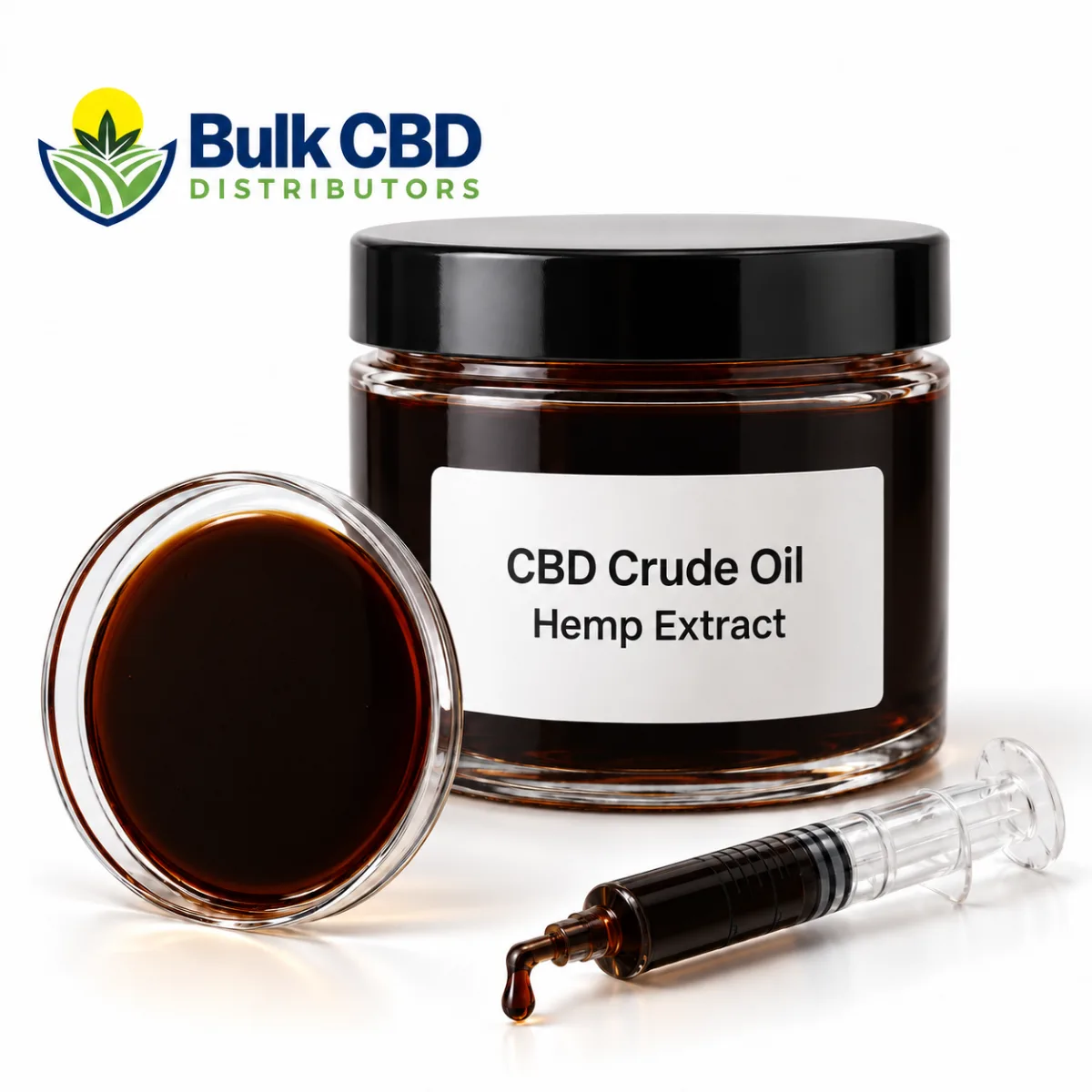
CBD crude oil is a dark, viscous extract with a complex composition that reflects the unrefined state of the hemp plant. A quality crude will carry CBD concentrations of 50 to 70% by weight, with the remainder consisting of minor cannabinoids, native terpenes, plant waxes, residual chlorophyll, and processing trace compounds. The color ranges from dark amber to near-black depending on the extraction method, solvent, and degree of initial cleanup.
Unlike distillate or isolate, crude has not gone through the distillation step that concentrates cannabinoids and removes plant material. Some crude on the market is sold unwinterized and some is winterized, so ask which you are getting; winterized crude has most waxes and lipids already removed. That processing history, or absence of it, is why crude is priced below distillate per CBD gram, and why it requires additional handling, testing, and verification at the point of purchase. A crude COA that looks right on the cannabinoid panel may still contain residual solvent levels, pesticide residues, or heavy metal concentrations that create downstream problems if the material goes into production without being caught at intake.
| Ingredient | Typical potency | Processing stage | Typical buyer use |
|---|---|---|---|
| CBD crude oil | 50 to 70% CBD | First extraction, not yet distilled | Feedstock for refining into distillate or isolate |
| Broad spectrum CBD distillate | 80 to 95% CBD | Distilled, with THC reduced while other cannabinoids are kept | Formulation ingredient for tinctures, soft gels and edibles |
| Full spectrum CBD distillate | 75 to 85%+ CBD | Distilled, keeping the native cannabinoid profile | Whole-plant style tinctures and soft gels |
| CBD isolate | 99%+ CBD, non-detect THC | Purified and crystallized | Exact-dose formulas that need a single cannabinoid |
Who Buys CBD Crude Oil and Why
The primary buyers of wholesale CBD crude fall into two categories. The first is extraction and toll processing labs that purchase crude as feedstock for further refinement, converting it into distillate or isolate at scale. For these buyers, crude is an input material evaluated primarily on CBD% per dollar, terpene retention (if relevant to the downstream product), and solvent and pesticide cleanliness. The second category is manufacturers who have in-house refining capability and want to control their own distillation and purification process rather than buying finished distillate from an outside supplier. Both buyer types have specific technical requirements for crude quality, and both are operating at volume levels where the financial stakes of a bad lot are significant.
A smaller segment of crude buyers uses it as a direct ingredient in products where the full-plant character of an unrefined extract is a formulation feature: certain topical applications, for example, where the wax and terpene fraction contributes to the product's texture and profile. These buyers typically require CO2-extracted crude specifically, and they pay closer attention to the terpene panel than extraction labs do.
Typical Cannabinoid and Composition Profile
A well-characterized CBD crude oil lot will show the following approximate ranges on a full-panel COA:
Total CBD (CBD + CBDA x 0.877): 50% to 70% by weight in a quality ethanol-extracted crude. CO2 crude may come in lower in initial extraction yield but with a cleaner minor compound profile. Very low CBD% crude (below 40%) is typically harvested from lower-grade biomass and carries higher processing cost to reach distillate-grade output.
Total THC: Variable and critical. For Farm Bill compliance under Section 781 of P.L. 119-37, total THC (delta-9 plus THCA x 0.877) at or below 0.3% is the threshold. Crude that tests above this threshold on a pre-decarboxylation panel is not compliant as a finished ingredient; it must be processed before use in a consumer product. Confirm that the COA panel covers total THC, not delta-9 alone.
Minor cannabinoids: CBG, CBN, CBC, and CBGA typically appear in the 0.5% to 3% range combined, depending on cultivar and harvest timing. These are not contaminants; they are native plant compounds that contribute to the crude's value for downstream blended formulations.
Waxes and lipids: Not measured separately on a standard COA but inferred from color, viscosity, and the cloudiness that appears when crude is cooled. A crude that has undergone partial winterization will behave differently in downstream processing than fully unrefined crude.
How to Read a CBD Crude COA
A complete CBD crude COA includes five test panels, each addressing a distinct risk category. Reviewing all five before accepting a lot is not optional at purchase volumes where a contaminated delivery creates a real production and financial problem.
Cannabinoid potency panel: Confirms CBD%, total cannabinoid content, and critically, total THC using the complete formula: delta-9 THC plus (THCA x 0.877). A COA that reports only delta-9 THC is not providing a total THC value. For crude, which naturally carries THCA as a precursor to THC, the combined formula matters.
Residual solvents panel: Ethanol-extracted crude should show ethanol residuals within USP Class 3 limits (5,000 ppm or below). Hydrocarbon-extracted crude requires stricter scrutiny for propane, butane, and hexane residuals. CO2-extracted crude typically shows clean residual solvent results. If the panel is absent, request it explicitly before accepting the lot.
Heavy metals panel: Hemp is a bioaccumulator. Crude extracted from plants grown in contaminated soil will concentrate heavy metals, particularly lead, arsenic, cadmium, and mercury. A full metals panel with results for all four analytes is standard practice.
Pesticide panel: A full pesticide screen covering the analytes relevant to the growing region is standard. Common flags include myclobutanil, bifenazate, and permethrin. A single-page "pesticide: pass" notation without individual analyte reporting is not a pesticide panel; it is a certification that a panel was performed. Ask for the full results.
Microbial panel: Total yeast and mold, total aerobic count, E. coli, and Salmonella. Crude intended for extraction into products consumed by people requires a clean microbial profile, even before further refinement. Verifying lab accreditation (ISO 17025, with scope covering each of these test categories) is the backstop that makes COA results meaningful.
COA Fraud in the CBD Crude Market
CBD crude is the category in the hemp ingredient market where COA fraud is most commonly encountered, and the reason is straightforward economics. A 100 kg crude order at industry pricing represents a transaction large enough to justify the effort of fabricating or altering a test report. The fraud takes several forms: COAs created with modified potency numbers on legitimate lab templates, real COAs from one lot attached to a different lot, and test reports from non-accredited laboratories presented as if they carry the same weight as ISO 17025 results.
The practical countermeasure is direct laboratory verification. Before accepting any large crude delivery, confirm the batch number from the COA directly with the testing laboratory. Most ISO 17025-accredited, third-party, DEA-registered laboratories will confirm whether a specific batch was tested and whether the reported results match their records. A supplier who cannot provide that verification path, or who deflects requests for direct lab contact, is not a supplier worth continuing with on a large crude order.
The check usually adds about a day to intake, and on a large crude order it is worth the time.
From the Field
"CBD crude oil is the highest-risk product category we carry, and I say that directly because buyers need to know it before they negotiate their first large crude order. The economics create the incentive: a 50 to 100 kg crude deal involves enough money that fabricated or altered COAs make financial sense to someone with poor ethics. We have seen this in the market. For every crude order above 10 kg, we require chain-of-custody documentation alongside the COA, and we verify the laboratory's accreditation scope directly before accepting any crude into our inventory. The question I ask every crude supplier we evaluate is not just whether they have a COA (every supplier claims to have one) but whether I can call the lab and confirm the batch number against their records. Suppliers who can facilitate that call are worth continuing the conversation with. Suppliers who cannot are not."
John Piccone, Founder, Bulk CBD Distributors
How CBD Crude Oil Is Priced and Packaged
CBD crude oil is priced per gram of CBD rather than per kilogram of raw material, which allows direct comparison across lots with different potency levels. A 55% CBD crude and a 62% CBD crude at the same per-gram-of-CBD price represent equivalent value; the processing yield from the 62% material is simply higher. When comparing crude pricing across suppliers, always normalize to a per-gram-of-CBD basis using the actual lot potency from the COA, not the supplier's advertised specification range.
Bulk crude usually ships in sealed aluminum pails for smaller quantities, HDPE drums for mid-volume orders, and fiber drums for larger lots. Very large orders depend on lot inventory and production scheduling, so confirm the lead time for the specific lot you are quoted.
Section 781 Compliance and CBD Crude Oil
CBD crude oil sold as a bulk B2B ingredient is not a finished consumer product and is not subject to the same per-container THC limits that Section 781 of P.L. 119-37 establishes for retail hemp products. However, crude that tests above 0.3% total THC by dry weight is not compliant as a direct hemp ingredient and must undergo processing to reduce total THC before it can be used in a finished product sold under the federal hemp framework.
If your downstream process involves decarboxylation, confirm the pre- and post-decarb THC profile with your supplier so you can plan the compliance posture of the finished material. For a detailed walkthrough of how Section 781 affects bulk ingredient buyers, see our 2026 hemp law guide.
Frequently Asked Questions
What is CBD crude oil?
CBD crude oil is the first extracted form of hemp, produced by processing plant material with a solvent such as ethanol or CO2. It contains CBD as the dominant cannabinoid alongside minor cannabinoids, terpenes, plant waxes, and chlorophyll. It is a starting material used by extraction labs and manufacturers for further refinement into distillate or isolate.
How does CBD crude oil differ from CBD distillate?
CBD crude is the unrefined extract produced directly from plant material. CBD distillate is crude that has been winterized to remove waxes and lipids, decarboxylated to convert CBDA to CBD, and then distilled to concentrate cannabinoids and remove plant matter. Distillate is a finished or near-finished ingredient; crude is feedstock that requires additional processing before most product applications.
What CBD percentage is typical in wholesale crude oil?
Quality CBD crude oil typically contains 50% to 70% CBD by weight depending on source biomass quality and extraction method. CO2 extraction tends to produce slightly lower initial yield but a cleaner minor compound profile. Crude below 40% CBD is generally considered low-grade feedstock with higher per-gram processing costs to reach distillate output.
What COA panels should a crude oil lot have?
A complete crude COA includes five panels: cannabinoid potency (with total THC using the delta-9 plus THCA x 0.877 formula), residual solvents, heavy metals (lead, arsenic, cadmium, mercury), full pesticide screen with individual analyte results, and microbial testing. All panels should be from an ISO 17025-accredited, third-party, DEA-registered laboratory.
Is CBD crude oil compliant under Section 781 of P.L. 119-37?
CBD crude oil sold as a bulk B2B ingredient is not a finished consumer product subject to the per-container limits in Section 781. However, crude with total THC above 0.3% by dry weight does not qualify as a compliant hemp ingredient. Confirm total THC on the lot COA before purchase.
What is the MOQ for bulk CBD crude oil at BCD?
Crude orders start at 1 kg, and larger volumes are quoted by lot. Most orders ship within a few days; very large orders depend on lot availability.
Why is CBD crude the highest-risk hemp ingredient category for fraud?
Large crude transactions involve enough dollar value to make COA fabrication or alteration financially rational for bad actors. The most common fraud types are modified potency numbers on real lab templates, COAs from one lot presented for a different lot, and results from non-accredited laboratories presented alongside accredited test results. Direct batch number verification with the testing laboratory is the primary countermeasure.
How should I verify a crude COA before purchase?
Contact the testing laboratory directly and confirm whether the batch number on the COA appears in their records, and whether the reported results match. ISO 17025-accredited laboratories will confirm this. Also verify that the laboratory's accreditation scope specifically covers each test category on the COA, not just that the lab holds accreditation in general.
What extraction methods are used to produce CBD crude oil?
The two most common extraction methods for CBD crude are ethanol extraction and CO2 extraction. Ethanol extraction produces higher initial yields and is more scalable but requires thorough solvent removal before downstream processing. CO2 extraction produces a cleaner initial extract with fewer co-extracted waxes and a more predictable residual solvent profile. Hydrocarbon extraction is less common in commercial hemp crude production.
How is CBD crude oil packaged and shipped?
CBD crude oil ships in sealed aluminum pails, HDPE drums, or fiber drums depending on order volume. It is a controlled-temperature product: extended exposure to high heat increases the rate of CBDA decarboxylation and can affect the potency and profile of the material over transit. Ask that the shipping documentation match the specific lot and the COA on file.
Compare Current CBD Crude Oil Specs and COAs
Current potency, sizes and the representative COA are on the CBD crude oil page. Crude orders start at 1 kg, and the batch COA for your lot comes with the order.