Good bulk hemp ingredient ordering for the holiday season comes down to timing: confirm specs and trial orders early, review COAs before year-end closures, and place order requests with enough buffer that Q1 launches are not waiting on raw material. Carrier delays, plant shutdowns, and year-end accounting all compress the window between mid-November and early January. This guide gives manufacturers, brands, and formulators a practical Q4 ordering calendar for crude, distillate, isolate, and water-soluble ingredients.
Why Is Q4 Different for Bulk Ingredient Buyers?
Most of the year, bulk hemp ingredient ordering is straightforward: the order request is confirmed, payment is taken, and material usually ships within a few days. In the last ten weeks of the year, several pressures stack up at once:
- Carrier congestion. Parcel and freight networks carry peak holiday volume from late November through December, so transit times can stretch.
- Holiday closures. Your own facility, your co-packer, testing labs, and suppliers may each close for different days around Thanksgiving, Christmas, and New Year's Day.
- Year-end accounting. Many buyers want material received and invoiced in a specific fiscal year, which pulls orders into a narrow December window.
- Q1 launch pressure. New products planned for January and February need raw material in hand before formulation, stability work, and packaging can begin.
None of these is a reason to panic. They are reasons to move the routine steps, especially trial orders and COA review, earlier than you would in March or July.
A Q4 Ordering Calendar
The table below is a planning template, not a supplier commitment. Adjust the dates to your own production schedule and your co-packer's holiday calendar.
| Window | Buyer action | Why it matters |
|---|---|---|
| October | Forecast Q1 volumes; confirm ingredient type and spec for each SKU | Spec changes take the longest to resolve |
| Early November | Order a small trial size and review representative COAs; run bench tests | Leaves time to switch ingredients if a trial batch fails |
| Mid November | Submit order requests for Q1 launch material | Ships ahead of peak carrier congestion |
| Early December | Place final top-up orders; confirm receiving dates | Avoids arrivals during facility closures |
| Late December | Count inventory; file batch COAs with lot records | Clean records for audits and year-end close |
| January | Begin Q1 production; reorder against actual sell-through | Avoids overbuying on forecast alone |
Key Dates for Holiday Ordering in 2026
These dates affect shipping, wires and compliance this season. Ask each supplier for its own holiday shipping cutoffs when you place an order request.
| Date | What happens | What to do |
|---|---|---|
| Wed, Nov 11, 2026 | Veterans Day bank holiday | Send wires a day early |
| Thu, Nov 12, 2026 | Section 781 synthetic cannabinoid exclusion begins | Confirm plant origin on every ingredient |
| Thu, Nov 26, 2026 | Thanksgiving | Get Q1 order requests in the week before |
| Fri, Dec 11, 2026 | Most of Section 781 takes effect, including total THC and the 0.4 mg per container cap | Finish THC reviews of finished SKUs before this date |
| Fri, Dec 25, 2026 | Christmas | Avoid deliveries that week unless your dock is staffed |
| Fri, Jan 1, 2027 | New Year's Day bank holiday | Plan year-end wires by Dec 30 |
How Much Inventory Should You Hold for Q1 Launches?
There is no single right number, but the logic is consistent. Start from finished-goods volume, convert to active ingredient required, then add a buffer for testing, losses, and reorder timing.
Converting product volume to ingredient volume
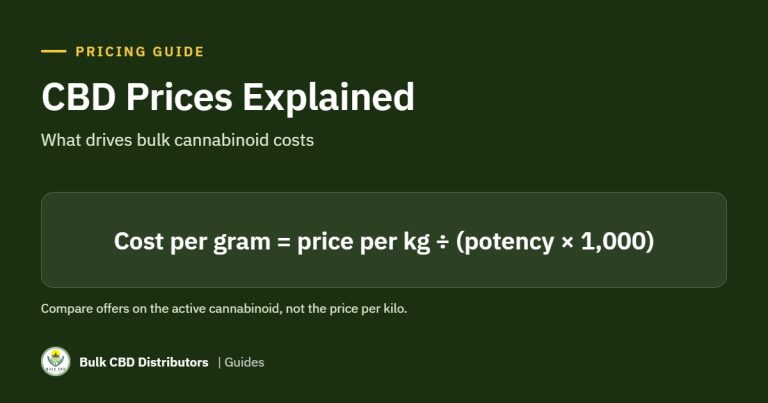
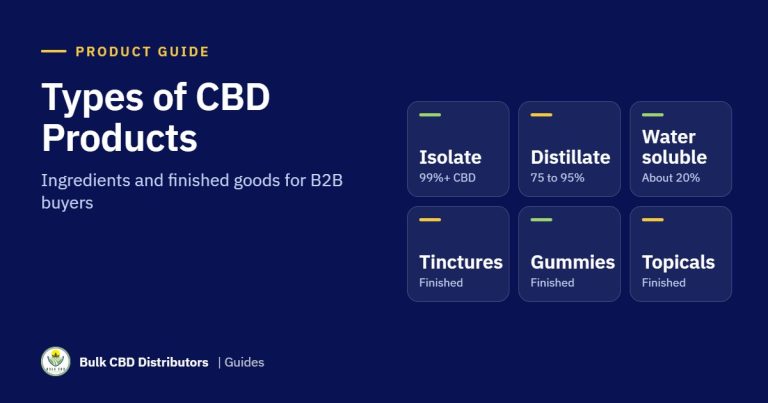
Ingredient potency changes how much material you need. Isolates are typically 99% or higher purity, so 1 kg of isolate delivers roughly 990 g of the target cannabinoid. Distillates generally run 75 to 95% of the primary cannabinoid depending on type (crystal resistant grades 45 to 60%+), so the same active content takes more kilograms. Crude oil commonly runs 50 to 70% and is usually bought for further processing rather than direct formulation.
A simple example: a launch of 10,000 units at 1,000 mg CBD each needs 10 kg of CBD. That is just over 10 kg of isolate, or roughly 12.5 kg of distillate at 80% CBD, before any process losses.
Buffers worth planning
- Process loss. Transfers, filtration, and line flushing leave material behind. Track your own historical loss rate and add it to the order.
- Testing draw. Finished-goods testing, retention samples, and stability samples all consume ingredient.
- Reorder gap. If your next order would land in early January, hold enough to cover production until that material is received and checked in.
Avoiding overbuying
Buying a full year of material in December ties up cash and storage. Many buyers cover Q1 and the first reorder cycle, then buy against real sell-through. Bulk ingredients are commonly sold from 100g to 1kg upward depending on the product, which makes smaller, more frequent orders practical for pilot runs and new SKUs.
Trial Orders and COA Review Timing
Trial orders and COA review are where holiday schedules slip most often, because they depend on several parties being available at once.
Trial orders
A small trial order (100g to 1kg depending on the product) lets your formulator confirm solubility, color, flavor, and behavior in your base before you commit. For water-soluble ingredients, test in your actual beverage or gummy matrix; performance can vary with pH and other ingredients. Place trial orders early enough that a failed bench test still leaves time to evaluate an alternative.
COAs
Supplier listings often show a representative COA, with the batch COA for your lot shipped with the order. Before you order, review the representative COA for:
- Potency of the target cannabinoid against your spec.
- Total THC calculated as delta-9 THC plus THCA converted with the 0.877 factor, at 0.3% or less on a dry weight basis, or non-detect if your product requires it.
- Residual solvents per USP 467, with each Class 2 solvent within its own limit (for example, hexane at or below 290 ppm) and Class 3 at or below 5,000 ppm.
- Heavy metals, pesticides, and microbials, each with analyte-level results.
- The lab: ISO 17025-accredited and a DEA-registered third-party laboratory.
When the batch COA arrives with your order, match the lot number on the COA to the lot on the container and file both together. Our guide on how to read a hemp COA walks through each section.
How Does Ordering and Payment Work?
With many bulk suppliers, an order starts as a request: the supplier confirms availability, lot, and specs, then payment is taken by card or wire. Ask what the usual ship time is after confirmation, and whether it changes in December.
During Q4, a few habits keep that process smooth:
- Send complete requests. Include ingredient type, target potency, quantity, shipping address, and the date you need material on your dock.
- Confirm receiving hours. Tell your supplier if your facility closes for the holidays so shipments do not arrive to a locked door.
- Arrange wire timing. Bank cutoffs and holidays can delay wires by a day or more. Factor that into your timeline.
- Consolidate where sensible. One order covering several SKUs is easier to receive and document than many small parcels in December.
How Should Section 781 Shape Your Planning?
Section 781 of P.L. 119-37 changes the federal hemp definition. Most of Section 781 takes effect on December 11, 2026, right in the holiday ordering window. From that date, total THC expressly includes THCA, and new limits apply to intermediate and final products, including a cap of 0.4 mg combined total THC and similar cannabinoids per container for final products. The Congressional Research Service summary explains the changes in plain language.
For Q4 planning, the practical points are:
- Mark December 11, 2026. Synthetic cannabinoids that cannot be naturally produced by the plant are excluded earlier, from November 12, 2026.
- Review every SKU that contains THC-bearing ingredients against the new definition before committing to large Q1 inventory.
- Favor flexibility. For products that may need reformulation, buy smaller quantities more often instead of a single large year-end order.
- Non-intoxicating ingredients such as CBD, CBG, CBC, and CBDV isolates and non-detect THC distillates are covered by Section 781 the same way as other hemp ingredients. Their low THC content usually makes finished-product totals easier to plan around, but confirm those totals with your own compliance advisor.
Our article on what the 2026 hemp law means for buyers covers the transition in more depth.
What This Means for Your Business
Holiday ordering problems are almost always timing problems. Lock specs in October, finish trial orders and COA review by mid-November, place Q1 order requests before carrier congestion peaks, and leave a buffer for wires and closures. Buy enough to start Q1 cleanly, then reorder against real demand.
Whichever ingredients you plan around, from isolates and distillates to crude and water-soluble ingredients, file the batch COA for every lot with your receiving records so Q1 production starts with clean documentation.
Planning Q1 Ingredients Around the Holidays?
Current specs and representative COAs are in the isolates, distillates and water-soluble collections. If it helps, send your product list and needed-by dates and we will confirm lots, specs and our holiday shipping cutoffs. Most orders ship within a few days.
Frequently Asked Questions
When should I order bulk hemp ingredients for a Q1 launch?
Aim to submit order requests by mid-November, after trial orders and COA review are complete. That keeps shipments ahead of peak holiday carrier congestion and facility closures.
How long does shipping take during the holidays?
Carrier transit times usually stretch in late November and December as networks handle peak volume. Ask your supplier for its holiday shipping cutoffs and build extra days into your needed-by date.
Are there holiday discounts on bulk hemp ingredients?
Some suppliers run year-end promotions, but price usually follows lot specs, volume and harvest supply more than the calendar. Compare quotes on cost per gram of the active cannabinoid and confirm how long each quote is valid.
What is the minimum order quantity at BCD?
MOQs run 100g to 1kg depending on the product. BCD does not offer free samples, so the smallest size works as a pilot order for new Q1 SKUs.
When is payment usually taken on bulk ingredient orders?
Many bulk suppliers take payment after the order request is confirmed, by card or wire. Allow extra time for wires around bank holidays.
Should I place a trial order before a bulk order?
Yes, if the ingredient is new to your formula. A first order in the 100g to 1kg range works as a trial. Place it early in Q4 so a failed bench test still leaves time to try an alternative.
Will the COA I review match the material I receive?
Listed COAs are usually representative of current material. Ask for the batch COA for your specific lot and match its lot number to the container.
How much inventory should I buy at year end?
Cover Q1 production plus process loss, testing draw, and the gap until your next order arrives. Many buyers then reorder against actual sell-through rather than buying a full year up front.
How does Section 781 affect year-end ordering?
Most of Section 781 takes effect December 11, 2026. From then, total THC includes THCA and new limits apply to intermediate and final products. Review THC-bearing SKUs before committing to large inventory.
Which ingredient types are easiest to plan around?
Isolates at 99% or higher purity and Non-Detect THC broad spectrum distillates give the most predictable dosing math and the simplest THC review, which makes them easier to schedule for Q1 launches.