Distillate is made by refining hemp crude oil in a vacuum still: the crude is winterized to remove fats and waxes, decarboxylated so CBDA becomes CBD, then distilled so the cannabinoids separate from everything lighter and heavier. What comes out is a clear, golden CBD distillate that typically tests 45 to 95% CBD depending on the grade. So how is distillate made in practice? This guide walks through each stage in the order a processing lab runs it, and explains how each step shapes the potency, color and smell you see when a drum arrives.
| Spec | At a glance |
|---|---|
| Starting material | Hemp crude oil, about 50 to 70% CBD after winterization |
| Core step | Short path or wiped film distillation under deep vacuum |
| Finished potency | 45 to 95% CBD depending on the grade |
| Proof of quality | Batch COA from an ISO 17025-accredited third-party lab |
Where Distillate Sits in the Hemp Processing Chain
- STAGE 1Hemp biomassDried flower and leaf
- STAGE 2Crude oil50 to 70% CBD
- STAGE 3 (this guide)Distillate45 to 95% CBD
- STAGE 4Isolate99%+ CBD
Hemp extraction produces crude oil. Distillation turns crude into distillate. Crystallizing distillate produces isolate. Each step removes material and adds cost, which is why distillate sits between crude and isolate on potency and processing. Our guide to hemp extraction methods covers the first step in detail, and our guide on how CBD isolate is made picks up where this one ends.
How Is Distillate Made? The 7 Steps for CBD
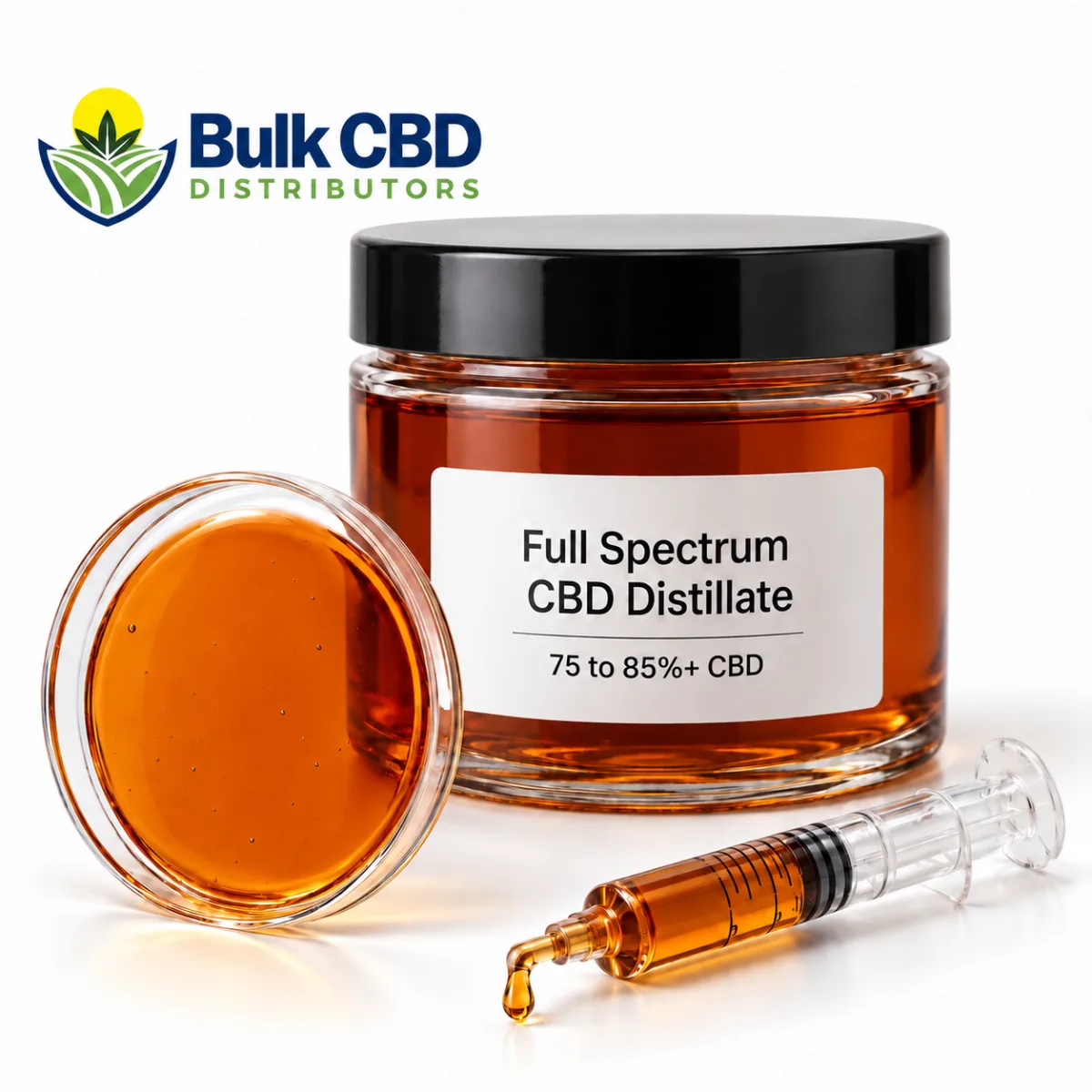
Every lab tunes its own temperatures, vacuum levels and run times, but the sequence below is standard across the industry.
- Extract the hemp. Dried hemp flower and leaf are extracted with ethanol, CO2 or a hydrocarbon solvent. The result is crude oil, a dark extract that carries cannabinoids along with fats, waxes, chlorophyll and plant material.
- Winterize the crude. The crude is dissolved in ethanol, chilled well below freezing and filtered. Fats, waxes and lipids drop out of solution and are removed, which is what makes the later distillation clean.
- Recover the solvent. Ethanol is stripped off under vacuum with a rotary or falling film evaporator and recycled. Residual solvent left here shows up later on the COA, so this step is run to completion.
- Decarboxylate. The extract is heated so CBDA converts to CBD, releasing carbon dioxide. Decarboxylation also degasses the oil so it does not foam or bump under the deep vacuum of the still.
- Distill the oil. Short path or wiped film distillation separates the oil by boiling point under deep vacuum. Light compounds and terpenes come off first, the cannabinoid fraction is collected as the main body, and heavy compounds stay behind.
- Run a second pass or remediate. A second distillation pass raises potency and lightens color. For broad spectrum or compliant full spectrum grades, THC is reduced with chromatography or another remediation step.
- Test, pack and store. A sample from the finished lot goes to an ISO 17025-accredited third-party lab for potency, THC, residual solvents, heavy metals, pesticides and microbials. The distillate is then packed in sealed, light-protected containers.
Steps 1 to 4: Getting Crude Oil Ready for the Still
Distillation only works well on clean, stable feed, so most of the effort happens before the still is switched on.
Extraction pulls cannabinoids out of the plant. Ethanol is the most common solvent at commercial scale; CO2 and hydrocarbons are also used. The choice affects throughput and how much wax and chlorophyll come along, which in turn affects how hard the next steps work. CBD crude oil is the product of this step.
Winterization removes fats, waxes and lipids. The crude is mixed with ethanol and deep-chilled, the waxes solidify, and the mixture is filtered. Skipping or rushing winterization leaves waxes that smear in the still and cloud the finished distillate.
Solvent recovery strips the ethanol under vacuum so it can be reused. Any solvent left behind is measured in the residual solvent panel of the COA.
Decarboxylation applies controlled heat so the acid form, CBDA, loses carbon dioxide and becomes CBD. The weight drops as CO2 leaves: CBDA has a molar mass of about 358.5 g/mol and CBD about 314.5, so every gram of CBDA yields at most about 0.877 g of CBD. Decarboxylating before distillation also keeps the oil from foaming under vacuum.
Step 5: Short Path vs Wiped Film Distillation
Both methods separate compounds by boiling point under deep vacuum, which lowers boiling points so cannabinoids can be distilled without the heat damage they would suffer at normal pressure. The difference is how the oil is heated and how long it stays hot.
| Feature | Short path distillation | Wiped film distillation |
|---|---|---|
| How it works | Oil is heated in a boiling flask; vapor travels a short distance to a condenser | Oil flows down a heated wall as a thin film spread by wipers; vapor condenses on an internal condenser |
| Operation | Batch | Continuous |
| Time at heat | Longer | Seconds to minutes |
| Best for | Smaller labs, pilot runs, high-purity polishing passes | High-volume production |
| Effect on color | More heat exposure can darken oil if pushed | Short residence time helps keep color light |
| Fractions | Heads, main body and tails collected by switching flasks | Distillate and residue streams collected continuously |
In both cases the run is split into fractions. The heads carry terpenes, residual solvent and other light compounds. The main body is the cannabinoid fraction that becomes distillate. The tails and residue hold heavier compounds, pigments and leftover waxes. Where the operator makes those cuts decides the trade-off between yield and purity.
Step 6: Second Passes and THC Remediation
A single pass often lands distillate in the high 70s to 80s for CBD. A second pass through the still raises potency, lightens color and removes more of the remaining odor. Spectrum is set here too:
- Full spectrum distillate keeps the plant's natural cannabinoid profile. Our full spectrum CBD distillate comes in two versions: Standard, which keeps its naturally occurring Delta-9 THC (typically above 0.3%) for processors who dilute or remediate, and Compliant, remediated to 0.3% or less.
- Broad spectrum distillate has THC reduced through chromatography or a similar step. Our broad spectrum CBD distillate runs 80 to 95% CBD and comes as Standard (0.3% or less, some lots non-detect) or Non-Detect THC.
- Crystal resistant distillate is balanced with a share of minor cannabinoids so it stays liquid. It typically runs 45 to 60%+ CBD, lower than other grades by design.
How Each Step Affects Potency, Color and Smell
| Step | Potency | Color | Smell |
|---|---|---|---|
| Extraction | Sets the starting crude potency | Dark green to brown crude | Strong plant odor |
| Winterization | Raises potency by removing fats and waxes | Clearer, less cloudy | Little change |
| Decarboxylation | Converts CBDA to CBD; weight drops as CO2 leaves | Can darken slightly with heat | Some terpenes lost |
| First distillation pass | Concentrates cannabinoids into the main body | Golden to amber | Most terpenes removed in the heads |
| Second pass | Raises potency further | Lighter gold | Mild, near neutral |
| Storage | Stable when sealed and cool | Darkens with light, heat and air | Can turn sharp if oxidized |
Two practical points for buyers. Color is a clue, not a grade: a darker distillate can be perfectly good, but very dark or green lots suggest heat damage, oxidation or poor winterization. And distillate is meant to be mild; brands that want a stronger hemp taste or aroma often add terpenes back at the formulation stage.
Comparing distillate grades for a formula?
Our bulk CBD distillate collection lists broad spectrum, full spectrum and crystal resistant grades with sizes and representative COAs. Ingredient MOQs run 100g to 1kg depending on the product. Request a wholesale quote with the grade and volume you need.
Step 7: What the COA Should Show for Distillate
The finished lot is tested before it ships. On a distillate COA, check these lines:
- Total CBD in percent. It should sit inside the grade's range: 80 to 95% for broad spectrum, 75 to 85%+ for full spectrum, 45 to 60%+ for crystal resistant.
- Minor cannabinoids. CBG, CBC, CBN and CBDV show whether the lot is a true spectrum product.
- Delta-9 THC and total THC. Total THC counts THCA as well; our total THC guide shows the math.
- Residual solvents. A clean result confirms solvent recovery and distillation worked.
- Heavy metals, pesticides and microbials. All should pass.
- Batch number and lab. The batch should match your lot, and the lab should be ISO 17025-accredited.
Our guide to reading a hemp COA explains each section, and our COA library has representative reports for every ingredient we carry.
Should You Make Distillate or Buy It?
Running a distillation line takes extraction equipment, a still, solvent handling, trained operators and a testing budget. For most brands and manufacturers, buying distillate by the kilo is faster and cheaper per gram of CBD than building that capacity. Labs that already extract often buy crude to keep their stills full. Manufacturers that make tinctures, softgels or edibles usually buy finished distillate or isolate and spend their effort on formulation instead.
Distillate and Section 781
Section 781 of P.L. 119-37 limits finished hemp consumer products to 0.4 mg of total THC per container from December 11, 2026. The cap applies to the finished product, not to bulk distillate, but it shapes which grade makes sense for products sold after that date. The Congressional Research Service summary covers the rule, and our 2026 hemp law guide explains what it means for bulk buyers. Non-detect broad spectrum and isolate are the simplest inputs for products under the cap.
How BCD Sources CBD Distillate
BCD has been in the hemp industry since 2020. Through direct and indirect relationships with major hemp ingredient manufacturers, distributors and brands, we compare lots before we list them and resell the batches that test well. Distillates are produced in cGMP-compliant facilities, every lot is third-party tested in ISO 17025-accredited labs, and the batch COA ships with the order.
You submit an order request, and we reply with confirmed stock and the final total; payment is only taken after that. Most ingredient orders ship the same or next day once paid, some take up to 72 business hours, and every box ships blind.
What This Means for Your Business
- Read color and smell as clues, the COA as proof. Potency, THC and contaminant results decide whether a lot is right for you.
- Match the grade to the product. Non-detect broad spectrum or isolate for products under the THC cap, full spectrum Compliant for products sold before December 11, 2026 or outside the cap, crystal resistant where the oil must stay liquid.
- Ask how the lot was made. Extraction solvent, number of distillation passes and remediation method all explain what you see on the COA.
- Buy the stage you can use. Crude if you refine, distillate if you formulate, isolate if you need a single, exact cannabinoid.
Frequently Asked Questions
How is distillate made?
Hemp is extracted into crude oil, the crude is winterized to remove fats and waxes, the solvent is recovered, the oil is decarboxylated, and then it is distilled under deep vacuum to separate the cannabinoid fraction. A second pass or THC remediation can follow before testing.
What is the difference between crude oil and distillate?
Crude oil is the first extract, typically 50 to 70% CBD after winterization, and still carries plant compounds. Distillate is crude refined in a still, typically 45 to 95% CBD depending on the grade (crystal resistant grades are kept at 45 to 60%+ by design), with most of those compounds removed.
What is short path distillation?
Short path distillation heats oil in a flask under deep vacuum so the vapor travels a short distance to a condenser. It runs in batches and is common in smaller labs and polishing passes.
What is wiped film distillation?
Wiped film distillation spreads oil in a thin film on a heated wall with rotating wipers, so each portion is heated only briefly. It runs continuously and suits high-volume production.
Why is decarboxylation done before distillation?
Decarboxylation converts CBDA to CBD and releases carbon dioxide. Doing it first means the cannabinoid is in the form buyers want and the oil does not foam under vacuum in the still.
Why does distillate color vary?
Color depends on winterization, heat exposure, the number of distillation passes and storage. Lighter gold usually means more refining; very dark or green lots can point to heat damage, oxidation or leftover plant material.
Why does CBD distillate have little smell?
Most terpenes boil off in the heads fraction during distillation, so the main body that becomes distillate is mild. Some brands add terpenes back during formulation.
How is THC removed from broad spectrum distillate?
THC is usually reduced with chromatography or a similar remediation step after distillation. The COA should show Delta-9 THC at 0.3% or less for Standard lots and non-detect for Non-Detect THC lots.
How is distillate turned into isolate?
Isolate is crystallized from high-purity distillate, then washed, dried and milled into a 99%+ CBD powder.
What is the minimum order for CBD distillate from BCD?
Ingredient minimums run 100g to 1kg depending on the product, with larger volumes quoted on request.