The best ingredients for CBD edibles and beverages start with a cannabinoid input matched to the phase of the product: water soluble CBD for drinks, CBD isolate or a water soluble powder for gummies, and isolate or distillate dissolved in the fat for chocolate and baked goods. Around that input, a formulator needs an emulsifier or carrier that keeps it evenly dispersed, a structure system such as pectin or gelatin, and acids, sweeteners and flavors chosen so pH, heat, light and oxygen do not break the product down. For CBD-infused drinks, our water soluble CBD is the usual starting point because it disperses in water where plain oil separates. This guide is for manufacturers and brands building edibles and beverages. It covers which input fits each format, what is inside a water soluble ingredient, gummy and beverage chemistry, how packaging drains potency from a drink, the total THC per container math for December 11, 2026, and the documents to ask for. It is about formulation and label math, not about how much CBD anyone should take.
| Format | Best cannabinoid input | Key supporting ingredients | Biggest watch-out |
|---|---|---|---|
| Drinks and shots | Water soluble CBD, liquid or powder | Acid, sweetener, preservative system, flavor, color | Potency loss to oxygen, packaging and ingredient interactions |
| Gummies | Water soluble powder, or CBD isolate pre-dispersed with an emulsifier | Pectin or gelatin, sugar and glucose syrup, acid, buffer salts, flavor, color | Final pH, solids and even mixing |
| Chocolate and fat-based foods | CBD isolate or distillate dissolved in the fat | Cocoa butter or other fat, lecithin | Even mixing and heat exposure |
| Baked goods | Isolate or distillate blended into the butter or oil | Fat, flour, sweetener | Time at temperature |
| Any format sold from Dec 11, 2026 | An input with low or non-detect total THC | Batch COA for every lot | 0.4 mg total THC per container |
- About 1% vs 6 to 9%Typical pectin vs gelatin use level in a gummy recipe
- pH 3.4 to 3.6Setting window one supplier cites for pectin gummies
- 117 daysTime for CBD in solution to fall to 95% at room temperature in one lab study
- 0.4 mgTotal THC cap per finished container from December 11, 2026
Start With the Phase, Not the Cannabinoid
The first decision is which phase the cannabinoid has to live in. CBD is lipophilic: it dissolves in fat and oil, not in water. That single property sorts most formulation choices, and it is why improving CBD's water solubility is an active research topic in pharmaceutical science. A drink is almost all water, a gummy is a sugar and water gel, and a chocolate is mostly fat, so each one needs a different form of the same molecule.
Cannabinoid Inputs for Edibles and Drinks: Isolate, Distillate and Minor Cannabinoids
Once the phase is set, choose the form of the cannabinoid. The ranges below are typical specifications; the batch COA for the lot you receive is always the number to formulate from.
| Input | Typical spec | Form | Best fit |
|---|---|---|---|
| CBD isolate | 99%+ CBD, non-detect Delta-9 THC | White crystalline powder, no taste or color | Exact dosing, clear drinks, light-colored candy |
| Broad spectrum CBD distillate | 80 to 95% CBD; Standard (0.3% Delta-9 or less) or Non-Detect THC grades | Thick amber oil | Formulas that want minor cannabinoids and can carry some color and flavor |
| Full spectrum CBD distillate | 75 to 85%+ CBD; Standard (typically above 0.3% Delta-9) or Compliant (0.3% or less) | Thick amber oil | Run the total THC per container math first; see the THC section below |
| Crystal resistant CBD distillate | 45 to 60%+ CBD | Pourable oil | Oil phases that must stay clear and flowable |
| Water soluble CBD, CBG, CBN or CBC | About 20% (a 10% liquid is also made) | Nano-emulsion, liquid or powder | Drinks, shots, gummy syrups and dry mixes |
| CBG and CBN isolate | 99%+ | Crystalline powder | Multi-cannabinoid gummies and drinks |
| CBC isolate | 90%+ CBC | Liquid isolate | Precise CBC dosing in blends |
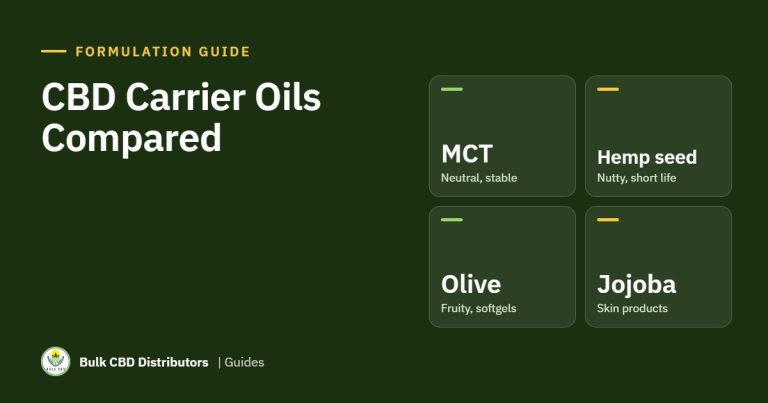
Isolate is the simplest input to dose because nothing else comes along with it. It is a crystalline solid that melts at around 66 to 67 C for CBD (CBG melts lower, around 52 C), so it has to be dissolved in a warm fat or oil, or pre-dispersed with an emulsifier, before it goes into a recipe. Our guide on how to make CBD oil from isolate or distillate shows the dissolving math, and CBD carrier oils compared explains why the oil phase matters.
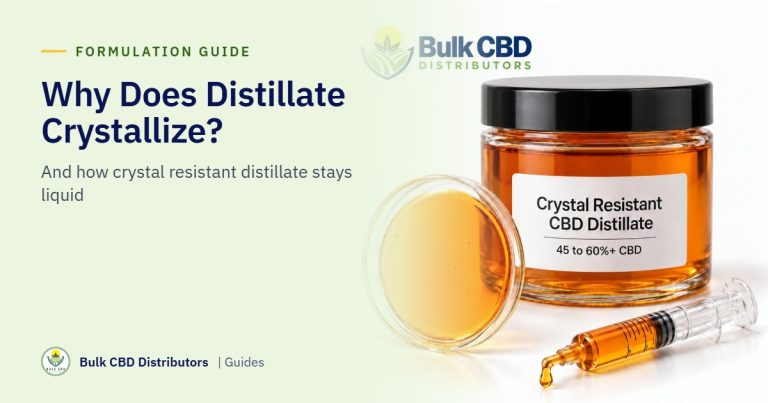
Distillate keeps part of the plant's cannabinoid profile and is already an oil, so it blends into chocolate, butter and baked goods easily but carries more color and flavor than isolate. High-strength distillate can crystallize in storage; our guide on why CBD distillate crystallizes explains why and when a crystal resistant grade is the fix. For the full comparison of the three families, see full spectrum vs broad spectrum vs CBD isolate, and compare grades in our CBD distillate collection.
Pro Tip: compare inputs on cost per milligram in the finished unit
A 55% crystal resistant distillate, a 90% distillate and a 20% water soluble powder are different materials, not cheap and expensive versions of the same thing. Work out the cost of the cannabinoid you actually deliver in each unit, then add the cost of any extra step, such as pre-dispersing isolate or building your own emulsion. Our guide to CBD prices shows the per-gram math.
Water Soluble CBD for Drinks and Gummies
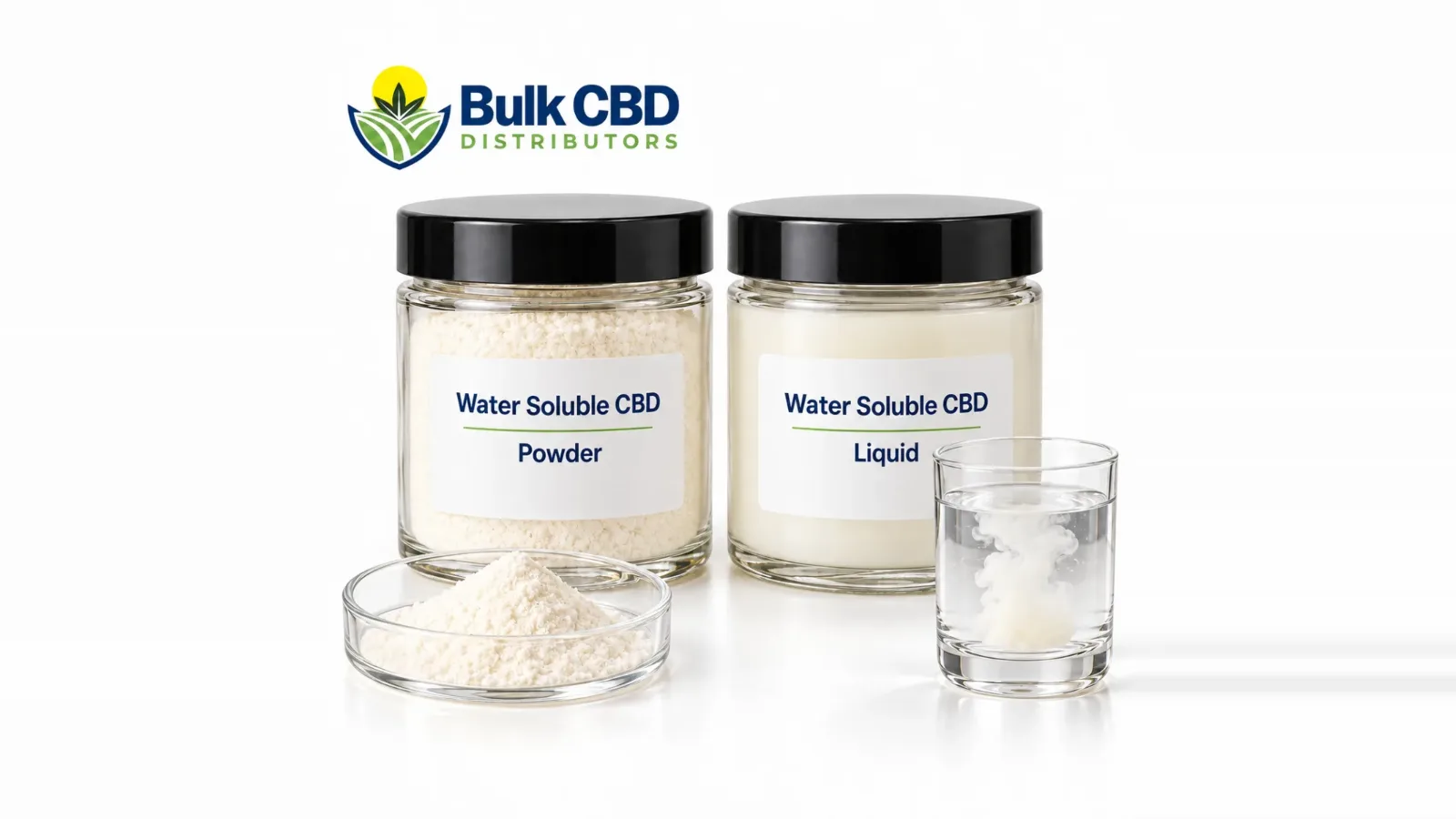
Water soluble CBD is cannabidiol processed so it disperses evenly in water, which plain oil cannot do. Producers get there with nano-emulsification, liposomal encapsulation or cyclodextrin complexation. Ours is a nano-emulsion with an 80 nm particle size, runs at about 20% CBD with small batch-to-batch variation, and comes as a liquid or a powder; a 10% liquid is also made. Dose from the batch COA, not from the label percentage. The same format is available for water soluble CBG, CBN and CBC, and the full water soluble cannabinoids collection lists every cannabinoid made this way.
For a deeper look at the technology itself, read our guide to water soluble CBD and nano-emulsification.
Liquid or Powder?
| Factor | Liquid | Powder |
|---|---|---|
| Best for | Beverage lines that meter liquids, shots and water-based drops | Dry drink mixes, stick packs and gummy syrups where extra water is a problem |
| Handling | Pump or pour; check the diluent | Weigh and disperse; check how it wets and dissolves |
| Always check | Clarity in your base, pH tolerance, settling over time | Dissolution speed, clumping, moisture pickup |
What the Published Studies Show
Water soluble ingredients are often marketed with large bioavailability multiples. The peer-reviewed record is more mixed, so here is what three studies actually measured, with their limits.
| Study | Design | What it found | Limits |
|---|---|---|---|
| Nakano et al., Medical Cannabis and Cannabinoids, 2019 | Rats; CBD oil vs a CBD nano-emulsion (mean particle size 35.3 nm) | Time to peak blood level fell from 8.0 h to 2.4 h. Dose-normalized exposure was about 65% higher, but the difference was not statistically significant. | Small groups, different doses, animal model |
| Berl et al., Cannabis and Cannabinoid Research, 2022 | Human, randomized, triple-blind, 32 healthy adults; nano-emulsion vs MCT oil | CBD peaked about 4.1 h sooner with the nano-emulsion. Measured CBD exposure did not differ significantly, and extrapolated exposure was higher with the MCT oil. | Single dose; funded by the developer of the tested formulation, whose CEO is an author |
| Abbotts et al., Nutrients, 2022 | Human, 14 men, randomized crossover, five CBD formulations at 30 mg | Pharmacokinetics differed widely between formulations, and taking CBD with food substantially changed them. | Small, male-only sample, all with a BMI of 25 or more; food tested with one formulation |
The consistent finding is faster absorption from a nano-emulsified form than from oil. Whether total exposure is higher varied by study. For a formulator, the takeaway is that the delivery system is part of the ingredient specification: ask for the supplier's data on the exact product, and be careful about repeating a bioavailability multiple on your own label unless you can support it.
Emulsifiers and Carriers: What Is Inside a Water Soluble Ingredient
A water soluble cannabinoid is an oil droplet wrapped in an emulsifier, held in water or dried to a powder. The emulsifier decides clarity, taste, label wording and compatibility with the rest of the recipe, so it deserves the same attention as the cannabinoid.
- Quillaja saponins. A plant-derived emulsifier family used in clear beverage nano-emulsions. A 2021 paper in the Journal of Cannabis Research described a quillaja saponin stabilized phytocannabinoid nanoemulsion and stress-tested it for stability.
- Polysorbates. Synthetic emulsifiers common in nano-emulsions; the Nakano study formulation used polysorbate 20 with vitamin E acetate and ethanol. Polyphenols in some juices can bind polysorbate and drop out of solution, taking potency with them.
- Gum arabic, modified starch and lecithin. Other common food and beverage emulsifiers, each with different taste, clarity and label implications. Lecithin is also the usual helper for dispersing isolate or distillate in chocolate and gummy premixes.
Questions to ask a supplier: What is the mean droplet or particle size? Which emulsifier and carrier are used? What is the labeled cannabinoid concentration, and how much does it vary by batch? What pH range and what base has the ingredient been tested in? Is there stability data in clear and cloudy drinks?
Gummy Ingredients: Gelling Agent, Sugar, Acid and Buffer
A gummy is a high-solids gel. The cannabinoid has to survive the cook, stay evenly spread while the gel sets, and not push the pH out of the setting window. The gelling agent comes first:
| Factor | Pectin (high methoxyl) | Gelatin |
|---|---|---|
| Source | Plant, usually citrus or apple; vegan | Animal-derived; kosher or halal only when certified |
| Typical use level | About 1% of the recipe | About 6 to 9% of the recipe |
| Bite | Short, clean | Chewy, elastic |
| Heat in transit | Holds its shape better in warm conditions | Softens in heat; in one supplier example, adding pectin raised a gelatin gummy's melting point from the 90s F to about 104 F |
| Process control | Tight: pH, solids and temperature all matter | More forgiving |
Pectin is the standard for vegan gummies, and it is the less forgiving system. Published supplier guidance gives these working windows:
- pH. One supplier cites a setting window of about pH 3.4 to 3.6 for high-methoxyl pectin gummies; a pectin producer's guide cites 2.8 to 3.5. Confirm the window for your exact pectin, then measure the finished pH with every ingredient in.
- Solids. Final solids of about 78 to 82 Brix at depositing.
- Temperature. Depositing at about 82 C (180 F).
- Acid timing and buffers. Add the acid as close to depositing as possible, and use buffering salts to hold the pH in range.
Flavors, colors and actives all push the pH in different directions, and one supplier notes that controlling pH can be overwhelming. Add your cannabinoid input to a small test batch and measure before you scale. For cook temperatures, step-by-step production and potency-per-gummy math, see our guide on how to make CBD gummies.
Pro Tip: test finished pieces, not just the batch
Water soluble powder disperses through a gummy syrup more easily than oil, and isolate needs an emulsifier premix to mix evenly. Whichever input you use, send gummies from the start, middle and end of a run to a lab and compare CBD per piece with the label. Uneven mixing shows up as piece-to-piece variation, not as a low batch average.
Beverage Ingredients: Acid, Sweetener, Preservatives and Packaging
A drink adds three problems a gummy does not have: a lot of water, a long shelf life and a package that touches the product. Beyond the water soluble cannabinoid, a typical CBD-infused drink needs an acid for flavor and microbial control, a sweetener, flavor and color, and a preservation plan. These choices matter most where they meet the emulsion.
A 2020 article in Cannabis Science and Technology by Harold Han of Vertosa, an emulsion supplier, lists the common causes of potency loss in infused beverages. They are an industry author's observations rather than a controlled trial:
- Oxidation. An emulsion creates a huge oil surface, and oxygen dissolves more readily in the oil droplets than in the surrounding water. Metal ions in the base can speed it up. Lower the dissolved oxygen in the base and limit headspace oxygen at filling.
- Ingredient incompatibility. Polyphenols in juices such as pomegranate can bind polysorbate and precipitate, reducing potency.
- Heat treatment. Pasteurization or other processing steps can break a poorly designed emulsion.
- Packaging. The polymer lining of aluminum cans and PET plastic bottles is hydrophobic and attracts oil droplets, which stick to the wall and drain potency over time. Glass is hydrophilic and avoids this attachment problem, though it is heavier to ship and does not stop oxidation or light damage.
| Package | Advantage | Watch-out |
|---|---|---|
| Glass | Hydrophilic surface; droplets do not attach | Weight and shipping cost |
| Aluminum can | Light, inexpensive, widely used | Polymer liner can attract emulsion droplets; test the emulsion with the liner |
| PET bottle | Light and clear | Same droplet attraction risk as can liners |
The stability science supports a cautious approach. In a 2020 study in the Journal of Chromatography B, Fraguas-Sanchez and colleagues found CBD took about 117 days to fall to 95% of its starting level at room temperature, held at least 12 months at 5 C, was sensitive to light, and broke down much faster under oxidizing conditions. CBD was more stable in ethanol than in an aqueous medium. These are laboratory conditions, not a drink shelf life, so run your own stability test on the finished beverage in its final package, stored the way it will be sold.
How Much Water Soluble CBD per Batch?
Beverage dosing runs on one formula: grams of input = CBD per unit (mg) x units / (input potency as a decimal x 1,000). Here is what that looks like for 1,000 cans, before any overage for losses in tanks and lines:
| CBD per can | 20% water soluble CBD | 10% water soluble liquid |
|---|---|---|
| 10 mg | 50 g | 100 g |
| 25 mg | 125 g | 250 g |
| 50 mg | 250 g | 500 g |
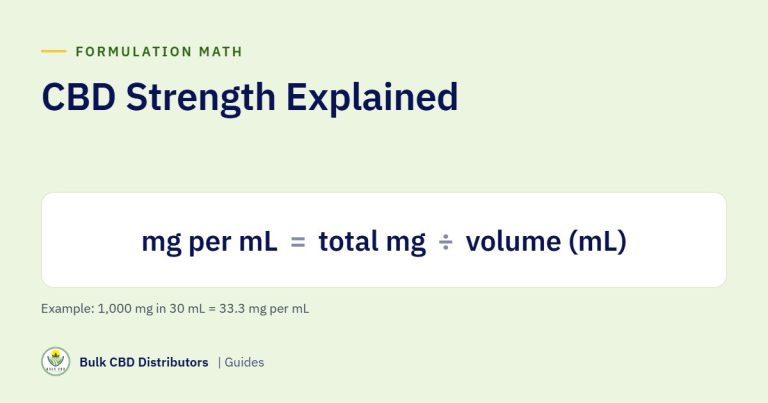
Because potency loss to packaging and oxygen happens after filling, measure CBD in finished cans at the start and end of the intended shelf life, not only on the day they are made. Our CBD strength guide covers overage and how test results compare with the label.
Chocolate, Baked Goods and Other Fat-Based Foods
Fat-based foods are the easiest home for oil-soluble cannabinoids. Isolate dissolves into warm cocoa butter, butter or MCT oil, and distillate blends in directly. A little lecithin helps the cannabinoid stay evenly spread through a batter or chocolate. Add it late in the process, since heat and oxygen shorten CBD's stability, and keep chocolate tempering temperatures in mind. In baking, time at temperature matters as well as the peak, so lab-test finished units rather than assuming the dose carries through the oven.
Flavor, Terpenes, Sweeteners and Color
Flavor is where isolate and distillate differ most. Isolate adds no taste of its own, while distillate carries the plant's color and an earthy taste that may need stronger flavoring to cover. Hemp-derived terpenes can add aroma and flavor in edible production. Sweeteners and colors matter beyond taste: they shift pH, add solids and can interact with an emulsion, so add them to the test batch together, not one at a time.
Total THC per Container From December 11, 2026
From December 11, 2026, Section 781 of P.L. 119-37 limits finished hemp consumer products to 0.4 mg of total THC per container. A can, a chocolate bar and a gummy jar each count as one container, so the same input can pass in one format and fail in another. The math: mg of THC per container = mg of input per container x total THC % / 100.
| Container | CBD per container | 80% distillate needed | Total THC per container | Against the 0.4 mg cap |
|---|---|---|---|---|
| 12 oz can | 10 mg | 12.5 mg | About 0.04 mg | Under |
| Chocolate bar | 100 mg | 125 mg | About 0.38 mg | Just under, with little margin |
| Jar of 30 gummies at 25 mg | 750 mg | About 938 mg | About 2.8 mg | About 7 times over |
Non-detect CBD isolate or a Non-Detect THC broad spectrum distillate removes most of this risk, which is why they are the usual inputs for gummies and other high-strength edibles. Water soluble ingredients carry the THC status of the cannabinoid they were made from, so check total THC on their COA too. Confirm total THC on the finished lot as well as the input; our total THC guide shows how to read and calculate it.
Testing and Documents to Require
Specify the ingredient documents before you formulate, and the finished-product tests before you launch.
- Ingredient batch COA from an ISO 17025-accredited third-party lab for the lot you receive: full cannabinoid panel, total THC, residual solvents, heavy metals, pesticides and microbials. Our guide on how to read a hemp COA walks through each section.
- Water soluble extras: particle size, carrier and emulsifier, concentration and its batch variation.
- Finished-product tests: cannabinoid content per unit, total THC per container, pH, microbials, and stability across the intended shelf life in the final package.
- Shelf life: set dates from stability data on the finished product; our guide on CBD shelf life explains how.
COMPLIANCE NOTE
Section 781 of P.L. 119-37 changes the federal hemp definition in two stages. From November 12, 2026, products containing cannabinoids not capable of being naturally produced by the cannabis plant are excluded. From December 11, 2026 (moved from November 12 by P.L. 119-103), the new total THC standard takes effect and finished hemp consumer products are limited to 0.4 mg of total THC per container. This applies to products made with any cannabinoid, including CBD, CBG, CBN and CBC. Our summary of what the 2026 hemp law means for bulk CBD buyers covers the details.
Separately, FDA states that adding CBD or THC to a food sold in interstate commerce is a prohibited act under section 301(ll) of the FD&C Act, and states set their own rules for hemp edibles and drinks, including age limits and per-serving caps in some markets. This guide is educational, not legal advice, and our ingredients are sold for business use. Check federal and state rules for your product and markets before you formulate or sell.
Nothing in this guide is a claim that any product treats, cures or prevents a condition.
How BCD Supplies Edible and Beverage Ingredients
We are a B2B distributor of hemp cannabinoid ingredients, not a manufacturer. Through working relationships, direct and indirect, with many of the larger hemp ingredient producers and distributors, we can pick lots that suit a formula, such as a non-detect THC distillate for gummies or a water soluble powder for a dry drink mix, rather than offering one producer's range. Each lot is tested by an ISO 17025-accredited third-party lab; the COA on a listing is representative, and the COA for your batch comes with the shipment.
Placing an order request costs nothing: we check stock and confirm the total, and payment is only taken after that. Packages ship plain, with no brand labeling on the box, so they can go to your facility or straight to a co-packer. If you would rather sell finished goods than make them, our white label CBD program puts your brand on finished products, and the Retail Ready section stocks bulk CBD edibles by the case.
Formulating a drink or an edible?
Compare water soluble cannabinoids and CBD distillate, or request a wholesale quote with your format, target strength per unit and package, and we will help you size the input.
How to Choose Ingredients for a CBD Edible or Beverage
- Pick the product phase. Decide whether the product is water-based, syrup-based or fat-based. That sets whether you need water soluble CBD, a dispersible input or an oil-soluble one.
- Choose the cannabinoid input. Pick isolate, distillate or water soluble, then set the cannabinoid and the purity or concentration range. Ask for total cannabinoids and total THC as well as the main cannabinoid percentage.
- Choose the structure and emulsifier. For gummies, choose pectin or gelatin for label, bite and heat tolerance. For drinks, choose the emulsifier and base for clarity, taste and label goals.
- Set the pH and process window. Confirm the setting pH, solids and depositing temperature with your pectin supplier, or the pH tolerance of the emulsion for drinks, and measure pH with every ingredient in the batch.
- Run the THC per container math. Multiply the input per container by its total THC percentage and divide by 100. Products sold from December 11, 2026 must stay at or below 0.4 mg per container.
- Plan packaging and shelf life. For drinks, test glass, can liners and PET with your emulsion, and run a stability test in the final package at the conditions the product will see.
- Lock the specification and test finished units. Write the cannabinoid, concentration, particle size, emulsifier, COA and total THC requirements into the purchase request, then test finished units from across the run.
What This Means for Your Business
- Choose the phase first, then the cannabinoid. It removes most wrong turns.
- Specify the emulsifier and the gelling agent as carefully as the cannabinoid.
- Measure pH with everything in the batch, especially for pectin gummies.
- Test drinks in their final package, at the start and end of shelf life.
- Run the THC per container math for every SKU that will sell after December 11, 2026.
Frequently Asked Questions
What are the best ingredients for CBD edibles and beverages?
A cannabinoid input matched to the product's phase (water soluble CBD for drinks, CBD isolate or a water soluble powder for gummies, isolate or distillate in the fat for chocolate), plus an emulsifier, a gelling agent where needed, and acids, sweeteners and flavors chosen so pH, heat and oxygen do not break the product down.
What is the best CBD ingredient for gummies?
Water soluble CBD powder mixes most evenly into a gummy syrup. CBD isolate is 99%+ pure with non-detect Delta-9 THC and no taste, but it needs an oil and emulsifier premix. Non-Detect THC broad spectrum distillate works when you want a hemp profile.
What is the best CBD ingredient for drinks?
Water soluble CBD, as a liquid or powder, is the standard input for CBD-infused drinks because plain CBD oil does not mix into water. Check its particle size, emulsifier, and behavior at your drink's pH and in your package before you scale.
Can you put CBD oil in a beverage?
Not on its own. CBD oil separates from water and floats or sticks to the package. A drink needs a water soluble form, such as a nano-emulsified liquid or powder, to keep the cannabinoid evenly dispersed.
What emulsifier is used in water soluble CBD?
It varies by producer. Common choices include quillaja saponins, polysorbates, gum arabic, modified starch and lecithin. Ask which one is used, because it affects clarity, taste, label wording and compatibility with other ingredients.
Why does CBD lose potency in drinks?
The usual causes are oxidation, light, heat during processing, ingredient interactions such as polyphenols binding polysorbate, and droplets sticking to can liners and PET bottles. Glass avoids the sticking problem. Test finished drinks in their final package over the full shelf life.
How much water soluble CBD do I need for 1,000 cans?
At 10 mg per can, 1,000 cans need 10,000 mg of CBD, which is 50 g of 20% water soluble CBD or 100 g of a 10% liquid, before overage.
Should I use isolate or distillate in edibles?
Use isolate for exact dosing with no color, taste or detectable THC. Use broad spectrum distillate when you want minor cannabinoids in the formula, and crystal resistant distillate when an oil phase must stay clear and pourable. Compare them on cost per milligram delivered.
What documents should I ask for with edible ingredients?
The batch COA for your lot from an ISO 17025-accredited third-party lab, with a full cannabinoid panel, total THC, residual solvents, heavy metals, pesticides and microbials. For water soluble ingredients, also ask for particle size, carrier and emulsifier details.
Does the 0.4 mg THC cap apply to CBD edibles and drinks?
Yes. From December 11, 2026, Section 781 of P.L. 119-37 limits finished hemp consumer products, including edibles and drinks made with CBD, to 0.4 mg of total THC per container.
Related Reading
- Water-Soluble CBD: Nano-Emulsification and Bulk Sourcing
- How to Make CBD Gummies: Gelatin vs Pectin, Infusion and Potency per Gummy
- CBD Carrier Oils Compared
- Does CBD Expire? Shelf Life and Storage
Sources
- Fraguas-Sanchez AI et al. Stability characteristics of cannabidiol for the design of pharmacological, biochemical and pharmaceutical studies. Journal of Chromatography B, 2020.
- Nakano Y et al. Development of a Novel Nanoemulsion Formulation to Improve Intestinal Absorption of Cannabidiol. Medical Cannabis and Cannabinoids, 2019.
- Berl V et al. A Randomized, Triple-Blind, Comparator-Controlled Parallel Study Investigating the Pharmacokinetics of Cannabidiol and Tetrahydrocannabinol in a Novel Delivery System, Solutech. Cannabis and Cannabinoid Research, 2022.
- Abbotts KSS et al. Cannabidiol and Cannabidiol Metabolites: Pharmacokinetics, Interaction with Food, and Influence on Liver Function. Nutrients, 2022.
- Han H. Potency Loss in Cannabis Beverages: Common Causes and Solutions. Cannabis Science and Technology, 2020.
- MJBizDaily. Is pectin or gelatin the right gelling agent for your cannabis gummies?
- SupplySide Food and Beverage Journal. Overcoming the challenges of pectin-based gummy formulation, 2022.
- Cargill. Pectin: creating a yummy gummy (supplier technical guide).
- U.S. Food and Drug Administration. FDA Regulation of Cannabis and Cannabis-Derived Products, Including Cannabidiol (CBD).
- Synthesis, characterization and stress-testing of a robust quillaja saponin stabilized oil-in-water phytocannabinoid nanoemulsion. Journal of Cannabis Research, 2021.
- Vicente LLP. Federal hemp update: definition change delayed to December 11.
Disclosure: Bulk CBD Distributors sells several of the ingredients discussed here, including CBD isolate, distillates and water soluble cannabinoids. The studies and sources cited are independent of us; where a source had a commercial sponsor or an industry author, we say so.