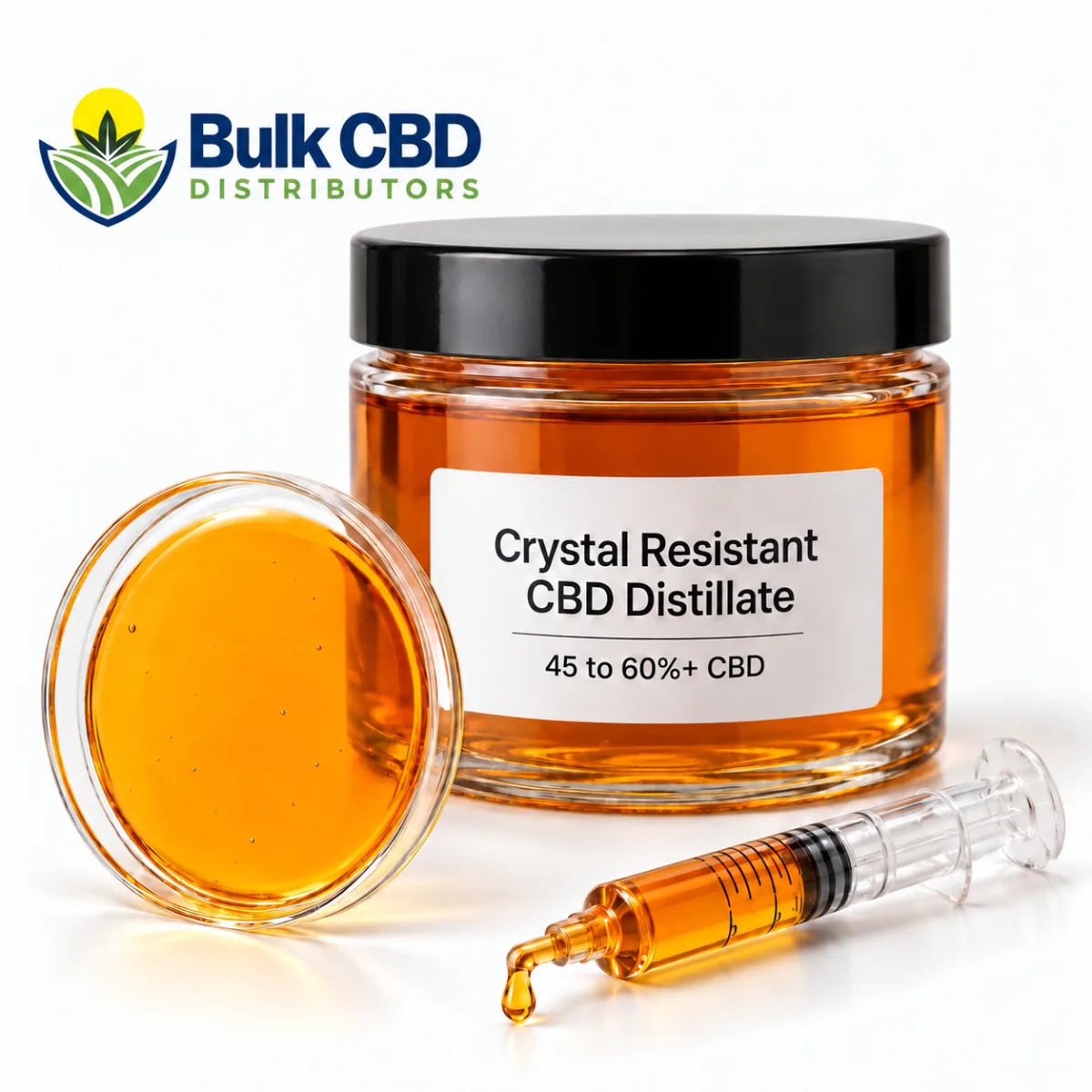
CBD distillate crystallizes because CBD is a solid at room temperature: when it makes up most of the oil, the mixture is close to saturated, and cold, time or a stray particle can start crystals forming. Crystal resistant distillate (CRD) avoids this by holding CBD at a lower share and carrying more minor cannabinoids, which makes it harder for CBD to pack into crystals. Our crystal resistant CBD distillate typically runs 45 to 60%+ CBD, lower than other grades on purpose, and stays pourable at room temperature. So why does CBD distillate crystallize in one batch and not the next? This guide covers the triggers, how to fix oil that has already crystallized, which products need a crystal resistant input, and how to specify one so the lot you receive behaves the way your formula needs.
| Spec | At a glance |
|---|---|
| Why it happens | CBD is a crystalline solid; high-purity distillate is close to saturation |
| Common triggers | High purity, cold, stray particles, time and stillness |
| Quick fix | Gentle, even warming re-dissolves the crystals |
| Lasting fix | Lower strength, blended inputs or crystal resistant distillate (45 to 60%+ CBD) |
What Makes CBD Distillate Form Crystals?
Pure CBD is a crystalline solid at room temperature; that is what CBD isolate is. It melts at around 66 to 67 C. In a distillate, CBD is dissolved in a small amount of other compounds. When CBD makes up most of the oil, the mixture is close to saturated, and it only needs a trigger for CBD molecules to line up and start a crystal.
The usual triggers are:
- High purity. The higher the CBD share, the less there is to keep it dissolved.
- Cold. Lower temperatures reduce how much CBD the oil can hold, which is why crystals often appear after winter shipping or cold storage.
- Seeds and surfaces. A stray crystal, a particle of dust or a scratched container wall gives crystals a place to start.
- Time and stillness. Oil that sits undisturbed for weeks has more chances to nucleate.
Once crystals start, they tend to spread. In a tincture they show up as cloudiness or sediment; in a softgel line they can block filling; in a cartridge they can stop the oil from flowing. CBG behaves the same way and melts lower, at around 52 C, which is why crystal resistant CBG exists too.
How Crystal Resistant Distillate Stays Liquid
- STAGE 1Hemp biomassDried flower and leaf
- STAGE 2Crude oil50 to 70% CBD
- STAGE 3 (this guide)Distillate45 to 95% CBD
- STAGE 4Isolate99%+ CBD
Crystal resistant distillate is still distillate. It starts from winterized crude and goes through the same vacuum distillation described in our guide on CBD distillate specs and grades. The difference is the target: instead of pushing CBD as high as possible, the producer keeps a measured share of CBN, CBC, CBG and CBDV in the finished oil. A lower CBD share, plus the minor cannabinoids and other compounds in the oil, makes it harder for CBD to pack into crystals, so the oil stays clear and flowable.
Here is the cannabinoid panel from the representative COA on our crystal resistant CBD distillate listing:
| Cannabinoid | Result | Role |
|---|---|---|
| CBD | 53.35% | Primary cannabinoid |
| CBN | 4.44% | Minor cannabinoid |
| CBC | 2.34% | Minor cannabinoid |
| CBG | 2.23% | Minor cannabinoid |
| CBDV | 0.67% | Minor cannabinoid |
| Delta-9 THC, Delta-8 THC, THCA, THCV | Not detected | Total THC: non-detect |
| Total cannabinoids | 63.03% | About 9.7% from minor cannabinoids |
That COA is representative, from a third-party lab report dated April 28, 2026; the batch COA for your lot ships with every order. The point to take from it is the mix: roughly a tenth of the oil is minor cannabinoids, which is what makes the oil behave differently from a 90% distillate.
Crystal Resistant vs Standard Distillate vs Isolate
| Feature | Crystal resistant distillate | Standard CBD distillate | CBD isolate |
|---|---|---|---|
| Typical CBD | 45 to 60%+ | 75 to 95% by grade | 99%+ |
| Physical form | Pourable oil | Thick oil; can crystallize | Crystalline powder |
| Crystallization risk | Low | Moderate to high at high strength | Is a crystal; can recrystallize in oil |
| Minor cannabinoids | Measured share kept on purpose | Present in broad and full spectrum | None |
| Best for | Products that must stay clear and flowable | Most oils, softgels and edibles | Exact, THC-free amounts |
Lower potency does not mean less value. Because CRD carries other cannabinoids, compare it on cost per gram of total cannabinoids for your formula, not on CBD percent alone. Our guide to CBD prices explains the per-gram math.
Which Products Need Crystal Resistant Distillate?
- High-strength tinctures. Oils from about 1,500 mg per 30 mL, and especially above 3,000 mg, are the most likely to cloud in cold storage.
- Softgels and capsules. A flowable input keeps automated filling lines running and fill weights consistent.
- Cartridges. Crystals inside cartridge hardware block flow, so CRD is common in CBD cartridge fills, often with added terpenes.
- Topicals and cosmetics. Crystals in a balm or cream feel gritty and look like a defect.
- Emulsion preparation. A stable, pourable oil phase makes water soluble emulsions more consistent.
If your product is low strength, sold quickly and kept at room temperature, standard broad spectrum CBD distillate or isolate may be enough. Test at full strength before you decide; our guide on how to make CBD oil includes a simple cold hold check.
Need an oil that stays clear?
Crystal resistant CBD distillate is available online in 500g, 1kg and 5kg sizes, with larger volumes by quote. Compare it with other grades in our CBD distillate collection, or request a wholesale quote with your format and target strength.
How to Specify Crystal Resistant Distillate
A clear specification saves a failed batch. Use these steps when you request quotes:
- Name the cannabinoid and grade. State crystal resistant CBD, CBG or CBN distillate, so every supplier quotes the same material.
- Set the potency range. For crystal resistant CBD, a typical range is 45 to 60%+ CBD. Ask for the total cannabinoid figure as well, since the minor cannabinoids are part of what keeps it liquid.
- Set the THC requirement. Specify total THC non-detect for products sold from December 11, 2026; otherwise Delta-9 THC at 0.3% or less. Ask for total THC on the COA either way.
- Describe your use and conditions. Tell the supplier the product format, target strength and the coldest temperature the product will see in storage or shipping.
- Ask for the batch COA. Require a COA from an ISO 17025-accredited third-party lab for the lot you receive, with the full cannabinoid panel, residual solvents, heavy metals, pesticides and microbials.
- Run a cold hold test. Before scaling, make a small batch at full strength and hold samples cool for several days to confirm they stay clear.
What to Check on a Crystal Resistant Distillate COA
- Primary cannabinoid in range. 45 to 60%+ CBD for crystal resistant CBD.
- Minor cannabinoids listed individually. CBN, CBC, CBG and CBDV should each appear with a result, not just a total.
- Total THC. Delta-9 THC at 0.3% or less, or non-detect if you need it; our total THC guide shows how to calculate it.
- Contaminant panels. Residual solvents, heavy metals, pesticides, microbials and mycotoxins should pass.
- Batch match and lab accreditation. The batch number should match your lot, and the lab should be ISO 17025-accredited and third-party.
Crystal Resistant CBG and CBN
The same approach works for other cannabinoids. Crystal resistant CBG distillate matters because CBG crystallizes readily and melts lower than CBD. Crystal resistant CBN distillate is used in formulas where a clear, pourable CBN oil matters. Our crystal resistant CBN guide covers that product in depth. All of them fall under the same finished product rules: from December 11, 2026, Section 781 of P.L. 119-37 limits finished hemp consumer products to 0.4 mg of total THC per container, whatever the cannabinoid.
What If Distillate Has Already Crystallized?
Crystallized distillate is usually not ruined. Gentle, even warming, such as a warm water bath with the container sealed, re-dissolves the crystals. Stir once it is fully liquid, and keep it away from cold surfaces afterward. Warming fixes the symptom, not the cause, so if a finished product crystallizes, the long-term fix is a lower strength, a blend with distillate, or a crystal resistant input.
How BCD Supplies Crystal Resistant Distillate
We carry crystal resistant CBD, CBG and CBN distillates alongside broad and full spectrum grades. Because we work directly or indirectly with major hemp ingredient manufacturers, distributors and brands, we can choose lots with a clean cannabinoid balance. Every lot is third-party tested in ISO 17025-accredited labs, and its COA ships with the order.
Nothing is charged when you submit an order request; we confirm availability and the total first. Most ingredient orders ship the same or next day after payment, some take up to 72 business hours, and packages ship blind.
What This Means for Your Business
- Use CRD where crystals would be a defect, such as high-strength oils, softgels, topicals and cartridges.
- Judge it by total cannabinoids, since the minor cannabinoids are part of the product, not filler.
- Write the cold conditions into your spec so the supplier knows what the oil has to survive.
- Test at full strength before scaling, with a few days of cold hold.
Frequently Asked Questions
Why does CBD distillate crystallize?
CBD is a crystalline solid at room temperature. In a high-purity distillate it is close to saturation, so cold, time, stillness or a stray particle can start crystals forming.
What is crystal resistant distillate?
Crystal resistant distillate is a cannabinoid distillate balanced with a share of minor cannabinoids so the main cannabinoid does not crystallize. It stays pourable at room temperature.
What does CRD stand for?
CRD stands for crystal resistant distillate. It is most often made with CBD, and also with CBG or CBN.
How does crystal resistant distillate prevent crystallization?
It keeps CBD at a lower share and carries minor cannabinoids such as CBN, CBC, CBG and CBDV. Together they make it harder for CBD to pack into crystals.
What potency is crystal resistant CBD distillate?
Crystal resistant CBD distillate typically runs 45 to 60%+ CBD. Total cannabinoids are higher because minor cannabinoids are part of the blend.
Is crystal resistant distillate lower quality than standard distillate?
No. Its CBD percentage is lower by design. Compare it on total cannabinoids and on how it performs in your product.
What products use crystal resistant distillate?
High-strength tinctures, softgels and capsules, topicals, cartridges and emulsion preparation, where crystals would look like a defect or interrupt production.
Can crystallized distillate be fixed?
Usually yes. Gentle, even warming re-dissolves the crystals. If a finished product keeps crystallizing, reduce the strength, blend inputs or switch to a crystal resistant grade.
Is there crystal resistant CBG and CBN?
Yes. Crystal resistant CBG distillate and crystal resistant CBN distillate use the same approach for those cannabinoids.
Does Section 781 apply to crystal resistant distillate?
The 0.4 mg total THC per container cap from December 11, 2026 applies to finished hemp consumer products made with any cannabinoid, including products made with crystal resistant distillate.