Water-soluble CBD is cannabidiol that has been processed to disperse uniformly in water-based formulations, a capability standard CBD oil does not have. For manufacturers producing beverages, functional drinks, water-based tinctures, and aqueous-phase personal care products, the format of choice is water-soluble CBD produced through nano-emulsification, liposomal encapsulation, or cyclodextrin complexation. This guide covers how each technology works, what specifications to require from a bulk supplier, and how water-soluble CBD integrates into commercial-scale manufacturing.
What Is Water-Soluble CBD?
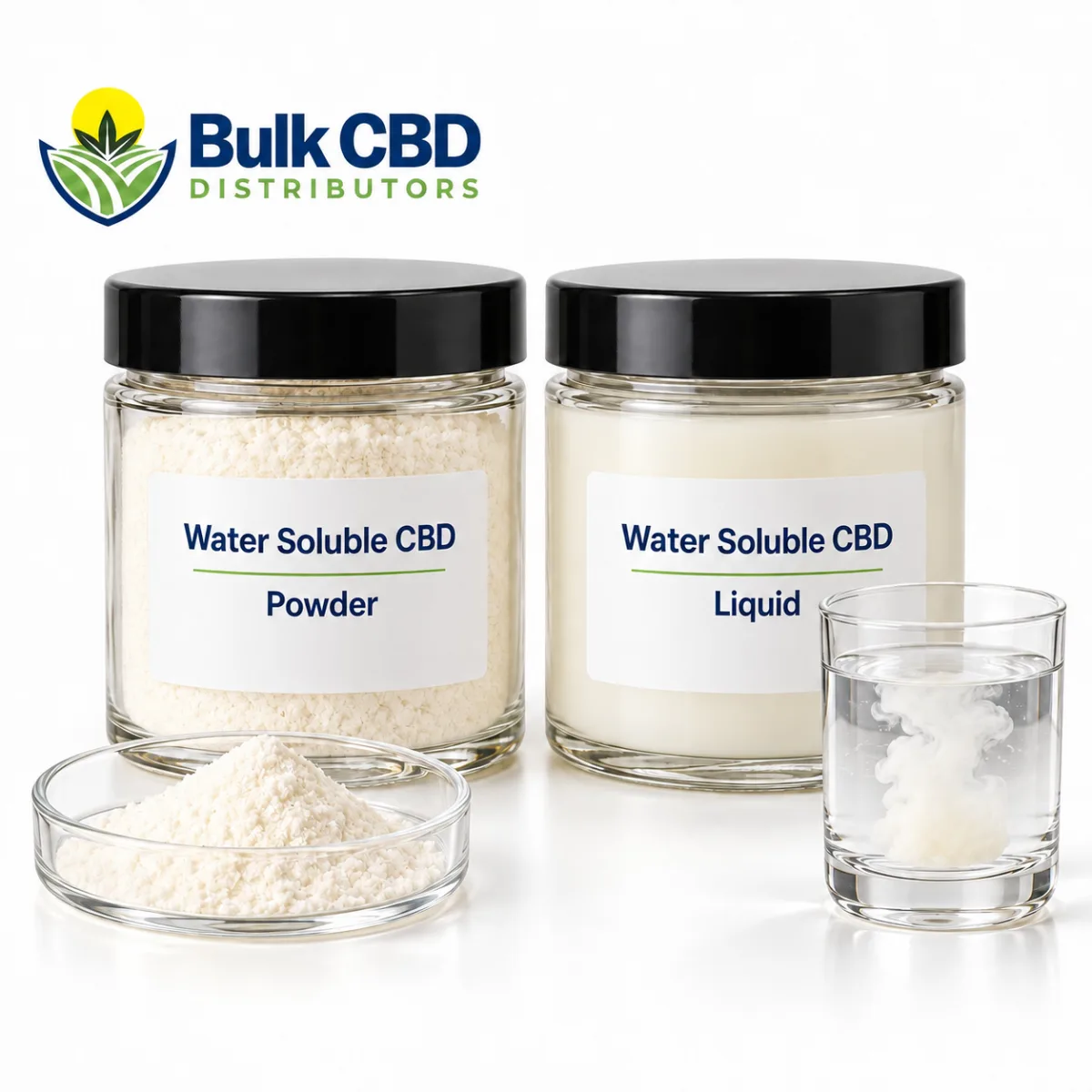
Water-soluble CBD is cannabidiol processed to disperse uniformly and stably in aqueous solutions. Unlike CBD isolate or distillate, which are lipophilic and separate from water, water-soluble CBD uses emulsification or encapsulation technology to create CBD-containing particles small enough to remain dispersed in water-based formulations without separation, creaming, or sedimentation over the product's shelf life.
Bulk water soluble CBD is usually sold as a powder or a liquid, made from isolate, broad-spectrum or full-spectrum inputs, and the input sets the THC status of the finished ingredient.
Why Standard CBD Oil Does Not Mix with Water
CBD is a highly lipophilic molecule. When CBD isolate or distillate is added directly to a water-based liquid, the CBD does not dissolve and separates out. Overcoming this requires mechanical and chemical intervention to reduce CBD-containing particles to a size and surface chemistry that allows stable aqueous dispersion. The three commercial approaches each use different physics and chemistry to achieve the same outcome: a CBD ingredient that mixes into water-based products and stays mixed.
The Three Water-Soluble CBD Technologies
1. Nano-Emulsification
Nano-emulsification uses high-shear mechanical energy (high-pressure homogenization, microfluidization, or ultrasonic processing) to break CBD oil into nano-scale droplets (typically 20 to 150 nm), stabilized by an emulsifier layer such as sunflower lecithin, soy lecithin, or polysorbate 80. Particle size below approximately 100 nm produces visually clear solutions. Nano-emulsified CBD is the most commercially prevalent format, sold in both powder and liquid forms.
2. Liposomal Encapsulation
Liposomal technology encapsulates CBD within phospholipid bilayer vesicles similar in composition to cell membranes. Particle sizes typically range from 50 to 400 nm; liposomal preparations are generally opaque or translucent. Liposomal CBD commands a price premium and is preferred for premium supplement applications including sublingual tinctures and softgel-fill formulations.
3. Cyclodextrin Complexation
Cyclodextrins trap CBD molecules inside a hydrophobic interior cavity, creating a water-soluble molecular inclusion complex that dissolves in water at the molecular level: genuinely water-soluble, not a suspension. Cyclodextrin-complexed CBD produces optically clear solutions and is often used in carbonated applications. Cost is highest of the three technologies.

Which CBD Solubilization Technology Should You Use?
The three water-soluble CBD solubilization technologies (also spelled solubilisation) trade off clarity, stability and cost. Use the table to match the technology to your product, then confirm particle size and emulsifier on the supplier's spec sheet.
| Factor | Nano-emulsion | Liposome | Cyclodextrin complex |
|---|---|---|---|
| How it works | Emulsifiers and mechanical energy make tiny oil-in-water droplets | CBD held in phospholipid bilayer vesicles | CBD molecules held inside ring-shaped sugar molecules |
| Typical size | 20 to 150 nm | 50 to 400 nm | Molecular complex |
| Appearance in water | Clear to slightly hazy, depending on size | Opaque to translucent | Optically clear |
| Best for | Most beverages, drink mixes and gummies | Premium supplements and sublinguals | Sparkling and clear beverages |
| Cost and availability | Widest supply, usually lowest cost | Higher cost | Specialty |
Most commercial water soluble CBD is a nano-emulsion. Potency varies slightly by batch, so check the batch COA before you run dose calculations.
Key Specifications to Request from a Bulk Water-Soluble CBD Supplier
Particle Size (d50 and d90)
For clear beverage applications, request d50 below 100 nm and d90 below 150 nm. Confirm via dynamic light scattering data on the supplier's technical data sheet, not just the supplier's stated claim. Instrument-based measurement is required; a specification number without supporting DLS data is not a verified specification.
CBD Concentration
Typically 10 to 100 mg/mL for liquids, 50 to 200 mg/g for powders. Confirm on the current-lot COA from an ISO 17025-accredited laboratory before dose calculations.
Emulsifier Type
Sunflower lecithin for clean-label positioning; polysorbate 80 for maximum emulsion stability; beta-cyclodextrin for sparkling beverage applications. Confirm in the supplier's technical data sheet.
pH Stability Range and Turbidity
Most formulations are optimized for pH 4 to 7. Confirm the stability window matches your formulation's target pH. For clear beverages, specify below 10 NTU at your intended use concentration.
From the Field
"Water-soluble CBD is one of the most specification-dependent categories in the wholesale market, and it is also one of the easiest categories to misrepresent. A supplier can claim sub-100 nanometer particle size without providing the dynamic light scattering data to back it up. We have seen beverage formulations built on 'water-soluble' ingredients that were poorly emulsified oil-in-water suspensions: products that looked fine in the batch but separated on the shelf within weeks. The documentation standard for water-soluble CBD should be at least as rigorous as for isolate or distillate: particle size from instrument-based measurement, stability data at your target pH, and emulsifier identity confirmed in the technical data sheet. If a supplier cannot provide those three things, their particle size claim is marketing, not specification."
John Piccone, Founder, Bulk CBD Distributors
Water-Soluble CBD in Product Formulation
Beverages
Add water-soluble CBD powder to the dry blend before hydration, or add liquid water-soluble CBD to the aqueous phase before pH adjustment and carbonation. For sparkling applications, use cyclodextrin-complexed CBD or nano-emulsions below 80 nm for best carbonation stability.
Tinctures and Sublinguals
Oil-free, water-phase tinctures are produced by diluting water-soluble CBD in water, glycerin, or an alcohol-water blend. The result is a clear or lightly hazy liquid with no oil phase, eliminating the oily mouthfeel of conventional oil-based tinctures.
Edibles and Supplements
Water-soluble CBD powder mixes directly into dry blends for stick packs, powdered drink mixes, and encapsulation. For gummy manufacturing, water-soluble CBD in the aqueous phase produces more uniform distribution than adding oil-phase isolate to a warm melt.
Stability Considerations for Manufacturing
- pH sensitivity: confirm the supplier's pH stability specification and conduct accelerated stability testing at 40 degrees Celsius for 4 to 8 weeks before production commitment.
- Temperature exposure: confirm acceptable temperature range from the supplier's TDS. Some emulsifier systems are sensitive to pasteurization temperatures (72 to 85 degrees Celsius).
- Dilution rate: using above or below the specified concentration range can produce instability. Confirm the recommended use concentration with your supplier.
- Shelf life: request accelerated stability data for the finished formulation type; water-soluble CBD in a beverage behaves differently than in a dry powder.
What This Means for Your Business
Water-soluble CBD costs more per milligram than standard isolate or distillate, but that cost difference must be evaluated against formulation benefits: oil-free product positioning, improved dose consistency, and access to beverage and clear-liquid product categories not feasible with oil-phase inputs. From a compliance standpoint, water-soluble CBD is treated like any other hemp-derived CBD ingredient under Section 781 of P.L. 119-37: total THC (THCA counts) and the 0.4 mg total THC per container cap on finished products apply from December 11, 2026, so check total THC on the emulsion's own COA.
Compare Current Water Soluble CBD Specs and COAs
BCD's water soluble CBD is a nano-emulsion made at an 80 nm particle size, regularly around 20% CBD in powder or liquid, with a 10% liquid also offered. Current sizes and the representative COA are on the water soluble CBD page, and other options are listed under bulk water soluble cannabinoids. Minimums run 100g to 1kg depending on the product, and most orders ship within a few days.
Frequently Asked Questions
What is water-soluble CBD?
Water-soluble CBD is cannabidiol processed using nano-emulsification, liposomal encapsulation, or cyclodextrin complexation to disperse uniformly in water-based formulations. It is sold as a powder or a liquid.
What is the difference between nano-emulsified and liposomal CBD?
Nano-emulsified CBD uses mechanical energy and emulsifiers to create oil-in-water droplets (20 to 150 nm). Liposomal CBD uses phospholipid bilayer vesicles (50 to 400 nm). Nano-emulsified is more commercially available and typically less costly; liposomal is preferred for premium supplement and sublingual applications.
What particle size should water-soluble CBD have for clear beverage applications?
D50 below 100 nm and d90 below 150 nm for optically clear beverages. For carbonated applications, below 80 nm or cyclodextrin-complexed CBD for better stability under CO2 pressure. Always confirm via dynamic light scattering data on the supplier's technical data sheet.
Can water-soluble CBD be used in sparkling beverages?
Yes, with caveats. Nano-emulsified CBD can destabilize under carbonation pressure if particle size is not tightly controlled. Specify particle size below 80 nm or use cyclodextrin-complexed CBD. Always test in your specific base formulation at your target carbonation level before committing to production.
Is water-soluble CBD more expensive than CBD isolate?
Yes. Water-soluble CBD costs more per milligram due to the additional processing. The premium is justified when the application requires aqueous compatibility where CBD isolate or distillate does not perform adequately.
What emulsifiers are used in bulk water-soluble CBD?
Sunflower lecithin (clean-label positioning), soy lecithin, polysorbate 80 (excellent stability), and beta-cyclodextrin (for complexed formats). Confirm the emulsifier in your supplier's technical data sheet before sourcing for a labeled product.
Does water-soluble CBD contain THC?
Depends on the CBD starting material. Water-soluble CBD made from isolate is non-detect THC. Made from broad-spectrum distillate, it carries 0.3% Delta-9 THC or less (non-detect on the Non-Detect THC option), and made from full-spectrum distillate it carries the source oil's THC, so check the per-container total. Confirm the required THC status when you request specifications.
What documentation should I request with a bulk water-soluble CBD order?
Current-lot COA from an ISO 17025-accredited laboratory (CBD concentration, total THC, residual solvents, heavy metals, microbials); technical data sheet (particle size d50/d90, emulsifier type, pH stability range, turbidity data, recommended use concentration); and a hemp compliance statement.
Can water-soluble CBD substitute for CBD isolate in all formulations?
Not directly. Water-soluble CBD contains emulsifiers and carriers in addition to CBD. For oil-phase applications (conventional tinctures, gummies, oil-based topicals), CBD isolate or distillate performs better and costs less. Water-soluble CBD is the right choice specifically where the product base is water, glycerin, or another aqueous carrier.