Crystal resistant CBN distillate is CBN distillate processed and balanced so it stays a flowable oil instead of forming crystals during storage, production and shelf life. It typically tests at 45 to 60%+ CBN, lower than standard CBN distillate, because that controlled cannabinoid balance is what keeps crystals from forming. For formulators, crystal resistant CBN is a handling and stability choice: it makes gummy, tincture, vape and capsule production more predictable.
Why Do CBN and Other Distillates Crystallize?
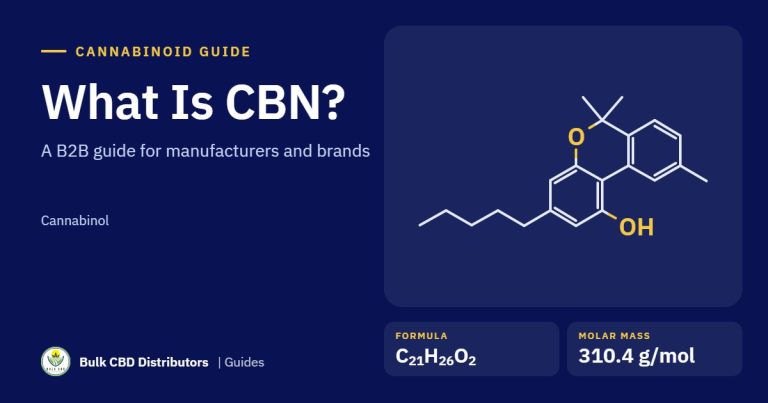
Many cannabinoids are solids in pure form. PubChem lists cannabinol (C21H26O2, molecular weight about 310.4 g/mol) with a melting point of 169 to 171 F, or roughly 76 to 77 C. That means pure CBN wants to be a solid at room temperature. Distillate stays liquid only because the target cannabinoid is mixed with other cannabinoids and plant compounds that disrupt its ability to line up into a crystal lattice.
When the target cannabinoid's share of the oil rises far enough, that disruption weakens. Molecules start to pack together, a few seed crystals form, and more material builds on them over days or weeks. This is the same reason high-purity CBD distillate can "sugar" in the drum. Several conditions raise the risk:
- High concentration of a single cannabinoid in the oil.
- Cold storage, especially below about 10 C (50 F), which slows molecular motion and favors crystal growth.
- Time, because crystallization often starts slowly and shows up weeks after production.
- Seed points such as scratches, particles or existing crystals in a container or cartridge.
- Temperature cycling during shipping and warehousing.
CBN itself forms in the plant and in stored extract as THC oxidizes and ages. Commercial CBN ingredients are made mainly by converting other hemp cannabinoids to CBN, then distilling and refining the result. Once it is concentrated, the crystallization behavior above becomes a production issue that formulators have to manage.
What Does Crystal Resistant Processing Change?
Crystal resistant processing does not change the CBN molecule. It changes the composition of the oil around it. The product is distilled and then balanced so CBN sits in a controlled range, typically 45 to 60%+, alongside a calibrated share of other cannabinoids. That mix keeps CBN molecules from packing into crystals under normal handling conditions.
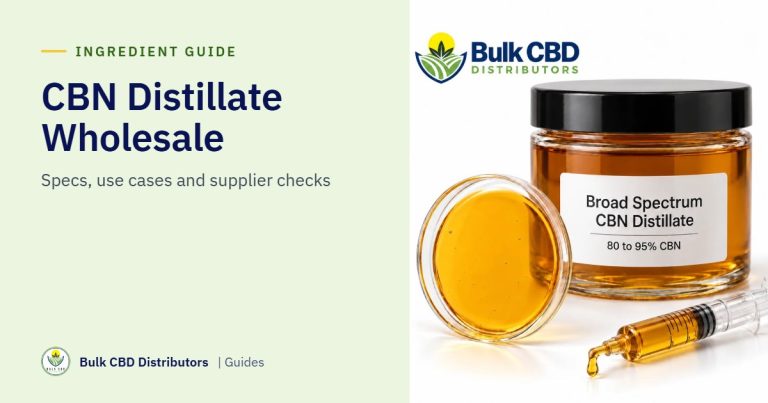
The trade-off is simple. You get a lower headline CBN percentage in exchange for an oil that stays flowable through manufacturing, packaging and the product's shelf life. Standard broad spectrum CBN distillate typically tests at 80 to 95% CBN, and CBN isolate at 99% or higher, but both can create crystal problems in liquid formats if they are not formulated carefully.
Crystal resistant CBN still has limits. Extended storage below about 10 C can trigger gradual crystallization in any cannabinoid-rich oil, so BCD recommends storing it between 15 and 25 C (59 to 77 F) and avoiding long-term refrigeration. The same concept applies to other crystal resistant distillates, which our CBD distillate guide covers for CBD.
Crystal Resistant CBN vs. Other CBN Forms
| Factor | Crystal resistant CBN | Broad spectrum CBN distillate | CBN isolate |
|---|---|---|---|
| Typical CBN | 45 to 60%+ | 80 to 95% | 99%+ |
| Physical state | Flowable oil | Viscous oil, can crystallize | Solid powder |
| Crystal risk in liquids | Low under normal storage | Moderate | Depends on carrier and dose |
| Best fit | Vapes, liquid fills, long shelf life | Tinctures, softgels, edibles | Exact-dose and dry formats |
| Dose math | More oil per mg of CBN | Moderate oil per mg | Least material per mg |
Which Product Formats Benefit Most?
Crystal resistant CBN helps wherever crystals would block equipment, change the look of a product, or make dosing uneven. The benefit is about processing and stability, not about how the finished product is positioned.
- Vape cartridges: the main application. Crystals forming inside cartridge hardware can block airflow and make units unusable, so a flowable input matters most here.
- Tinctures: long-shelf-life tinctures can show crystal sediment over months if a high-CBN input is used near its limit. Crystal resistant input reduces that risk.
- Gummies: a flowable oil is easier to meter into the depositor and blends more evenly into the batch at production temperatures.
- Softgels and capsules: automated fill lines need consistent viscosity. Crystals in the fill oil can interrupt a run.
- Topicals: crystal precipitate in a balm or cream affects texture and appearance.
For dry formats such as powder capsules or tablets, CBN isolate is often the simpler choice, since there is no liquid phase for crystals to form in.
How Do You Specify It on a Purchase Order?
A clear purchase order prevents a mismatch between what your production team expects and what arrives. Include these lines:
- Product name and form: "Crystal resistant CBN distillate, flowable oil." Do not simply write "CBN distillate," which could mean a standard high-CBN grade.
- CBN range: state the acceptable range, for example "CBN 45 to 60%+ by HPLC," and the minimum you will accept.
- THC limit: specify total THC (Delta-9 plus THCA multiplied by 0.877, plus Delta-8 and other THC isomers), not Delta-9 alone, and the maximum allowed for your finished product plan.
- Physical acceptance criteria: "No visible crystals at receipt when held at 20 to 25 C." This gives you a clear basis to reject a lot.
- Documents: batch COA for the lot shipped, with the lot number matching the container label.
- Quantity and packaging: total weight and preferred container sizes, so you can open only what a production run needs.
What Should You Check on the COA?
Review the batch COA for crystal resistant CBN in this order:
- Lot match. Product name, lot number and test date should match your container.
- CBN potency. Confirm CBN falls in the 45 to 60%+ range you ordered. A result far above that range may mean a standard grade was shipped.
- Full cannabinoid panel. Read every line, including CBD, CBG, CBC, Delta-9 THC and THCA. The other cannabinoids are part of what makes the product crystal resistant, so they should be present and listed.
- Total THC. Recalculate total THC yourself. CBN products can carry measurable THC, so this line deserves extra attention.
- Residual solvents. Results within USP 467 limits.
- Contaminants. Heavy metals, pesticides and microbial results, each marked pass.
- Lab credentials. An ISO 17025-accredited lab independent of the seller. Many buyers also require a DEA-registered third-party laboratory.
Product page COAs are usually representative, so ask for the batch COA for the lot you receive. Our guide to reading a hemp COA explains each section in detail.
Price Versus Standard CBN Distillate and Regulatory Status
Crystal resistant CBN can look cheaper or more expensive depending on how you measure it. Per kilogram, crystal resistant CBN can list below broad spectrum CBN distillate. But crystal resistant CBN carries less CBN per gram, so the useful comparison is cost per gram of CBN delivered, not cost per kilogram of oil.
A simple way to compare:
- Take the price per kilogram from each quote.
- Multiply 1,000 g by the CBN percentage on each lot COA to get grams of CBN per kilogram.
- Divide price by grams of CBN to get cost per gram of CBN.
Then add the cost of problems avoided. If a standard grade causes even a small share of cartridges or tincture bottles to show crystals, the cost of rework, returns or scrap can outweigh a small price difference. Volume tiers also matter: per-kilogram prices drop at larger sizes, so consolidating CBN demand across SKUs improves the math.
Regulatory Status
CBN from hemp may remain federally legal, though its status under Section 781 of P.L. 119-37 is less settled, because most commercial CBN is converted from other cannabinoids. FDA has been directed to publish lists of cannabinoids, including those with effects similar to THC, and it has not yet published its similar-effects list, so CBN's status depends in part on that list. Section 781 also counts total THC, including THCA, toward the hemp definition and caps final products at 0.4 mg per container of total THC and similar cannabinoids. Ask suppliers to document how their CBN was produced, and see the Congressional Research Service summary of Section 781 for an overview of the law.
What This Means for Your Business
Crystal resistant CBN is a production tool. If your product is a vape, a long-shelf-life tincture, a gummy run or a liquid-fill capsule, it reduces the risk that crystals disrupt production or show up on the shelf. Specify it clearly on the purchase order, check the CBN range and total THC on every batch COA, compare cost per gram of CBN rather than per kilogram, and store it at room temperature. For background on the molecule and the wider CBN market, read What Is CBN? A B2B Guide and our CBN distillate wholesale guide.
Compare Current Crystal Resistant CBN Specs and COAs
Current sizes and a representative COA from an ISO 17025-accredited third-party laboratory are on the crystal resistant CBN distillate page. At BCD, the batch COA ships with every order, MOQs are 100g to 1kg depending on the product, and most orders ship within a few days. If you have questions about which CBN form fits your format, we are glad to help.
Frequently Asked Questions
What is crystal resistant CBN?
It is CBN distillate processed and balanced to stay a flowable oil instead of crystallizing. It typically tests at 45 to 60%+ CBN.
Why is the CBN percentage lower than standard distillate?
Keeping CBN in a controlled range alongside other cannabinoids is what prevents crystals from forming. The lower headline number is the design trade-off for stability.
Does crystal resistant CBN ever crystallize?
It resists crystallization under normal storage, but long exposure to cold, below about 10 C, can still cause gradual crystals. Store it at 15 to 25 C.
Which products use crystal resistant CBN?
Vape cartridges are the main use. It is also used in tinctures, gummies, softgels, capsules and topicals where a flowable input simplifies production.
How do I order crystal resistant CBN correctly?
Name the product as crystal resistant CBN distillate, state the CBN range and total THC limit, add a no-visible-crystals acceptance line, and require the batch COA.
What should I check on the COA?
Lot match, CBN within 45 to 60%+, the full cannabinoid panel, total THC, residual solvents, heavy metals, pesticides and microbials from an accredited third-party lab.
Is crystal resistant CBN cheaper than standard CBN distillate?
Per kilogram it can list lower, but it carries less CBN per gram. Compare cost per gram of CBN using each lot's potency.
What is the minimum order?
MOQs are 100g to 1kg depending on the product; current sizes are listed on the product page.
Is CBN legal under Section 781?
CBN may remain federally legal, though its status under Section 781 is less settled, because most commercial CBN is converted from other cannabinoids and FDA has not yet published its similar-effects list. Finished products must also meet the total THC and per-container limits.
What is the melting point of CBN?
PubChem lists cannabinol with a melting point of 169 to 171 F, about 76 to 77 C, which is why concentrated CBN tends to crystallize.