CBN distillate is a concentrated hemp-derived oil in which cannabinol is the primary cannabinoid, typically 80 to 95% CBN in broad spectrum grades and 45 to 60%+ CBN in crystal resistant grades designed to stay flowable. Wholesale buyers use it in tinctures, softgels and capsules, gummies, and vape cartridges, and they judge it on CBN potency, total THC, minor cannabinoid profile, color, viscosity, and contaminant results. This guide covers CBN distillate specs, the formats it goes into, what to check on the COA, what drives pricing, and how to vet a supplier. For current lots, see bulk CBN distillate.
What Is CBN Distillate?
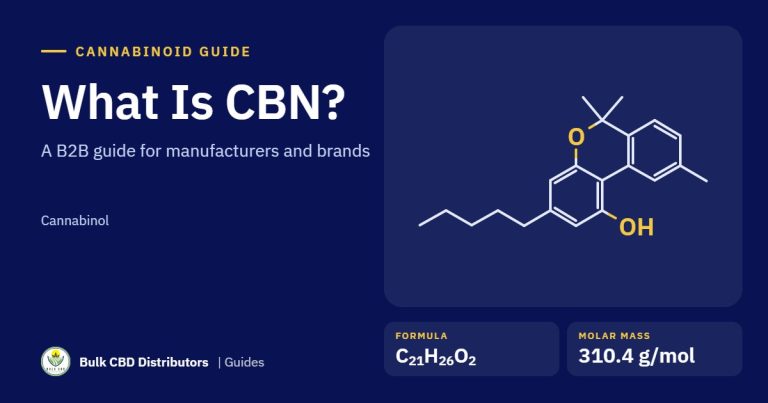
CBN distillate is produced from hemp extract that has gone through controlled conversion to raise its cannabinol content, followed by winterization, short-path or wiped-film distillation, and, where needed, chromatographic remediation to reduce residual THC. The result is a viscous gold to amber oil in which CBN is the dominant cannabinoid, with smaller amounts of other hemp cannabinoids and terpenes retained. If you are new to the ingredient, our guide What Is CBN? A B2B Guide for Manufacturers and Brands explains the chemistry and regulatory status in detail.
Compared with CBN isolate, distillate keeps a broader cannabinoid profile and is easier to work into oil-phase products without a dissolving step. Compared with crude, it is far cleaner and ready for formulation. That middle position is why distillate is the most common CBN input for liquid and softgel products.
CBN Distillate Specs: Potency, Profile, Color, and Viscosity
| Spec | Broad spectrum CBN distillate | Crystal resistant CBN distillate |
|---|---|---|
| CBN content | 80 to 95% | 45 to 60%+ |
| Delta-9 THC | 0.3% or less dry weight; frequently non-detect | 0.3% or less dry weight |
| Minor cannabinoids | Retained alongside CBN | Calibrated to resist crystallization |
| Appearance | Viscous gold to amber oil | Flowable oil at room temperature |
| Crystallization | Can crystallize at high CBN levels | Engineered to resist |
| Sealed shelf life | 18 to 24 months | 18 to 24 months |
Potency
Potency is the main specification. Broad spectrum CBN distillate typically assays at 80 to 95% CBN; crystal resistant grades sit at 45 to 60%+ by design. Always work from the lot COA value. A 65% lot and a 78% lot at the same price per kilogram are very different buys.
Minor Cannabinoids
The non-CBN fraction usually includes other hemp cannabinoids carried through distillation. That fraction is a feature for multi-cannabinoid products and a variable to control for single-cannabinoid labels. Ask for the full panel, not just CBN and THC, and make sure the sum of identified cannabinoids is reasonable for the stated grade.
Color and Viscosity
Color ranges from light gold to darker amber. Darker oil can reflect more retained compounds or heat history, but color alone does not grade quality; the COA does. Viscosity matters on the production floor. Broad spectrum CBN distillate is thick at room temperature and usually needs gentle warming to pour and meter accurately. Confirm the viscosity at your fill temperature before you schedule a run.
When Should You Choose Crystal Resistant CBN Distillate?
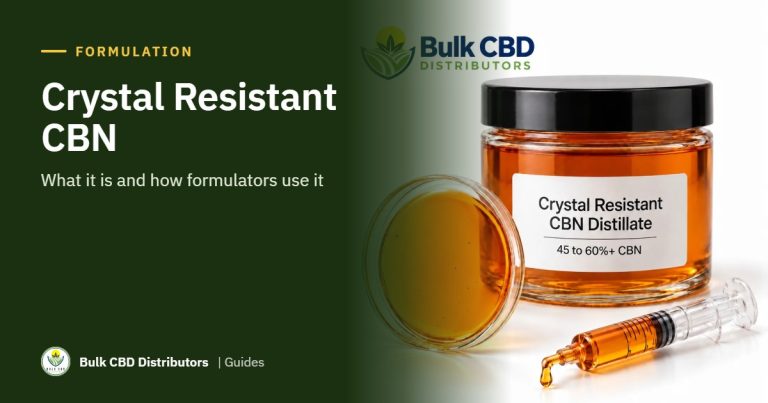
CBN at high concentration tends to form crystals in liquid systems over time. In a tincture that shows up as sediment or haze; in a vape cartridge it can block airflow and make the hardware fail. Crystal resistant CBN distillate solves this with a controlled cannabinoid balance at 45 to 60%+ CBN that disrupts the conditions that trigger crystallization, so the oil stays flowable through manufacturing, packaging, and shelf life.
The trade-off is a lower headline CBN percentage. Choose crystal resistant grades when:
- The product is a cartridge or any format where crystals cause a hardware or appearance failure.
- Finished liquids will see temperature swings in shipping or storage.
- You want a flowable input that can be dispensed without repeated heating.
Choose broad spectrum 80 to 95% grades when the product is a softgel, edible, or tincture at moderate loading and you prefer more CBN per gram of input. When in doubt, run a 30-day hold test at your expected storage temperature with both grades.
Product Formats That Use CBN Distillate
The descriptions below cover formulation and handling only. Label copy for any CBN product should describe the ingredient and amount per serving, not effects.
- Tinctures: distillate dissolves directly into MCT or other carrier oils. Calculate grams of distillate from the target milligrams per bottle divided by lot potency. Use crystal resistant grades or moderate loading if recrystallization appears in hold tests.
- Softgels and capsules: distillate in a carrier oil is a standard fill. Its viscosity may call for slightly warmer fill temperatures; confirm against your encapsulation equipment.
- Gummies and edibles: distillate is added to the oil or fat phase or pre-blended with an emulsifier before depositing. For aqueous systems, a water soluble CBN form at around 20% is often easier.
- Vape cartridges: crystal resistant distillate is the usual choice because crystallization inside hardware is the main failure mode. Test with your specific hardware before scaling.
- Topicals: distillate goes into the oil phase of balms and creams, typically at 0.5 to 3% by weight.
Whatever the format, test finished batches with a third-party lab for potency and total THC before release.
What Should You Check on a CBN Distillate COA?
Require a lot-specific COA from an ISO 17025-accredited, DEA-registered third-party laboratory, and check these items in order.
- Total THC. Calculated as Delta-9 + Delta-8 + (THCA x 0.877). Because CBN is made from THC, this is the first number to read. A COA showing only Delta-9 is not sufficient.
- CBN potency against the grade you ordered: 80 to 95% for broad spectrum, 45 to 60%+ for crystal resistant.
- Full cannabinoid panel, so you know what the rest of the oil contains.
- Residual solvents under USP 467 limits.
- Heavy metals, pesticides, and microbials, each with individual analyte results.
- Lot and sample ID matching the material you receive, and a test date recent enough for your QA program.
Our step-by-step guide to reading a hemp COA shows how to verify a lab's accreditation scope and spot common COA problems.
What Drives CBN Distillate Pricing?
- Potency: higher CBN percentage means more cannabinoid per kilogram. Normalize every quote to cost per gram of CBN using the lot COA.
- Grade: crystal resistant formulation adds a processing step; broad spectrum grades with THC remediation add chromatography cost.
- Conversion capacity: CBN supply depends on conversion and purification capacity rather than harvest volume, so prices can move faster than CBD prices when demand changes.
- Volume: per-gram pricing falls as you move from 100g and 500g sizes to 1kg, 5kg, and larger quoted volumes.
- Documentation: full-panel, lot-specific testing costs money. An unusually low quote often means something in the documentation or the oil is missing.
A simple worked example: at the same price per kilogram, an 80% lot delivers 800 g of CBN per kilogram and a 70% lot delivers 700 g, so the 80% lot gives about 14% more CBN per dollar. Do this math for every quote before comparing suppliers.
How Do You Vet a CBN Distillate Supplier?
- Batch COA with every order, matched to the lot shipped, from an ISO 17025-accredited third-party lab.
- Total THC transparency. The supplier should report all THC fractions and explain how remediation is handled.
- Regulatory awareness. CBN's status under Section 781 is less settled than CBD's: most commercial CBN is converted from other hemp cannabinoids, the law excludes cannabinoids manufactured outside the plant, and the FDA has not yet published its similar-effects list. A good supplier will say so plainly rather than overpromise. See our 2026 hemp law guide and the Congressional Research Service summary.
- Clear grades. The supplier should state whether a product is broad spectrum or crystal resistant and give the CBN range for each.
- Consistent lot-to-lot potency, so you are not recalculating formulas mid-production.
- Straightforward ordering terms. The supplier should state MOQ, lead time and payment terms in writing, and confirm the lot and its batch COA before you pay.
Our guide to vetting a legitimate B2B supplier covers the general checklist. You can review all CBN formats in the CBN category.
What This Means for Your Business
Choosing CBN distillate comes down to matching grade to format. Use crystal resistant 45 to 60%+ distillate for cartridges and any liquid that must stay flowable; use broad spectrum 80 to 95% distillate for softgels, edibles, and moderate-loading tinctures. Read total THC first on every COA, normalize quotes to cost per gram of CBN, and run hold tests before scaling. Because CBN's federal position depends on an FDA list that has not been published, keep production flexible and documentation complete. Handled that way, CBN distillate is a practical ingredient for multi-cannabinoid product lines.
Compare Current CBN Distillate Grades and COAs
Current sizes and representative COAs for both grades are on the bulk CBN distillate page, including crystal resistant CBN distillate. At BCD, the batch COA ships with every order, MOQs are 100g to 1kg depending on the product, and most orders ship within a few days. If you are unsure which grade fits your format, we are glad to help.
Frequently Asked Questions
What is CBN distillate?
A concentrated hemp-derived oil in which CBN is the primary cannabinoid, typically 80 to 95% CBN for broad spectrum grades and 45 to 60%+ for crystal resistant grades.
What is the difference between CBN distillate and CBN isolate?
Isolate is 99%+ CBN as a crystalline powder with other compounds removed. Distillate is an oil that keeps other hemp cannabinoids alongside CBN and needs no dissolving step.
Why is crystal resistant CBN distillate only 45 to 60%+ CBN?
The lower CBN level and calibrated minor cannabinoid content are what keep the oil from crystallizing. The trade-off is less CBN per gram in exchange for reliable flow.
Which CBN distillate is best for vape cartridges?
Crystal resistant CBN distillate, because crystallization inside cartridge hardware is the main failure mode. Test with your specific hardware first.
Can CBN distillate be used in gummies?
Yes. Add it to the oil or fat phase, or pre-blend with an emulsifier. For water-based systems, water soluble CBN at around 20% is often simpler.
What color should CBN distillate be?
Usually gold to amber. Color alone does not grade quality; potency, total THC, and contaminant results on the COA do.
What is the most important line on a CBN distillate COA?
Total THC, calculated as Delta-9 + Delta-8 + (THCA x 0.877). Then confirm CBN potency against the grade you ordered.
How should I store CBN distillate?
Sealed, cool, dry, and away from light. Sealed CBN distillate is listed at an 18 to 24 month shelf life under proper conditions.
Is CBN distillate legal under Section 781?
CBN may remain federally legal, but its status under Section 781 is less settled. The FDA has not yet published its similar-effects list, so its final status will be confirmed once that list appears.
What is BCD's minimum order for CBN distillate?
MOQs run 100g to 1kg depending on the product. Most orders ship the same or next day once payment is received.