The types of CBD products fall into two groups: ingredients, such as CBD isolate, distillates, water soluble CBD and crude oil, and finished goods, such as tinctures, gummies, topicals and drinks. A B2B buyer usually works in one group or bridges both, for example a brand that buys isolate for its own tinctures and finished gummies for its shelves. This guide maps every major type, what it is used for and who buys it, so you can plan a product line or an order of wholesale CBD products with the right inputs.
| Spec | At a glance |
|---|---|
| Ingredient types | Isolate, broad, full and crystal resistant distillate, water soluble, crude |
| Finished formats | Tinctures, gummies, topicals, drinks, softgels, flower |
| Ingredient MOQs | 100g to 1kg depending on the product |
| Key document | The batch COA, for the ingredient and the finished product |
Ingredients vs Finished Goods: The Two Groups of CBD Products
| Feature | CBD ingredients | Finished CBD goods |
|---|---|---|
| What it is | Concentrated CBD measured in percent | Consumer products with a set mg per unit |
| Examples | Isolate, distillates, water soluble, crude | Tinctures, gummies, topicals, drinks, flower |
| Who buys | Manufacturers, formulators, co-packers, brands | Retailers, distributors, online stores |
| Sold by | The gram and kilo | The unit, case or display |
| Key document | Batch COA of the concentrate | Batch COA of the finished product |
Many wholesale orders mix the two: a brand might buy isolate for its own oil line and finished gummies for its retail shelves.
CBD Ingredient Types
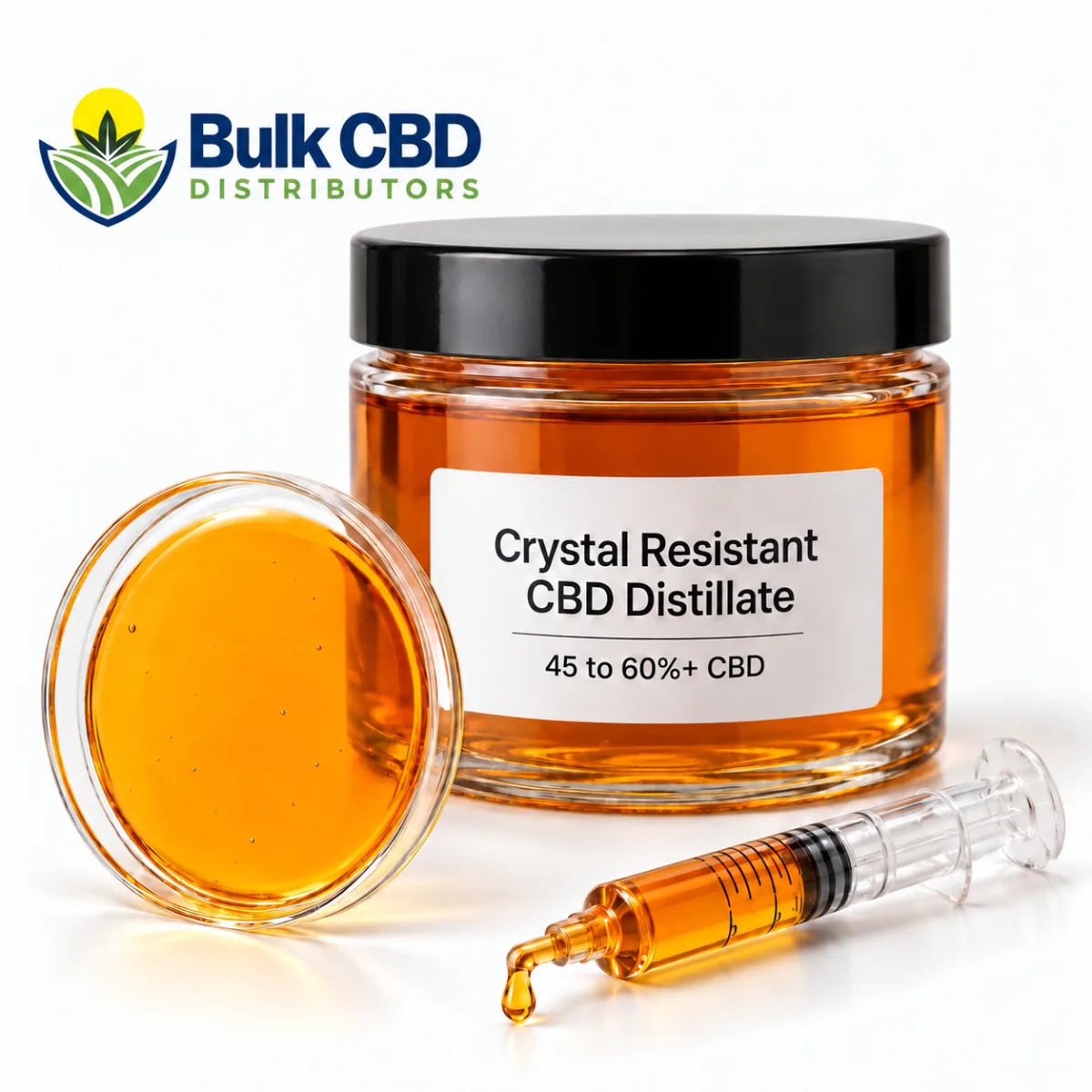
Ingredients are where CBD is measured and priced. Each type has a different potency, form and best use.
| Type | Typical spec | Form | Main uses |
|---|---|---|---|
| CBD isolate | 99%+ CBD, non-detect Delta-9 THC | Crystalline powder | Tinctures, edibles, topicals, THC-free products |
| Broad spectrum CBD distillate | 80 to 95% CBD with minor cannabinoids | Viscous oil | Oils, softgels, edibles; Standard (0.3% or less Delta-9) or Non-Detect THC |
| Full spectrum CBD distillate | 75 to 85%+ CBD, natural profile | Viscous oil | Processors and whole-plant products; Standard or Compliant |
| Crystal resistant CBD distillate | 45 to 60%+ CBD | Oil that stays liquid | Cartridges and high-strength oils |
| Water soluble CBD | About 20%, 80nm particle size | Powder or liquid | Drinks, gummies, drink mixes |
| CBD crude oil | 50 to 70% CBD, winterized | Dark, thick extract | Further refining into distillate or isolate |
Distillates are the workhorse of the category, and our CBD distillate collection covers broad, full spectrum and crystal resistant grades. For the spectrum question in depth, read our full spectrum vs broad spectrum vs isolate guide. For drinks and gummies, our water soluble CBD guide explains how nanoemulsions work.
Finished CBD Product Types
Finished goods are built from the ingredients above. Each format has its own buyers, margins and compliance points.
Oils and tinctures
The most familiar CBD product: a concentrate dissolved in MCT or another carrier, sold in dropper bottles with a set mg per bottle. Tinctures are simple to make and easy for customers to understand. See our CBD tinctures for wholesale retail options.
Gummies and edibles
Gummies are one of the most popular CBD formats on retail shelves because they are pre-measured and familiar. They are made with isolate, broad spectrum or water soluble CBD. Browse CBD gummies for retail-ready lines.
Topicals and skin care
Creams, balms, gels and lotions use isolate or distillate in a cosmetic base. Topicals sell well in wellness, spa and pharmacy channels, and they need careful label language. See our CBD topicals.
Beverages
Canned drinks, shots and drink mixes rely on water soluble CBD, because standard CBD oil separates in water. Drinks are a format many brands are adding to their lines.
Softgels and capsules
Pre-measured CBD in a capsule or softgel, usually made with isolate or broad spectrum distillate. They are common in supplement channels.
Flower and pre-rolls
Dried hemp flower with high CBD, sold loose or pre-rolled. Flower is a separate category from extracts, and buyers should check how the total THC definition in Section 781 applies before planning a line for 2027.
Which Buyers Use Which CBD Products?
| Buyer | Usually buys | Why |
|---|---|---|
| Manufacturers and formulators | Isolate, distillates, water soluble | Full control over strength, taste and cost |
| Brands without a facility | White label or private label finished goods | Launch under their name without production |
| Retailers and smoke shops | Retail-ready tinctures, gummies, topicals | Shelf-ready products with set prices |
| Extraction labs and processors | Crude oil, full spectrum distillate | Inputs for refining and remediation |
| Beverage and edible makers | Water soluble CBD, isolate | Ingredients that mix into water and sugar bases |
If you want finished goods under your own name, our white label and private label program bridges the two groups. If you want ready-to-sell products from established brands, browse our Retail Ready collection.
Mixing ingredients and finished goods in one order?
Many buyers combine isolate or distillate with retail-ready lines. Ingredient MOQs run 100g to 1kg depending on the product. Request a wholesale quote with the products and volumes you need.
How to Choose the Right CBD Product Type
Four questions narrow the choice quickly:
- Do you have production capacity? If yes, buy ingredients. If not, buy finished or white label goods.
- Does your label need to be THC-free? Use isolate or non-detect broad spectrum.
- Is the product water based? Use water soluble CBD for drinks and many gummies.
- Will it sell after December 11, 2026? From that date, Section 781 of P.L. 119-37 limits finished hemp consumer products to 0.4 mg total THC per container, whatever the cannabinoid, which favors isolates and non-detect distillates.
The Congressional Research Service summary covers the law, and our 2026 hemp law guide explains what it means for bulk buyers.
How Are Different CBD Product Types Tested?
Every type needs a COA, but the numbers that matter change with the format. For ingredients, the COA reports potency in percent or mg/g, plus Delta-9 and total THC, residual solvents, heavy metals, pesticides and microbials. For finished goods, the lab reports CBD per unit, such as mg per mL for a tincture, mg per piece for a gummy or mg per can for a drink, and total THC per container. When you buy both, keep the ingredient COA and the finished product COA together for each lot, because retailers and marketplaces may ask for either. Our guide to reading a hemp COA explains each section.
Beyond CBD: Minor Cannabinoid Products
The same product types exist for CBG, CBN, CBC and CBDV, as isolates, distillates and finished goods. Brands add them to differentiate a line, for example CBD with CBN in an evening tincture or CBD with CBG in a daytime gummy. Our minor cannabinoids guide covers each one.
How BCD Supplies Both Groups
BCD has been in the hemp industry since 2020 and carries ingredients and finished products in one place. We work directly or indirectly with major hemp ingredient manufacturers, distributors and brands, so we can choose the lots and lines we carry. Ingredients are third-party tested in ISO 17025-accredited labs, and the batch COA ships with every order.
An order on our site is a request, not a checkout. We confirm what is in stock and what it costs, then you pay. Most ingredient orders ship the same or next day after payment, some take up to 72 business hours, and boxes ship blind.
What This Means for Your Business
- Know which group you buy in. Ingredients and finished goods are priced, tested and compared differently.
- Match the input to the format. Isolate for precision, distillates for a fuller profile, water soluble for drinks and gummies.
- Use white label to bridge the gap if you want your own brand without production.
- Plan your 2027 range now around the total THC cap for finished products.
Frequently Asked Questions
What are the main types of CBD products?
CBD products split into ingredients, such as isolate, distillates, water soluble CBD and crude oil, and finished goods, such as tinctures, gummies, topicals, drinks, softgels and flower.
What are the types of CBD?
By spectrum, CBD comes as isolate (CBD only), broad spectrum (CBD with minor cannabinoids, THC reduced) and full spectrum (the plant's natural profile, including some Delta-9 THC).
Which CBD product type is best for manufacturers?
Manufacturers usually buy isolate or distillate because they control strength, taste and cost. Beverage and edible makers often add water soluble CBD.
What is the difference between CBD isolate and CBD distillate?
Isolate is a 99%+ pure CBD powder with no other cannabinoids. Distillate is a viscous oil, usually 45 to 95% CBD depending on the grade, that keeps minor cannabinoids and some terpenes.
What CBD product type is best for drinks?
Water soluble CBD. Standard CBD oil separates in water, while water soluble CBD is emulsified to mix evenly into drinks and water-based products.
What is CBD crude oil used for?
CBD crude is an in-process extract, 50 to 70% CBD, used by processors who refine it into distillate or isolate. It is not usually used directly in finished products.
Can I sell CBD products under my own brand?
Yes, through white label or private label programs, or by buying bulk ingredients and making the products yourself or with a co-packer.
Which CBD products are affected by Section 781?
From December 11, 2026, finished hemp consumer products are limited to 0.4 mg total THC per container. Bulk ingredients are a separate stage, but the cap shapes which inputs finished products can use.
Are there CBG and CBN versions of these products?
Yes. CBG, CBN, CBC and CBDV come as isolates, distillates and finished goods, and are often blended with CBD.
What is the minimum order for CBD ingredients at BCD?
Ingredient minimums run 100g to 1kg depending on the product, with sizes up to 100kg on most ingredients.