CBG distillate is a concentrated hemp extract containing 80 to 95% cannabigerol, produced by extracting CBG-dominant hemp plant material and refining the crude through winterization, decarboxylation, and distillation. It sits between CBG crude and CBG isolate in the processing chain: more refined than crude, retaining minor cannabinoids and terpenes unlike isolate, and available at a per-gram-of-CBG cost that is typically 20% to 40% lower than isolate-grade material. It is a common choice for formulators who want a multi-cannabinoid CBG ingredient without the handling requirements of isolate. This guide covers how CBG distillate is made, how it is priced, what to look for on the COA, and where it performs best in formulation. Current grades, specs and COAs are on the CBG distillate page.
| Spec | Broad spectrum CBG distillate |
|---|---|
| Potency | 80 to 95% CBG (batch-dependent; see the lot COA) |
| Form | Gold to amber oil with minor cannabinoids retained |
| Delta-9 THC | 0.3% or less, frequently non-detect |
| Typical sizes | Usually sold from 100g to 1kg upward |
What CBG Distillate Is
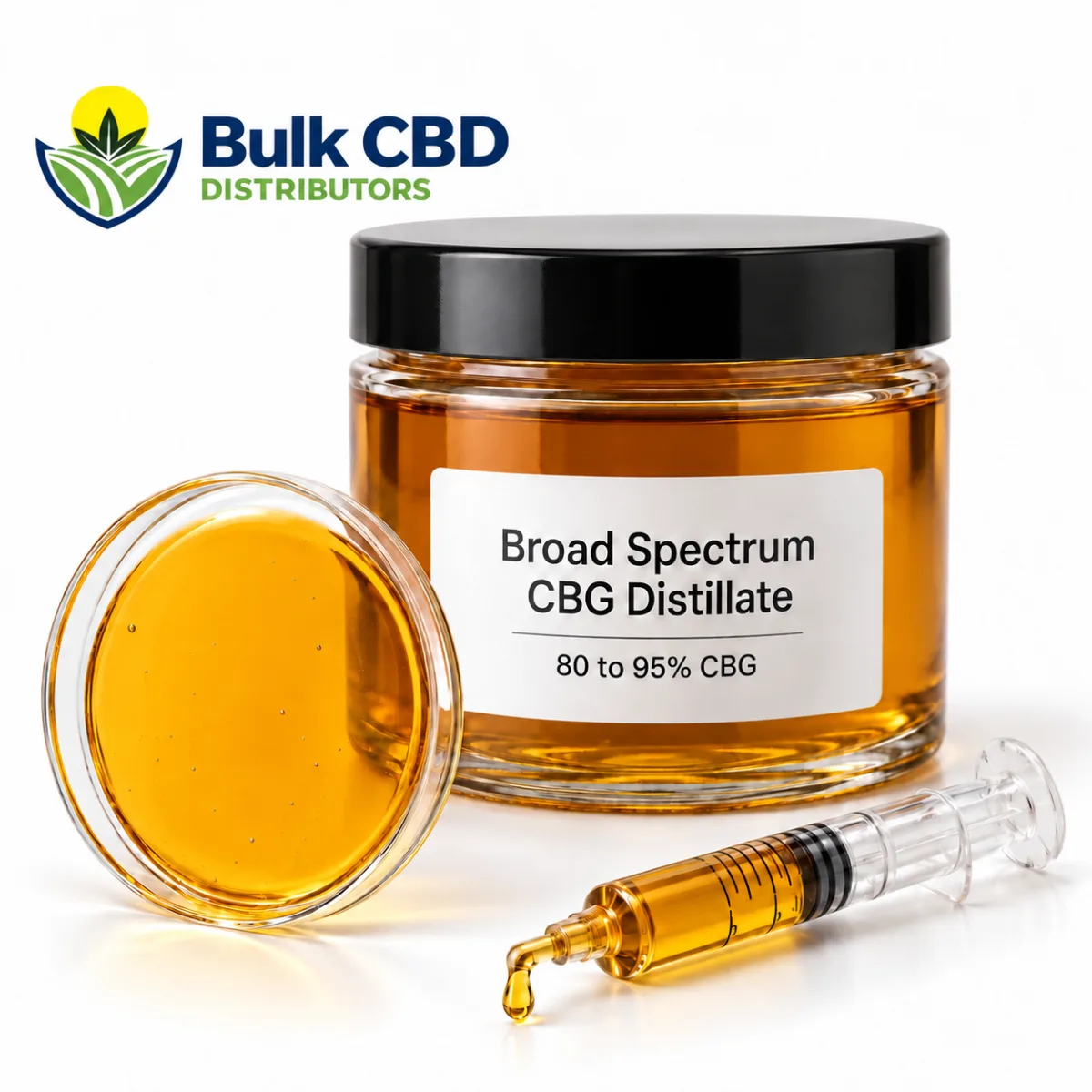
CBG distillate begins as raw extract from CBG-dominant hemp biomass or flower. That crude material undergoes winterization to remove plant waxes and lipids, decarboxylation to convert CBGA to CBG, and short-path or wiped-film distillation to concentrate CBG and separate it from heavier plant compounds. The result is a thick, golden to amber oil with 80 to 95% CBG by weight and a residual minor cannabinoid and terpene profile reflecting the source material.
CBG distillate is not clear the way CBD distillate sometimes appears in high-refinement lots. Quality is evaluated by the COA, not by color.
CBG Distillate vs. CBD Distillate: The Price and Why It Exists
CBG distillate consistently commands a 2x to 5x premium over comparable CBD distillate on a per-gram-of-cannabinoid basis. The premium has the same structural causes as all CBG pricing: specialized genetics, lower yield per acre, and a smaller processing infrastructure. A buyer evaluating CBG distillate pricing should confirm the CBG% on the lot-specific COA and normalize to a cost-per-gram-of-CBG basis before comparing quotes. A 75% CBG distillate and an 85% CBG distillate at the same per-kg price are not equivalent; the 85% lot delivers more CBG per dollar of spend.
The economics are real and not transitional. Buyers building products around CBG distillate should plan for the premium to persist and price their finished products accordingly rather than waiting for CBG prices to reach CBD levels. Understanding why CBG costs what it costs is part of building a defensible CBG product business.
Typical Specs and COA Review Points
A quality wholesale CBG distillate lot will show:
CBG%: 80 to 95% by weight. This is the primary specification. Lots below 65% are not distillate-grade by most definitions. Confirm the specific lot percentage from the COA before accepting any order.
Residual CBD: The most common secondary cannabinoid, typically 3% to 15% depending on the source genetics and distillation cut. For formulations where residual CBD complements the CBG, this is a feature. For formulations requiring single-cannabinoid CBG precision, CBG isolate is the more appropriate form.
Total THC: Non-detect on delta-9, delta-8, and THCA from an ISO 17025-accredited, third-party, DEA-registered laboratory. CBG distillate should show total THC within spec, and many lots test non-detect; confirm on the lot COA, because distillation concentrates THC.
Residual solvents: Confirm the residual solvents panel shows USP Class 3 limits at minimum.
| COA item | What to look for |
|---|---|
| CBG% | 80 to 95% by weight on the lot-specific COA |
| Residual CBD | Typically 3% to 15%, depending on source genetics and distillation cut |
| Delta-9 THC | 0.3% or less; broad spectrum lots are frequently non-detect |
| Residual solvents | Within USP Class 3 limits at minimum |
| Testing lab | ISO 17025 accredited third-party laboratory; ask for the batch COA with every order |
Formulation Applications
CBG distillate is the preferred CBG form for most liquid-phase formulations due to its oil-phase compatibility and lower per-gram cost relative to isolate:
Multi-cannabinoid tinctures: CBG distillate at 5 mg to 30 mg per serving blended with CBD distillate or broad-spectrum oil creates a multi-cannabinoid profile that can be labeled and marketed as such. The retained terpene fraction in CBG distillate contributes to the tincture's flavor profile and its full-panel COA character.
Topical formulations: Oil-phase CBG distillate is compatible with most topical base systems. The minor cannabinoid retention makes CBG distillate a more complete ingredient for topicals where the multi-cannabinoid story is part of the product positioning.
Softgel manufacturing: CBG distillate in MCT or another carrier oil is a standard formulation approach for CBG softgels. The higher viscosity of CBG distillate relative to CBD distillate at room temperature may require slightly warmer fill temperatures. Confirm your equipment's operating range against the material's viscosity at your fill temperature before committing to a production run.
| Format | Typical CBG | Physical form | Where it fits |
|---|---|---|---|
| Broad spectrum CBG distillate | 80 to 95% | Gold to amber oil | Tinctures, topicals and softgels where minor cannabinoids are welcome |
| Crystal resistant CBG distillate | 45 to 60%+ | Oil formulated to stay pourable | Liquid formulas where crystallization causes problems |
| CBG isolate | 99%+ | White crystalline powder | Single-cannabinoid precision; recrystallizes readily |
| Water soluble CBG | Around 20% | Powder or liquid | Water-based formulas such as beverages and drink mixes |
From the Field
"When buyers ask why CBG distillate costs 2x to 5x more per gram than CBD distillate, I walk them through the input economics rather than just naming the price. CBG-dominant hemp genetics cost more to source and maintain. Those genetics produce fewer cannabinoid grams per acre than optimized CBD cultivars. The processing infrastructure for CBG is smaller, which means less competitive pressure on margins and less optimization of yield at scale. Every one of those cost drivers is real. A price that seems below market for CBG distillate should raise the same question it raises for any agricultural commodity sold well below its production cost: what is different about this lot, this supplier, or this documentation? In most cases the answer involves quality or verification shortcuts that the buyer discovers later. CBG distillate at fair market value from a supplier who can explain the price is a better starting point than a suspiciously low quote from one who cannot."
John Piccone, Founder, Bulk CBD Distributors
Section 781 Compliance and CBG Distillate
CBG distillate from compliant hemp feedstock is a non-intoxicating cannabinoid product generally expected to remain within the hemp definition, provided total THC limits are met, under Section 781 of P.L. 119-37. Total THC should be confirmed on each lot COA; many compliant CBG distillate lots test non-detect. Section 781 affects CBG the same way it affects CBD: total THC (including THCA) counts, cannabinoids that cannot be naturally produced by the plant are excluded from November 12, 2026, and from December 11, 2026 finished consumer products are capped at 0.4 mg total THC per container. Because broad spectrum CBG distillate can carry up to 0.3% Delta-9 THC, run the per-container math on each lot's actual result.
Is There THC-Free CBG Distillate?
Buyers often search for "THC-free" or "T-free" CBG distillate. In practice that means a broad spectrum CBG distillate: the oil goes through an extra remediation step that pulls THC down while keeping CBG and the minor cannabinoids. A typical broad spectrum CBG distillate runs 80 to 95% CBG with Delta-9 THC at 0.3% or less, and lots are frequently non-detect.
- Check the lot, not the label: "THC-free" is a marketing term. Ask for the COA showing Delta-9 THC, THCA and Delta-8 THC, with the lab's limit of quantitation (LOQ).
- Need a non-detect THC result? Use CBG isolate (99%+ CBG, non-detect THC) instead, or blend isolate into your formula.
- Finished products: run the per-container THC math on the lot's actual result, because 0.3% or less is not zero. See how to calculate THC per container.
Frequently Asked Questions
Is THC-free CBG distillate available?
Broad spectrum CBG distillate is the closest match: 80 to 95% CBG with Delta-9 THC at 0.3% or less, and lots are frequently non-detect. Confirm the lot COA. For a consistently non-detect result, use CBG isolate.
What is CBG distillate?
CBG distillate is a concentrated hemp extract containing 80 to 95% cannabigerol, produced through extraction, winterization, decarboxylation, and distillation of CBG-dominant hemp plant material. It retains a minor cannabinoid and terpene profile from the source material and is priced between CBG crude and CBG isolate.
What is the typical CBG percentage in wholesale CBG distillate?
Quality wholesale CBG distillate carries 80 to 95% CBG by weight. Lots below 65% are not typically considered distillate-grade material. Residual CBD is the most common secondary cannabinoid, typically 3% to 15%. Always confirm specific lot percentages on the COA before accepting a delivery.
How does CBG distillate differ from CBG isolate?
CBG distillate retains minor cannabinoids and terpenes from the source plant alongside 80 to 95% CBG. CBG isolate removes all other compounds, reaching 99%+ CBG purity. Distillate costs 20% to 40% less per gram of CBG than isolate and is easier to handle in liquid formulations. Isolate is appropriate when single-cannabinoid precision and purity documentation are requirements.
Why does CBG distillate cost more than CBD distillate?
CBG distillate commands a 2x to 5x premium over comparable CBD distillate per gram of cannabinoid due to specialized genetics costs, lower yield per acre from CBG-dominant cultivars, and a smaller processing infrastructure. These are structural factors that reflect the actual production economics of CBG.
Is CBG distillate compliant under Section 781 of P.L. 119-37?
CBG distillate from compliant hemp feedstock is a non-intoxicating cannabinoid ingredient generally expected to remain within the hemp definition, provided total THC limits are met, under Section 781 of P.L. 119-37. Section 781 affects CBG the same way it affects CBD: total THC (including THCA) counts, and from December 11, 2026 finished consumer products are capped at 0.4 mg total THC per container. Broad spectrum CBG distillate is 0.3% Delta-9 THC or less and frequently non-detect, so confirm the lot COA and run the per-container math.
What is the minimum order for CBG distillate at BCD?
CBG distillate at BCD starts at 100g; minimums across BCD products are 100g to 1kg depending on the product. Current sizes and the representative COA are on the CBG distillate page.
What COA panels should a CBG distillate lot have?
A complete CBG distillate COA includes: cannabinoid potency panel with CBG%, residual CBD, and total THC (non-detect across delta-9, delta-8, THCA); residual solvents within USP Class 3 limits; heavy metals; and pesticides with individual analyte results. All panels should be from an ISO 17025-accredited, third-party, DEA-registered laboratory.
What formulations use CBG distillate?
CBG distillate is used in multi-cannabinoid tinctures and sublingual formats, topical formulations, softgel manufacturing, and blended cannabinoid products where a CBG-dominant oil-phase ingredient with a minor cannabinoid profile is the requirement. It is the preferred CBG form for most liquid-phase formulations.
How should CBG distillate be stored?
Store CBG distillate in a sealed container in a cool, dry environment below 25 degrees Celsius. Like CBG isolate, CBG distillate can increase in viscosity or show crystallization tendency at lower temperatures. Gentle warming to 40 to 50 degrees Celsius restores workable viscosity without degrading the cannabinoid profile.
How does CBG distillate compare to CBD distillate in formulation behavior?
CBG distillate is thick at room temperature and thickens further as temperature drops. For formulations and filling processes optimized for CBD distillate, confirm operating temperatures work with CBG distillate's viscosity profile before scaling a CBG-based production run.
Compare CBG Distillate and Isolate Specs
You can compare current specs and COAs on the CBG distillate page, or see isolate, crystal resistant and water soluble formats on the wholesale CBG page. We are glad to help you pick the right form and put together a quote.