CBD strength is the amount of CBD in a product, stated as mg per container, mg per mL, mg per gram or mg per serving; you calculate it by dividing the total CBD by the volume, weight or number of servings. A 1,000 mg tincture in 30 mL is 33.3 mg per mL; a jar of 30 gummies at 25 mg each holds 750 mg. For manufacturers buying wholesale CBD ingredients, the same math runs backward: from the label claim to the grams of isolate or distillate each batch needs. This guide covers the formulas, worked examples for oils, gummies, drinks and topicals, and the total THC check every product will need from December 11, 2026. It is about label and batch math, not about how much anyone should take.
| Spec | At a glance |
|---|---|
| mg per mL | Total CBD mg / volume in mL |
| mg per serving | mg per mL x serving size in mL |
| Grams of input | CBD mg / (input potency x 1,000) |
| THC check | 0.4 mg total THC or less per container from December 11, 2026 |
The Units Behind CBD Strength
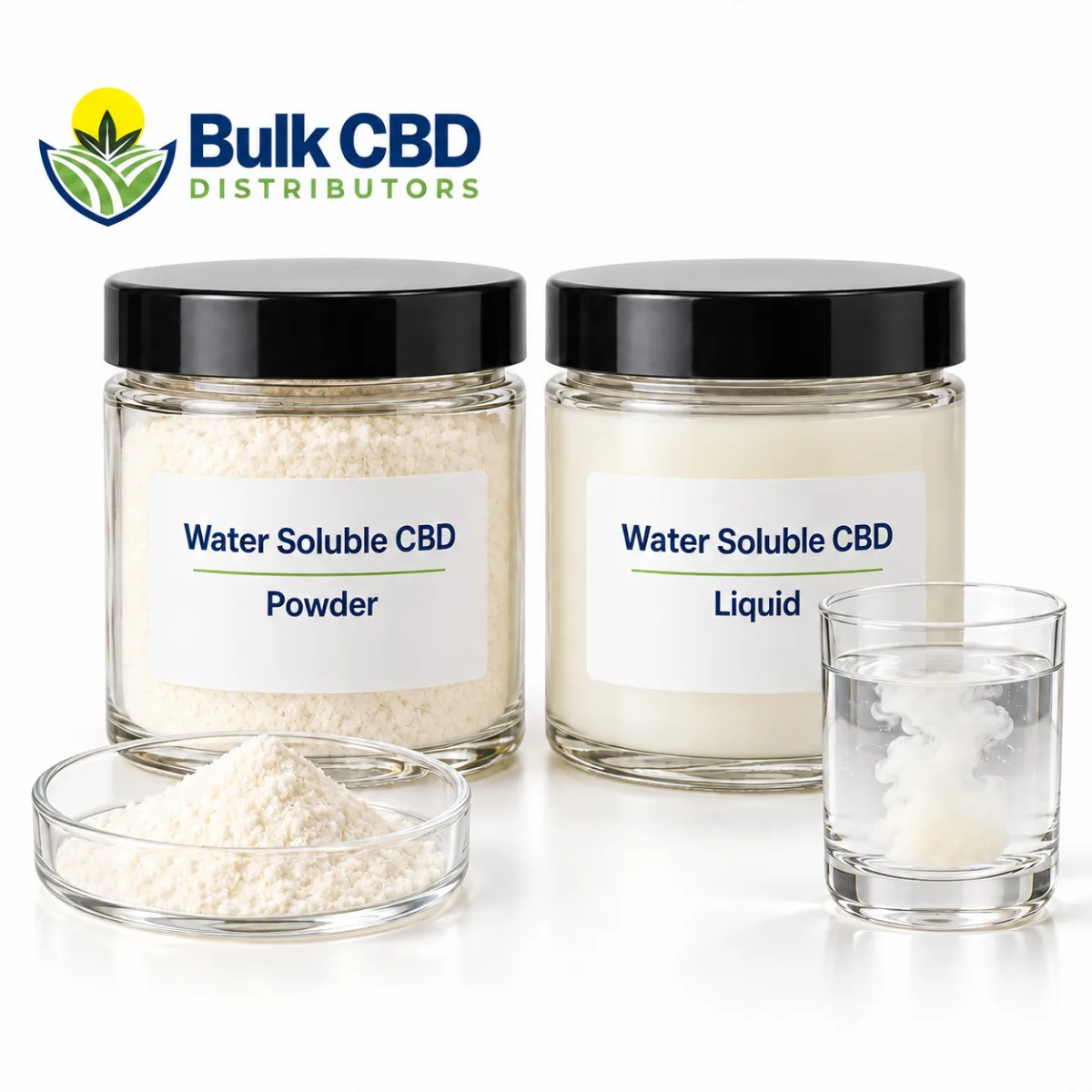
Most mix-ups come from comparing different units. These are the ones on labels and COAs:
| Unit | What it measures | Where you see it |
|---|---|---|
| mg per container | Total CBD in the bottle, jar or can | Front of most labels |
| mg per mL | CBD in each milliliter of liquid | Tincture labels and finished oil COAs |
| mg per serving | CBD in one dropper, gummy, capsule or can | Supplement facts panels |
| mg per gram | CBD in each gram of a solid or concentrate | Topical, edible and concentrate COAs |
| Percent (w/w) | Grams of CBD per 100 g | Ingredient COAs (isolate, distillate) |
Two conversions connect them. Percent to mg per gram: multiply by 10, so 99% isolate is 990 mg/g and 20% water soluble CBD is 200 mg/g. Volume to weight: multiply mL by the density of the oil. A 30 mL MCT tincture weighs about 28 g.
The Core Formulas
mg per mL = total CBD (mg) / volume (mL)
mg per serving = mg per mL x serving size (mL), or total mg / servings per container for gummies and capsules
grams of input = CBD needed (mg) / (input potency x 1,000)
mg of THC per container = grams of input per container x total THC % x 10
The input potency always comes from the batch COA of the lot you are using. Our ingredient amount calculator and potency blend calculator run these formulas with live catalog sizes.
Worked Examples by Product Type
| Product | Label claim | Strength | CBD input per unit |
|---|---|---|---|
| Tincture, 30 mL | 1,000 mg per bottle | 33.3 mg/mL; about 33 mg per 1 mL dropper | 1.01 g isolate at 99%, or 1.18 g distillate at 85% |
| Gummies, 30 per jar | 25 mg per gummy | 750 mg per jar | 0.76 g isolate per jar |
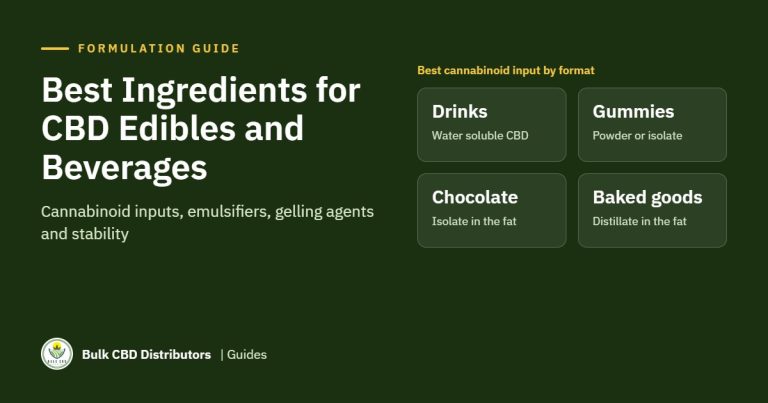
| Drink, one can | 10 mg per can | 10 mg per can | 0.05 g of 20% water soluble CBD, or 0.1 g of 10% |
| Topical, 60 g jar | 500 mg per jar | 8.3 mg/g, about 0.83% | 0.51 g isolate per jar |
| Softgel, 30 per bottle | 25 mg per softgel | 750 mg per bottle | 0.88 g distillate at 85% per bottle |
Scale each figure by the number of units in the run. A run of 1,000 gummy jars at 750 mg needs about 758 g of isolate before overage. For drinks, water soluble CBD at about 20% means each gram carries 200 mg of CBD; the 10% liquid carries 100 mg.
Working From Input Potency
The same label claim needs different amounts of each input, because potency differs:
| Input | Typical potency | Grams for 1,000 mg of CBD |
|---|---|---|
| CBD isolate | 99%+ | 1.01 g |
| Broad spectrum CBD distillate | 80 to 95% | 1.05 to 1.25 g |
| Full spectrum CBD distillate | 75 to 85%+ | 1.18 to 1.33 g |
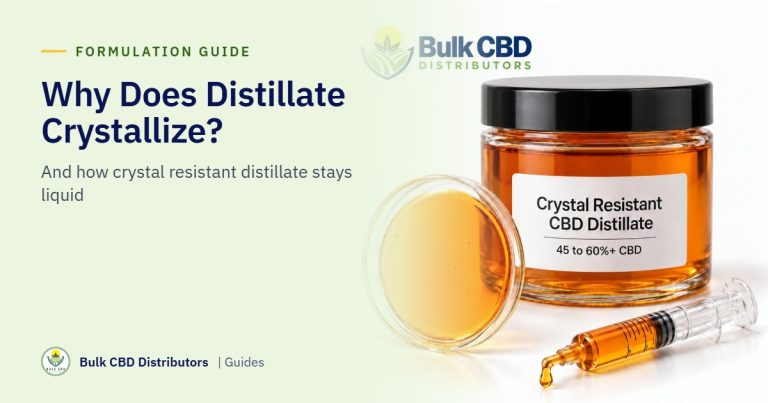
| Crystal resistant CBD distillate | 45 to 60%+ | 1.67 to 2.22 g |
| Water soluble CBD | About 20% or 10% | 5 g or 10 g |
Use the exact COA number, not the range. A lot at 87.4% needs 1.144 g for 1,000 mg; rounding to 85% would put 2.8% more CBD in every bottle than the label says. Our guide on how to make CBD oil walks through a full tincture run.
Turn your label claim into an order
Enter your strength and unit count in the order estimator, then compare sizes in our CBD distillate collection or the CBD isolate listing. Ingredient MOQs run 100g to 1kg depending on the product. Request a wholesale quote for larger runs.
How to Calculate CBD Strength for a Production Batch
- Fix the label claim. Decide the CBD amount per unit and per container, for example 25 mg per gummy and 30 gummies per jar, or 1,000 mg in a 30 mL bottle.
- Convert to total mg per batch. Multiply the mg per container by the number of containers in the run. 1,000 jars of 750 mg is 750,000 mg, or 750 g of CBD.
- Read the input potency from the COA. Take the CBD percentage from the batch COA of the lot you will use, not a rounded label figure. Isolate is typically 99%+; distillates run 45 to 95% by grade; water soluble CBD is about 20% or 10%.
- Calculate grams of input. Divide total CBD mg by potency x 1,000. 750,000 mg at 99% is about 758 g of isolate.
- Add a process overage. Add a small overage, often 2 to 5%, for material left in tanks, lines and molds. Record it in the batch record.
- Check total THC per container. Multiply grams of input per container by the input's total THC percentage x 10 to get mg of THC. For products sold from December 11, 2026 it must be 0.4 mg or less per container.
- Test the finished lot. Send a finished sample to an ISO 17025-accredited third-party lab and compare the result with the label claim before release.
Process Losses and Overage
Some CBD never reaches the package. Oil clings to tank walls, mixing heads and filler lines; gummy mass stays in depositors and molds; heat can cost a little potency. Manufacturers cover this with an overage, often 2 to 5%, set from their own results. Track the finished COA against the label for the first few runs and adjust. Overage should cover losses, not inflate the label: a product that tests far above its claim is as much a labeling problem as one that tests below.
Finished Product Testing vs the Label Claim
Labs report finished products in the unit that suits the format: mg/mL for oils, mg/g for topicals and edibles, mg per unit for gummies, capsules and cans. Convert the result to your label unit before comparing. A tincture that tests at 32.1 mg/mL in a 30 mL bottle holds about 963 mg, 3.7% under a 1,000 mg claim. Many state rules and retailer standards allow a tolerance around the label claim, often about 10%; check the rule for each market you sell in. Our COA reading guide explains where the numbers sit on the report.
The Total THC Check for Products Sold From December 11, 2026
From December 11, 2026, Section 781 of P.L. 119-37 limits finished hemp consumer products to 0.4 mg of total THC per container. The Congressional Research Service summary explains the rule. The math is the same as for CBD:
mg of THC per container = grams of input per container x total THC % x 10
Take a 1,000 mg tincture made with 1.18 g of distillate. If that distillate carries 0.3% total THC, the bottle holds about 3.5 mg of THC, almost nine times the cap. To stay at 0.4 mg, the input could carry no more than about 0.034% total THC. In practice that means non-detect inputs: CBD isolate or non-detect broad spectrum distillate. Our total THC guide shows how to read total THC from a COA, including THCA.
How BCD Helps With the Numbers
Every ingredient we sell ships with its batch COA, so the potency you calculate from is the potency in your drum. We have been in the hemp business since 2020, and through direct and indirect relationships with major hemp ingredient manufacturers, distributors and brands we can pick lots with strong, consistent potency. Testing is done by ISO 17025-accredited third-party labs.
We confirm stock and your total before any payment is taken. Most ingredient orders ship the same or next day after payment, some take up to 72 business hours, and boxes ship blind.
What This Means for Your Business
- Calculate from the batch COA every run, because a few points of potency change grams, cost and label accuracy.
- Convert units before comparing finished test results with your label.
- Set overage from data, starting around 2 to 5% and adjusting to your own results.
- Run the THC per container math on every SKU that will sell from December 11, 2026.
Frequently Asked Questions
What does CBD strength mean?
CBD strength is the amount of CBD in a product, given as mg per container, mg per mL, mg per gram or mg per serving.
How do you calculate mg of CBD per mL?
Divide the total CBD in milligrams by the volume in milliliters. A 1,000 mg bottle of 30 mL is 33.3 mg per mL.
How much CBD is in one dropper?
A full dropper is usually about 1 mL, so it holds the mg per mL figure. In a 1,000 mg, 30 mL tincture that is about 33 mg. Check your dropper's actual volume.
How many grams of CBD isolate make 1,000 mg of CBD?
About 1.01 g of 99% isolate. The formula is mg needed divided by potency times 1,000.
How do I convert CBD percent to mg per gram?
Multiply the percent by 10. 99% isolate is 990 mg per gram; 20% water soluble CBD is 200 mg per gram.
How much water soluble CBD goes into a 10 mg drink?
About 0.05 g of a 20% water soluble CBD, or 0.1 g of a 10% liquid, per can.
Why does my finished product test lower than the label?
Usually process loss, rounding the input potency, or uneven mixing. Use the exact COA potency, add a measured overage and check mixing before filling.
How much overage should I add for CBD formulation?
Many manufacturers start at 2 to 5% and adjust once they have finished COA results from their own runs.
How do I check total THC per container?
Multiply grams of input per container by the input's total THC percent times 10. From December 11, 2026 the result must be 0.4 mg or less.
Does this guide give CBD dosage advice?
No. It covers label and batch math for manufacturers. It does not cover how much CBD a person should take.