To make CBD oil, dissolve a measured amount of CBD isolate or CBD distillate into a carrier oil such as MCT, mix until uniform, then test the finished batch so the label matches the bottle. The work that matters happens before mixing: choosing the input and calculating the grams each bottle needs from the potency on the batch COA. For brands buying wholesale CBD oil ingredients, this guide on how to make CBD oil walks through the process the way brands and contract manufacturers run it, from a 100-bottle pilot to full production lots.
| Spec | At a glance |
|---|---|
| Inputs | CBD isolate (99%+) or CBD distillate (45 to 95% by grade) |
| Grams per bottle | Target mg / (potency x 1,000) |
| Carrier | MCT, hemp seed or olive oil, warmed to 40 to 60 C |
| Finished testing | CBD in mg/mL and total THC per container |
What Do You Need to Make CBD Oil?
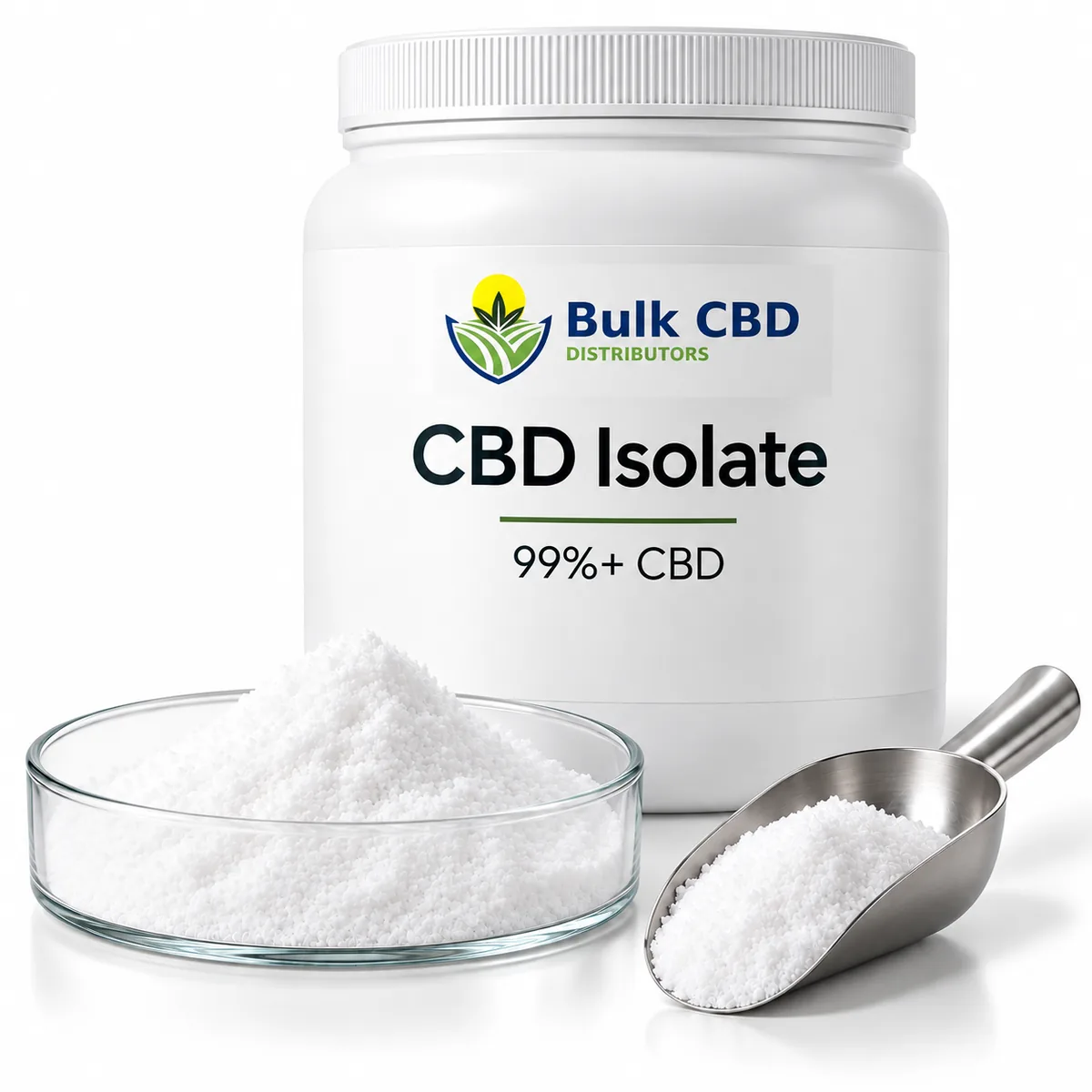
Every CBD oil is built from three parts: a CBD concentrate, a carrier oil and, optionally, flavor. The concentrate sets the strength and the label claims. The carrier sets texture, taste and shelf life.
| Component | Common choices | What it decides |
|---|---|---|
| CBD concentrate | CBD isolate (99%+), broad or full spectrum distillate, crystal resistant distillate | Strength, THC status, color and taste |
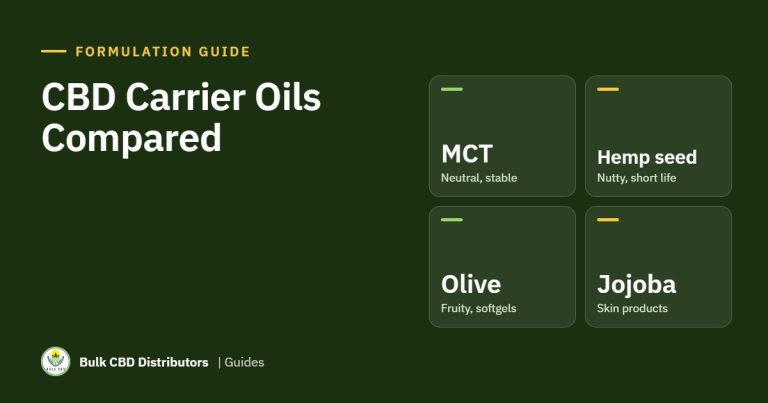
| Carrier oil | MCT oil, hemp seed oil, olive oil, or a blend | Texture, flavor, shelf life |
| Flavor | Food-grade flavor oils, natural extracts, sweeteners | Taste and customer repeat rate |
| Packaging | Amber glass dropper bottles, 15 to 60 mL | Light protection and dosing format |
Brands that buy wholesale CBD oil ingredients are buying the concentrate in this table. The carrier and flavor come from food ingredient suppliers, and the finished oil is mixed in-house or by a co-packer.
Should You Use CBD Isolate or Distillate?
Both make good CBD oil. The choice comes down to the label you want and how you plan to handle the material.
| Feature | CBD isolate | Broad spectrum distillate | Full spectrum distillate |
|---|---|---|---|
| Potency | 99%+ CBD | 80 to 95% CBD | 75 to 85%+ CBD |
| THC | Non-detect Delta-9 | Standard: 0.3% or less, some lots non-detect; Non-Detect THC option | Standard (often above 0.3% Delta-9) or Compliant |
| Form | Crystalline powder | Thick oil, warm to pour | Thick oil, warm to pour |
| Taste and color | Neutral, clear oil | Light amber, mild hemp taste | Amber, fuller hemp taste |
| Mixing | Dissolves in warm carrier | Warm to pour, then blend | Warm to pour, then blend |
Isolate is the easiest input for a first product. It weighs out as a powder, dissolves cleanly in warm MCT and gives a precise, THC-free number. Broad spectrum CBD distillate keeps CBG, CBC and other minor cannabinoids while holding THC down, and its Non-Detect THC option is verified on every batch by a third-party, DEA-registered lab. Full spectrum CBD distillate comes in two versions: Standard, which carries the plant's natural Delta-9 and suits processors who dilute or remediate, and Compliant, remediated to 0.3% or less. For a deeper comparison, read our full vs broad spectrum vs isolate guide.
How Much CBD Do You Need per Bottle?
The math is simple, and it should always use the potency from your batch COA rather than a rounded label number:
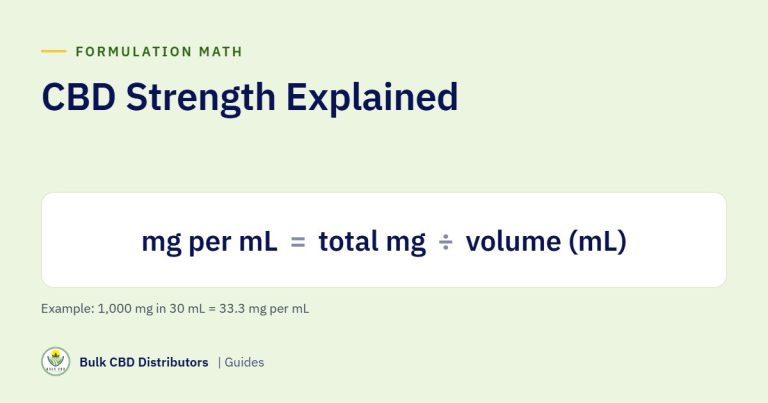
Grams of input per bottle = target CBD in mg / (input potency x 1,000)
| Target per 30 mL bottle | CBD isolate at 99% | Distillate at 85% | Distillate at 92% |
|---|---|---|---|
| 500 mg | 0.51 g | 0.59 g | 0.54 g |
| 1,000 mg | 1.01 g | 1.18 g | 1.09 g |
| 1,500 mg | 1.52 g | 1.76 g | 1.63 g |
| 3,000 mg | 3.03 g | 3.53 g | 3.26 g |
Multiply by your bottle count to size the order. A run of 1,000 bottles at 1,000 mg each needs about 1.01 kg of isolate, or about 1.18 kg of an 85% distillate. Most manufacturers add a small overage, often 2 to 5%, to cover material left in tanks and lines. Our ingredient amount calculator does this arithmetic with live catalog sizes, and the potency blend calculator helps when you mix two inputs to hit a target.
Size your first run before you order
Most manufacturers start with a pilot batch, then scale. MOQs on bulk CBD distillate and isolate run 100g to 1kg depending on the product, with sizes up to 100kg. Request a wholesale quote with your bottle count and strength.
How to Make CBD Oil, Step by Step
The process below is the standard production method for CBD tinctures and oils. It scales from a lab bench to a mixing tank without changing the order of steps.
- Choose your CBD input. Pick CBD isolate for a THC-free, flavor-neutral oil, broad spectrum distillate to keep minor cannabinoids without THC, or full spectrum distillate for the whole plant profile where your market allows it.
- Set the strength per bottle. Decide the CBD amount per bottle, such as 1,000 mg in 30 mL. That figure drives every calculation that follows.
- Calculate the input weight from the COA. Divide the target milligrams by the input potency from the batch COA. For 1,000 mg at 99% potency you need about 1.01 g of isolate per bottle; at 85% you need about 1.18 g of distillate.
- Warm the carrier oil. Heat MCT or your chosen carrier gently, typically to 40 to 60 C, so the concentrate dissolves evenly. Avoid high heat, which can darken the oil and drive off terpenes.
- Dissolve and mix the concentrate. Add the weighed isolate or warmed distillate and stir until fully dissolved and uniform. At production scale, use a jacketed tank or overhead mixer for consistent results.
- Add flavor and finish the formula. Blend in flavor oils or sweeteners if used, then bring the batch to its final weight or volume with carrier oil.
- Test a sample from the finished batch. Send a retained sample to an ISO 17025-accredited third-party lab for potency and total THC so your label matches what is in the bottle.
- Fill, label and keep records. Fill into amber glass, label with the tested CBD amount and batch number, and keep the input COA and the finished product COA together for each lot.
Write each step into a batch record: input lot number, weight, carrier lot, temperature, mixing time and final volume. That record, together with the input COA and the finished COA, is what retailers and marketplaces ask for when they review a new brand.
How Do You Keep CBD Oil from Crystallizing?
High-strength oils, especially those made with isolate, can form crystals when they cool or sit in a cold warehouse. Distillate-based oils can do the same over time. Three practical fixes help:
- Test before you scale. Make a small batch at your target strength, then hold samples cool for several days and check for cloudiness or crystals.
- Use a crystal resistant input. Crystal resistant CBD distillate at 45 to 60%+ CBD is processed to stay liquid, which is why it is popular in high-strength oils and cartridges.
- Blend inputs. Mixing isolate with a broad spectrum distillate often keeps an oil clear at strengths where isolate alone would crystallize.
We cover the chemistry in our crystal resistant CBN guide, and the same logic applies to CBD.
Testing, Labeling and Section 781
Test every finished lot, not just your inputs. Mixing losses, uneven blending and heat can move the final number, and a label that overstates CBD is a common reason products are pulled from shelves. Ask your lab for potency in mg/mL and total THC, then multiply mg/mL by bottle volume to confirm the label amount.
From December 11, 2026, Section 781 of P.L. 119-37 limits finished hemp consumer products to 0.4 mg of total THC per container. The date moved from November 12 under P.L. 119-103; only the exclusion of synthetic cannabinoids still starts November 12. The Congressional Research Service summary explains the change. For a CBD oil, that makes isolate and non-detect broad spectrum the simplest inputs for products sold after that date. Our total THC calculation guide shows how to work out total THC from a COA.
Sourcing CBD Oil Ingredients from BCD
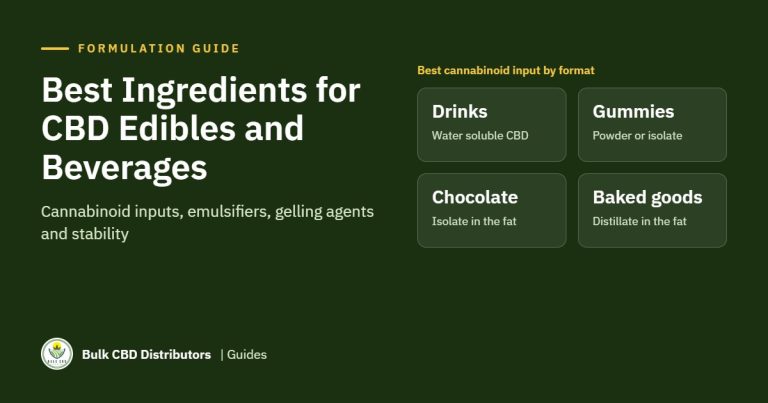
We supply CBD isolate, broad spectrum, full spectrum and crystal resistant CBD distillates, plus water soluble CBD for drinks and gummies. Each lot is third-party tested in ISO 17025-accredited labs and produced in cGMP-compliant facilities, and the batch COA ships with the order.
Every order starts as a request. We check availability, confirm the total, and only then send payment options. Once paid, most ingredient orders ship the same or next day, a few take up to 72 business hours. Ingredients are blind shipped, with no brand labeling on the packaging, so you can order confidently for your company or even directly to your clients, knowing that we also value discretion and privacy.
What This Means for Your Business
- Start with isolate if this is your first oil. It is the easiest input to weigh, mix and label accurately.
- Always calculate from the batch COA. A few percent of potency difference changes the grams per bottle and the cost per bottle.
- Run a pilot, then scale. A small test batch catches crystallization and taste issues before you commit to a full run.
- Keep paperwork with every lot. Input COA, batch record and finished COA together make retail approval faster.
Frequently Asked Questions
How do you make CBD oil from isolate?
Weigh the isolate for your target strength, warm the carrier oil to about 40 to 60 C, and stir the isolate in until it fully dissolves. Then add flavor, bring the batch to final volume and test a sample.
How do you make CBD oil from distillate?
Warm the distillate so it pours, weigh it against your target strength using the COA potency, and blend it into warm carrier oil until uniform. Distillate oils are amber and keep minor cannabinoids.
How much CBD isolate do I need for a 1,000 mg bottle?
About 1.01 g of 99% isolate per bottle. The formula is target milligrams divided by potency times 1,000.
What is the best carrier oil for CBD oil?
MCT oil is the most common because it is neutral, stable and dissolves CBD well. Hemp seed oil and olive oil also work and suit certain labels.
Why does my CBD oil crystallize?
High-strength oils, especially isolate-based ones, can form crystals when they cool. Testing at strength, using crystal resistant distillate, or blending isolate with distillate usually solves it.
Do I need to test finished CBD oil?
Yes. Test every finished lot for potency and total THC at an ISO 17025-accredited third-party lab so the label matches what is in the bottle.
Is full spectrum CBD oil allowed after December 11, 2026?
From December 11, 2026, finished hemp products are limited to 0.4 mg total THC per container under Section 781. Full spectrum oils will need to meet that cap, which is why many brands are moving to isolate or non-detect broad spectrum.
Can I make CBD oil without heat?
Distillate needs gentle warming to pour, and isolate dissolves faster in warm oil. Very low heat is fine; the goal is a uniform mix without darkening the oil.
How much CBD isolate should I order for 1,000 bottles?
At 1,000 mg per bottle you need about 1.01 kg of isolate, plus a 2 to 5% overage for process losses. Our ingredient amount calculator does the math for other strengths.
Does BCD sell finished CBD oil?
BCD sells the CBD ingredients used to make oil, carries Retail Ready CBD tinctures from established brands, and offers white label CBD oils that carry your own brand.