CBC distillate specs come down to a few numbers every buyer should confirm before ordering: CBC content (typically 80 to 90%+ on BCD lots), total THC, the minor cannabinoid profile, and a clean contaminant panel from an ISO 17025-accredited third-party lab. Pricing, MOQs and lead times follow from those specs and from how scarce CBC is compared with CBD and CBG. This guide walks through the spec sheet, the COA, packaging, pricing drivers and how to vet a CBC distillate supplier.
What Is CBC Distillate?
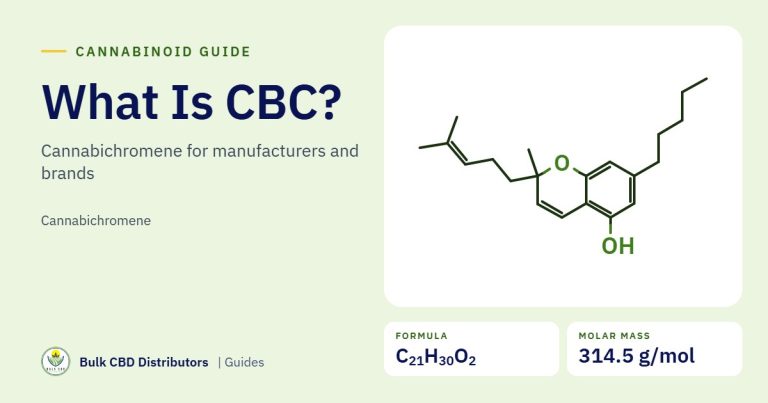
CBC distillate is a hemp extract refined to concentrate cannabichromene, a non-intoxicating cannabinoid, as the dominant compound. It is made by extracting hemp with ethanol or CO2, winterizing to remove fats and waxes, decarboxylating to convert CBCA into CBC, and then running short-path distillation and further separation to raise the CBC fraction. The finished material is a viscous oil. If you want background on the molecule itself, start with our guide What Is CBC (Cannabichromene)?
CBC distillate sits between crude extract and CBC isolate. Isolate is purified above 90% CBC and is used when a formulator needs a precise single-cannabinoid input. Distillate keeps some other cannabinoids and costs less per kilogram, which makes it the usual choice for multi-cannabinoid tinctures, softgels, gummies and topicals where CBC is one labeled ingredient among several.
What Are Standard CBC Distillate Specs?
The table below shows the specs BCD lists for CBC distillate, next to typical CBD and CBG distillate for comparison. All figures are typical ranges; the batch COA for your lot is the controlling document.
| Spec | CBC distillate | Broad-spectrum CBD distillate | CBG distillate |
|---|---|---|---|
| Primary cannabinoid | 80 to 90%+ CBC | 80 to 95% CBD | See lot COA |
| Delta-9 THC | Non-detect to 0.3% or less | 0.3% or less, some lots non-detect | Lot dependent |
| Form | Viscous oil, softens when warm | Viscous amber oil | Viscous oil |
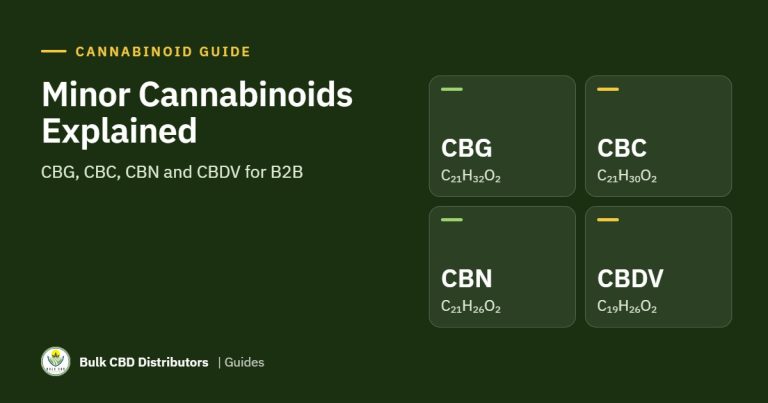
| Molecular formula | C21H30O2 | C21H30O2 | C21H32O2 |
| Shelf life sealed | 18 to 24 months | 18 to 24 months | 18 to 24 months |
| Relative supply | Limited | Broad | Moderate |
Molecular formulas are from PubChem for cannabichromene, cannabidiol and cannabigerol. CBC and CBD are isomers, which is why their formulas match even though they are different compounds with different physical behavior.
Three spec points deserve attention when you write a purchase order:
- Minimum CBC percentage. State the minimum you will accept, for example "CBC not less than 70% by HPLC." That gives you a clear basis to reject a lot that falls short.
- THC basis. Specify total THC, not Delta-9 alone. When Section 781 takes effect, the federal hemp definition will count THCA toward the 0.3% limit, and your finished goods will face a 0.4 mg per container cap on total THC and similar cannabinoids.
- Physical state. CBC distillate softens in warm rooms. Note your receiving and storage temperatures so the supplier ships in packaging suited to them.
How Do You Read a CBC Distillate COA?
A COA for CBC distillate follows the same structure as any hemp extract COA, with a few CBC-specific checks. Use this order when you review one:
- Header and lot match. Confirm the product name, lot or batch number and test date. The lot number should match the label on the container you receive. A COA older than the lot is a red flag.
- Lab credentials. The testing lab should be ISO 17025 accredited. Many buyers also require a DEA-registered third-party laboratory. The lab should be independent of the seller.
- Cannabinoid panel. Find CBC first. Then read the full panel: CBD, CBG, CBN, CBCA and the THC fractions. A CBC distillate that lists only CBC and Delta-9 is incomplete.
- Total THC calculation. Total THC should be calculated as Delta-9 THC plus THCA multiplied by 0.877, plus Delta-8 and other THC isomers, which Section 781 counts. Check the math yourself.
- Residual solvents. Results should fall within USP 467 limits, for example hexane at or below 290 ppm (Class 2) and Class 3 solvents such as ethanol at or below 5,000 ppm.
- Heavy metals, pesticides and microbials. Look for lead, arsenic, cadmium and mercury results, a multi-residue pesticide screen and a microbial panel, each marked pass.
Product page COAs are usually representative, so ask for the batch COA for your specific lot and file it with your production records. For a full walk-through of every COA section, see How to Read a Hemp COA.
Typical Order Sizes, Lead Times and Packaging
Typical Order Sizes
Bulk CBC distillate is usually sold from 100g up through multi-kilogram tiers, with larger volumes priced by quote. A smaller first order lets your R&D team confirm flow, color and blend behavior before you commit to a production quantity.
Lead Time
Lead time depends mostly on lot availability, because CBC supply is narrower than CBD supply. Confirm the specific lot before you schedule production. Very large or recurring volumes may need extra time to allocate, so share your forecast early if CBC is a core input.
Packaging
- Sealed containers sized to the order, with lot labels that match the COA. Confirm container type and size with your supplier before you order.
- For larger orders, ask whether the volume can be split across several sealed units so you open only what you need.
- Ask about packaging for hot-weather transit if your receiving dock is not climate controlled, since CBC softens as temperature rises.
On arrival, store CBC distillate cool, dry and away from light. BCD suggests 15 to 22 C for working stock and refrigeration for longer holds. Warm gently and evenly before pouring, and weigh by mass rather than volume.
How Does CBC Distillate Pricing Compare With CBD and CBG?
CBC distillate is generally priced above standard and broad-spectrum CBD distillate. Several factors drive that gap:
- Low natural abundance. Standard hemp usually contains well under 1% CBC by dry weight, far less than CBD in CBD cultivars or CBG in CBG cultivars. More input material is needed for each kilogram of CBC.
- Separation work. Because CBC is mixed with larger amounts of CBD and other cannabinoids, processors need additional distillation passes or chromatography to concentrate it. Each pass adds labor, solvent, energy and yield loss.
- Fewer producers. Fewer processors run CBC at scale, so there is less price competition and lot sizes are smaller.
- Purity target. Higher CBC specs cost more. Moving from the low end to the high end of the 80 to 90%+ range takes extra processing.
- Volume tier. Per-kilogram pricing falls at larger tiers, which helps brands that standardize on CBC across several SKUs.
Compared with CBG, the price gap depends on the product. Dedicated CBG cultivars give processors a high-CBG starting material that CBC lacks, but broad-spectrum and crystal resistant CBG distillates carry their own processing costs, so some CBG SKUs list above CBC distillate. Compare cost per gram of active cannabinoid at the same volume tier rather than list price. For context on CBG economics, see our CBG distillate buying guide.
To keep cost in check, buy distillate rather than isolate when CBC is a blend component, consolidate CBC demand across SKUs to reach a better tier, and build doses from actual lot potency rather than overdosing to cover uncertainty.
How Should You Vet a CBC Distillate Supplier?
CBC is a smaller market, which makes supplier vetting more important. Use this checklist before your first order:
- Lot-specific COAs. Ask for the COA tied to the lot you will receive, not a generic sheet. Compare it with the representative COA you approved.
- Independent testing. Confirm the lab is ISO 17025 accredited and independent of the seller. A DEA-registered third-party laboratory adds another layer of assurance.
- Production method. Ask whether the CBC is plant extracted and separated. Section 781 excludes cannabinoids synthesized or manufactured outside the plant, so document the answer.
- Consistency. Ask for COAs from two or three recent lots. Large swings in CBC percentage or THC mean more reformulation work for you.
- Clear ordering terms. Look for written MOQ, lead time and payment terms. Be cautious of prices far below the market, which can point to low-potency material or poor documentation.
- Responsiveness. A supplier should answer spec and COA questions directly and in writing.
Our guide to vetting a legitimate B2B supplier covers the broader process.
What This Means for Your Business
CBC distillate is a premium, limited-supply input that rewards careful specification. Write minimum CBC and total THC limits into your purchase order, read every batch COA in full, and plan storage around CBC's tendency to soften when warm. Budget for a higher per-kilogram cost than CBD distillate and offset it with smart volume tiers and accurate dosing. Done well, CBC distillate gives you a labeled differentiator that fewer competitors can match.
Compare Current CBC Distillate Specs and COAs
Current sizes and a representative COA from an ISO 17025-accredited third-party laboratory are on the CBC distillate page. At BCD, the batch COA ships with every order, MOQs are 100g to 1kg depending on the product, and most orders ship within a few days. If you have spec questions, we are glad to help.
Frequently Asked Questions
What potency is CBC distillate?
CBC distillate typically tests at 80 to 90%+ CBC, depending on the lot. The batch COA states the exact figure for each lot.
Does CBC distillate contain THC?
Delta-9 THC ranges from non-detect to 0.3% or less by dry weight depending on the lot. Always check total THC on the batch COA.
What is the minimum order for CBC distillate?
MOQs are 100g to 1kg depending on the product. Larger volumes are available by bulk quote.
What affects CBC distillate lead time?
Mostly lot availability and order volume. CBC supply is narrower than CBD supply, so confirm the specific lot before you schedule production and share forecasts early for recurring volumes.
Why is CBC distillate more expensive than CBD distillate?
CBC is present at well under 1% in most hemp and must be separated from larger amounts of CBD and other cannabinoids. Lower yields and fewer producers raise the cost per kilogram.
Is CBC distillate the same as CBC isolate?
No. Distillate is typically 80 to 90%+ CBC and keeps some other cannabinoids. Isolate is purified above 90% CBC.
What should a CBC distillate COA include?
A full cannabinoid panel with CBC and total THC, residual solvents, heavy metals, pesticides and microbials, from an ISO 17025-accredited third-party lab, with a lot number that matches your container.
How should CBC distillate be stored?
Store sealed containers cool, dry and dark. BCD suggests 15 to 22 C for working stock and refrigeration for long holds. Shelf life is typically 18 to 24 months sealed.
Is CBC distillate intoxicating?
CBC is generally described as non-intoxicating. The finished product's THC content still needs to meet federal and state limits.
Should I test CBC distillate before a production run?
Yes. A trial batch lets your R&D team confirm flow, color, blend behavior and potency against the batch COA before you commit to a production lot.