CBG vs CBD comes down to three practical differences for a formulator: CBG comes from CBGA, the upstream acid that the hemp plant converts into CBDA and then, with heat, CBD, it is far less abundant in standard hemp and so costs more per gram, and at high loadings it can crystallize out of liquid formulas. Chemically the two are close cousins, both are non-intoxicating, and both work in the same oil-phase systems, so the real decision is about cost, handling, and what each one adds to your product story. This guide compares CBG and CBD on chemistry, supply, forms, formulation behavior, stability, and pricing, then shows how to combine them at a target ratio.
How Are CBG and CBD Related Chemically?
CBG (cannabigerol) and CBD (cannabidiol) are both 21-carbon phytocannabinoids. PubChem lists CBG as C21H32O2 with a molecular weight of 316.5 g/mol and CBD as C21H30O2 at 314.5 g/mol. The two-hydrogen difference reflects structure: CBG has an open chain where CBD has a closed ring, which is a direct result of how the plant builds one from the other.
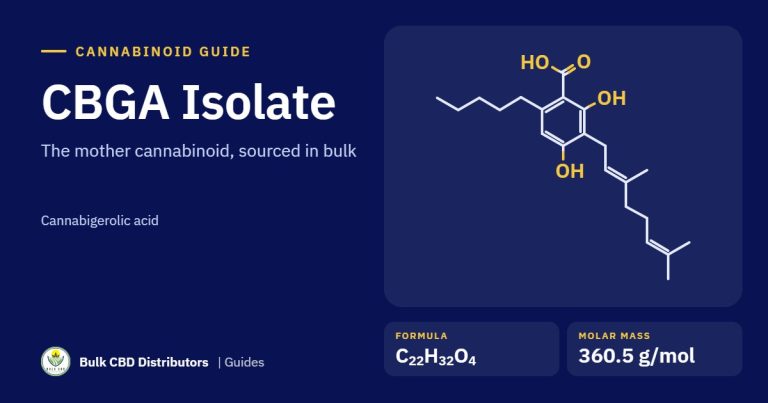
In the living plant, cannabinoids are made in their acid forms. CBGA (cannabigerolic acid) is synthesized first, and plant enzymes then convert most of it into CBDA, THCA, and CBCA. When harvested material is heated during processing (decarboxylation), the acids lose a carboxyl group and become the neutral cannabinoids buyers work with: CBDA becomes CBD, and any CBGA that was not converted becomes CBG. That is why CBG is often described as the precursor or "mother" cannabinoid. For a formulator, the useful takeaway is that both molecules come out of the same extraction and refinement chain, and both are non-intoxicating, so neither changes the compliance logic of a finished product beyond the usual total THC checks.
Why Does CBG Cost More Than CBD?
The price gap starts in the field. In a standard CBD-dominant hemp cultivar, the CBGA-to-CBDA conversion is nearly complete by harvest, leaving roughly 0.5 to 1% CBG by dry weight. Extracting CBG from that material is not economical. The commercial CBG supply depends on CBG-dominant genetics in which the conversion enzymes are limited, so the plant holds 10 to 15% CBG at harvest instead.
Those cultivars carry real costs. The genetics are fewer and more expensive to maintain, harvest timing must still be managed for total THC compliance, and the processing base for CBG is smaller than for CBD, so there is less scale and less price competition. Our complete wholesale guide to CBG covers the supply side in more depth. For formulators, the point is simple: CBG is a specialty input, and a CBG price that looks far below the market deserves the same scrutiny as any underpriced ingredient.
Forms and Purity Ranges Side by Side
Both cannabinoids are sold in the same families of forms, which makes side-by-side substitution and blending straightforward. Ranges below reflect typical wholesale specifications; the batch COA always governs.
| Form | CBD typical spec | CBG typical spec | Formulator notes |
|---|---|---|---|
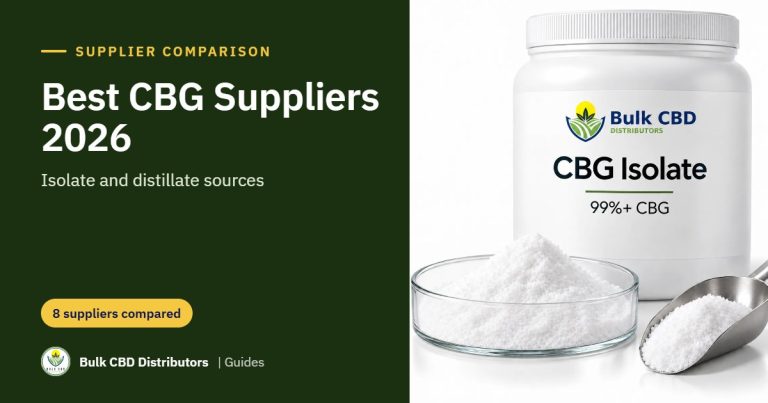
| Isolate | 99%+ crystalline powder | 99%+ crystalline powder | Exact dosing, flavor-neutral; CBG recrystallizes more readily |
| Distillate | 75 to 95% oil, depending on grade | 80 to 95% oil, depending on grade | Retains minor cannabinoids; CBG lots often carry 3 to 15% residual CBD |
| Crystal resistant distillate | 45 to 60%+ | 45 to 60%+ | Stays flowable for carts and liquid formulas |
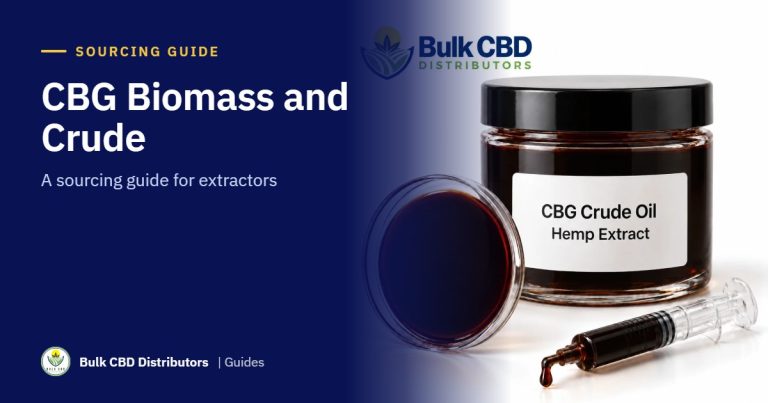
| Crude oil | 50 to 70% | About 60% | Feedstock for further refinement, not finished goods |
| Water soluble | Varies by product | Around 20% | Beverages, drink mixes, gummies |
For single-cannabinoid precision, start with CBG isolate or CBD isolate. For multi-cannabinoid oils, compare distillate grades in the CBG category.
How Do CBG and CBD Behave in Oil-Phase Formulas?
Both cannabinoids are lipophilic. They dissolve in MCT oil, hemp seed oil, and other common carrier oils, and both can be incorporated into the oil phase of balms, creams, and softgel fills. In most oil-based systems they are effectively interchangeable from a solubility standpoint, with three practical differences.
- Crystallization: CBG isolate and higher-potency CBG distillate can crystallize or solidify at room temperature, especially at higher loadings or when a batch cools quickly. In tinctures this can show up as haze or sediment weeks after filling.
- Viscosity: CBG distillate tends to be thicker at room temperature than CBD distillate, so softgel and cartridge fill lines may need slightly warmer operating temperatures. Confirm against your equipment's range before a production run.
- Flavor: Isolates of both are close to neutral. Distillates carry hemp-forward notes, and CBG distillate's retained minor cannabinoid and terpene fraction can read differently from a CBD distillate even at the same potency.
For topicals, typical CBG loadings run 0.5 to 3% by weight in balms and creams, and 0.5 to 2% in skincare serums. CBD sits in a similar range in most topical systems. For CBG in liquids, dissolve isolate into gently warmed carrier and run a 30-day hold test at your storage temperature before scaling. For carts and other liquid formats where crystals cause failures, crystal resistant distillate at 45 to 60%+ is the usual answer.
Stability, Storage, and Handling
CBG and CBD share the same main degradation drivers: heat, light, and oxygen. Both should be stored sealed, cool, and dark, with headspace minimized once a container has been opened. A few handling points differ in practice.
- Isolate powders: both are fine crystalline powders that can clump if exposed to humidity. Reseal promptly and store with desiccant where practical.
- Distillates: both may be semi-solid at room temperature. Warm gently in a water bath or controlled oven to pour; avoid repeated hard heating cycles, which can darken the oil and shift the cannabinoid profile.
- Finished liquids: because CBG recrystallizes more readily, temperature swings during shipping and storage matter more for CBG tinctures than for CBD tinctures. Build cold-chain or temperature notes into your QA if you sell into cold climates.
- Testing: confirm potency on the batch COA at receipt and plan a stability test on the finished product. Total THC should be checked using Delta-9 plus (THCA x 0.877) plus Delta-8 and other THC isomers, per the method described in our guide to reading a hemp COA.
What Drives CBG and CBD Pricing?
Price per kilogram is a poor comparison tool. Normalize every quote to cost per gram of target cannabinoid using the batch COA potency. A 75% distillate and an 85% distillate at the same per-kilogram price are not the same value; the 85% lot delivers about 13% more cannabinoid per dollar.
The main pricing drivers are:
- Feedstock: CBG-dominant biomass is scarcer and costs more per gram of cannabinoid than CBD biomass.
- Refinement level: isolate requires crystallization and washing steps; THC remediation adds cost to broad-spectrum distillates.
- Lot size: per-gram pricing falls as volume rises, with the steepest breaks between 100g, 1kg, and 5kg tiers.
- Market cycles: CBG premiums have historically been largest for distillate, which our CBG distillate guide puts at 2x to 5x comparable CBD distillate per gram. Isolate spreads move with supply and can be much narrower, so always compare current quotes rather than relying on a rule of thumb.
When Section 781 takes effect, both CBG and CBD from compliant hemp are generally expected to remain within the federal hemp definition, provided total THC limits are met. Section 781 still affects both the same way: total THC (including THCA) counts, cannabinoids that cannot be naturally produced by the plant are excluded from November 12, 2026, and from December 11, 2026 finished consumer products are capped at 0.4 mg total THC per container. See our 2026 hemp law overview and the Congressional Research Service summary of Section 781.
When to Use Each, and How to Combine Them at a Target Ratio
Use CBD as the volume cannabinoid when cost per serving is the main constraint and your customers recognize the ingredient. Use CBG when the product needs a distinct label position, a multi-cannabinoid profile, or a premium tier. Many brands do both: a CBD base with CBG added at a stated ratio such as 2:1, 1:1, or 3:1.
To hit a target ratio, work from milligrams of each cannabinoid per finished unit, then convert to raw material using batch COA potency:
- Set the per-unit target. Example: a 30 mL tincture with 500 mg CBD and 250 mg CBG (a 2:1 ratio).
- Scale to the batch. 1,000 bottles need 500 g of CBD and 250 g of CBG as active cannabinoid.
- Divide by COA potency. With 99% isolates: 500 / 0.99 = about 505 g CBD isolate, and 250 / 0.99 = about 253 g CBG isolate. With a 75% CBG distillate instead: 250 / 0.75 = about 333 g.
- Account for residual cannabinoids. If the CBG distillate carries 10% residual CBD, 333 g adds about 33 g of CBD, so reduce the CBD input to about 467 g of active CBD (about 472 g of 99% isolate) to hold the 2:1 ratio.
- Add an overage only if your QA program specifies one, then verify the finished batch with third-party testing before release.
Isolates make ratio control simplest because each input contributes one cannabinoid. Distillates add character and lower cost per gram, but they require the residual-cannabinoid math in step 4. Our full-spectrum vs. broad-spectrum vs. isolate comparison explains how spectrum choice affects the label. If you are sourcing upstream, the companion guide on CBG biomass and crude sourcing covers feedstock.
What This Means for Your Business
CBG and CBD are not competitors so much as complementary inputs. CBD gives you scale, familiar labeling, and lower cost per serving. CBG gives you differentiation, at a premium you need to plan for. The practical playbook is to decide the per-unit milligram targets first, choose isolate when you need clean ratio control, choose distillate when you want a multi-cannabinoid profile, and normalize every quote to cost per gram of cannabinoid. Run hold tests for CBG crystallization before scaling liquid formats, and keep the batch COA for each input on file.
Compare CBG and CBD Isolate Specs
If you are planning a blend, you can compare current CBG isolate and CBD isolate specs and COAs, or see distillate grades on the wholesale CBG page. BCD carries both cannabinoids in isolate and distillate grades, and we are happy to quote both inputs together.
Frequently Asked Questions
What is the main difference between CBG and CBD for formulators?
CBG comes from CBGA, the precursor the hemp plant converts into CBDA, so CBG is much less abundant and costs more. Both are non-intoxicating and oil-soluble, but CBG crystallizes more readily in liquid formulas.
Is CBG made from CBD?
No. Both come from CBGA in the plant. Enzymes convert CBGA to CBDA, and heat converts CBDA to CBD. CBG comes from CBGA that was not converted, which is why CBG-dominant cultivars are needed.
Why is CBG more expensive than CBD?
Standard hemp holds only about 0.5 to 1% CBG at harvest. Commercial CBG needs specialized cultivars at 10 to 15% CBG, a smaller processing base, and tighter harvest timing, all of which raise cost per gram.
Can I swap CBD isolate for CBG isolate in an existing formula?
Often yes on a milligram-for-milligram basis, since both are 99%+ and oil-soluble. Run a hold test first, because CBG is more likely to recrystallize at the same loading.
Which is better for gummies, CBG or CBD?
Both work. Isolates of either suit flavor-neutral gummies, and water soluble forms suit aqueous systems. The choice usually comes down to your label position and cost per serving.
How do I calculate a 1:1 CBG to CBD blend?
Set equal milligram targets per unit, multiply by batch size, then divide each by its batch COA potency. If either input is a distillate with residual cannabinoids, subtract those from the other input.
Does CBG distillate contain CBD?
Often, yes. CBG distillate commonly carries 3 to 15% residual CBD depending on source genetics and the distillation cut. Check the batch COA.
Are CBG and CBD affected by Section 781?
Yes, both in the same way. Both are non-intoxicating and are generally expected to remain within the federal hemp definition as long as total THC limits are met, but total THC (including THCA) counts, and from December 11, 2026 finished consumer products are capped at 0.4 mg total THC per container.
What should I check on the COA for CBG and CBD?
Potency of the target cannabinoid, total THC using the full formula, residual solvents, heavy metals, pesticides, and microbials, from an ISO 17025-accredited third-party laboratory.
What is BCD's minimum order for CBG and CBD?
MOQs run 100g to 1kg depending on the product. Most orders ship within a few days after the order request is confirmed and payment is taken by card or wire.