Full-spectrum CBD oil is hemp-derived extract containing cannabidiol as the dominant cannabinoid alongside the complete native cannabinoid and terpene profile of the source hemp plant, including its natural THC. Real full spectrum usually tests above 0.3% Delta-9 THC, so it comes in two versions: Standard (natural, typically above 0.3% Delta-9 THC, in-process material) and Compliant (remediated to 0.3% Delta-9 THC or less). For B2B buyers (manufacturers, brands, and retailers building products that position on whole-plant hemp authenticity), full-spectrum CBD oil offers the most complete expression of what the hemp plant produces. This guide covers what full-spectrum CBD oil is, what its cannabinoid profile looks like, the Section 781 compliance considerations that apply to full-spectrum specifically, and how to evaluate and source it in bulk.

What Is Full-Spectrum CBD Oil?
Full-spectrum CBD oil is hemp extract that retains the complete cannabinoid and terpene content of the source plant after extraction and distillation. Unlike broad-spectrum CBD distillate (which removes THC) or CBD isolate (which removes everything except CBD), full-spectrum oil preserves the full range of compounds including minor cannabinoids and the plant's natural THC, which typically tests above 0.3% Delta-9 THC unless the oil is remediated to the Compliant version. It is an amber to dark amber oil-phase ingredient with characteristic hemp flavor and odor from retained terpene content.
Cannabinoid and Terpene Profile
Typical quality full-spectrum CBD distillate ranges: CBD 75 to 85%+ by dry weight; CBG 0.5 to 3%; CBN typically below 0.5% in fresh well-processed material; CBC typically below 1%; total THC typically above 0.3% in Standard lots and 0.3% Delta-9 THC or less in Compliant lots (total THC is Delta-9 + THCA x 0.877, plus Delta-8 and other THC isomers counted under Section 781); terpenes typically low after distillation unless reintroduced. For a head-to-head comparison across all key specification variables, see Full Spectrum vs. Broad Spectrum vs. CBD Isolate: The Definitive B2B Comparison.
Full-Spectrum Versions: Standard and Compliant
Full-Spectrum CBD Distillate
Full-spectrum CBD distillate is the standard in-process ingredient format: amber oil containing 75 to 85%+ CBD with the full native cannabinoid and terpene profile intact and its natural THC, typically above 0.3% Delta-9 THC. Standard is sold for further processing or remediation, not as a direct finished-product ingredient.
Compliant Full-Spectrum CBD Distillate
Compliant full-spectrum CBD distillate is remediated to 0.3% Delta-9 THC or less while keeping the minor cannabinoid profile, for finished products. Finished products still need a per-container THC check under Section 781.
Section 781 THC Compliance for Full-Spectrum Buyers
For Bulk Ingredient Buyers
The applicable compliance standard is the Farm Bill's 0.3% total THC threshold, calculated as Delta-9 + Delta-8 + (THCA x 0.877). This total THC (including THCA) basis is written into the statutory hemp definition by Section 781 of P.L. 119-37. The Compliant version of full-spectrum CBD distillate, with a current-lot COA confirming 0.3% Delta-9 THC or less, is the version for finished products. Standard full spectrum typically tests above 0.3% and is in-process material for further processing or remediation.
For Finished Product Formulators
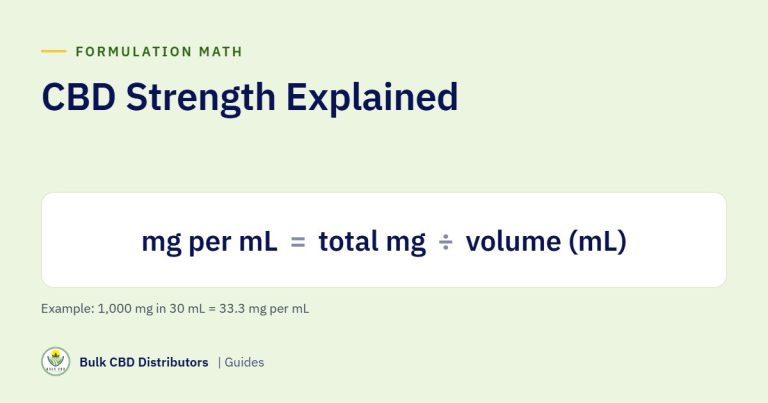
Section 781 introduces a per-container cap of 0.4 milligrams of total THC for finished consumer products. A full-spectrum tincture at 1,000 mg CBD per 30 mL bottle using distillate at 75% CBD and 0.25% total THC would contain approximately 3.3 mg total THC per bottle, well above the 0.4 mg cap. Manufacturers should conduct this calculation for every full-spectrum SKU and determine whether reformulation is needed before Section 781 takes effect. See What the 2026 Hemp Law Means for Bulk CBD Buyers.
What a Quality Full-Spectrum CBD Oil COA Must Show
- Total THC by the correct formula: Delta-9 + Delta-8 + (THCA x 0.877), checked against the version you are buying (Compliant lots at 0.3% Delta-9 THC or less). A COA showing only Delta-9 THC is not sufficient.
- Full cannabinoid panel: CBD percentage plus CBG, CBN, CBC, and any other detectable cannabinoids. A COA showing only CBD and total THC does not confirm the full-spectrum profile.
- Terpene panel (recommended): useful where terpene content is part of the formulation rationale.
- Residual solvents per USP 467: all process solvents confirmed below regulatory limits.
- Heavy metals, pesticides, and microbials: the complete contamination panel.
- ISO 17025-accredited, DEA-registered third-party laboratory: both credentials required on every current lot.
From the Field
"Full-spectrum CBD oil is the one format where the THC documentation question matters most, and it is also the format where I have seen the most documentation shortcuts taken. For years, a significant portion of the market was only testing Delta-9 THC and calling product compliant, ignoring the full formula that includes Delta-8 and the THCA conversion factor. The difference between Delta-9 alone and the complete total THC calculation can be the difference between a compliant bulk ingredient and a non-compliant one. That gap has real consequences for buyers who relied on the abbreviated result. BCD requires the complete formula on every full-spectrum COA because that is the only number that actually means what Farm Bill compliance requires. When you review a full-spectrum COA, the first thing to check is whether total THC is calculated correctly, not just whether delta-9 is below 0.3%."
John Piccone, Founder, Bulk CBD Distributors
How to Evaluate a Full-Spectrum CBD Oil Supplier
- Total THC calculation method: does the COA use the complete formula (Delta-9 + Delta-8 + THCA x 0.877), or only Delta-9 THC? Suppliers calculating only Delta-9 may be understating actual total THC.
- Lab credentials: ISO 17025-accredited and DEA-registered third-party laboratory on every current lot. Non-negotiable for material containing THC.
- Lot traceability: the specific lot's THC level must be documented for your compliance files.
- Consistency of minor cannabinoid profile: if entourage positioning is part of your product story, confirm the supplier maintains profile consistency across lots.
- Post-Section 781 compliance posture: does the supplier document compliance with both the 0.3% bulk ingredient threshold and the 0.4 mg finished product container cap?
What This Means for Your Business
Full-spectrum CBD oil remains a viable bulk ingredient after Section 781 takes effect for buyers who understand the compliance landscape. From December 11, 2026, the hemp definition counts total THC, including THCA, so check the total THC figure on every lot COA. Standard full spectrum typically tests above 0.3% and is in-process material; the Compliant version is the one for finished products, where the main compliance work is the per-container calculation. Buyers who have not run the total THC per container calculation for their full-spectrum SKUs should do so before Section 781 takes effect. For products exceeding the cap, broad-spectrum CBD distillate (the Non-Detect THC option) or CBD isolate is the usual substitution.
Compare Current Full-Spectrum CBD Distillate Specs and COAs
Both versions, current sizes and the representative COA for full-spectrum CBD distillate are on the product page, and other grades are listed under CBD distillate. Minimums run 100g to 1kg depending on the product, and most orders ship within a few days.
Frequently Asked Questions
What is full-spectrum CBD oil?
Full-spectrum CBD oil is hemp-derived extract containing CBD as the dominant cannabinoid alongside the complete native cannabinoid profile (CBG, CBN, CBC, terpenes) and the plant's natural THC: typically above 0.3% Delta-9 THC in the Standard version and 0.3% or less in the Compliant version. An oil-phase ingredient with characteristic hemp flavor and amber color.
Does full-spectrum CBD oil contain THC?
Yes. Standard full spectrum keeps the plant's natural THC, typically above 0.3% Delta-9 THC, and the Compliant version is remediated to 0.3% Delta-9 THC or less. Total THC is calculated as Delta-9 + Delta-8 + (THCA x 0.877) and should be confirmed on every current-lot COA.
Is full-spectrum CBD oil legal under Section 781?
Yes, as a bulk B2B ingredient. Compliant full-spectrum CBD distillate, at 0.3% Delta-9 THC or less, is the version for finished products after Section 781 takes effect, and finished products must also meet the 0.4 mg per container cap. Standard full spectrum typically tests above 0.3% and is in-process material. Finished consumer products must contain no more than 0.4 mg total THC per container; manufacturers should confirm their finished SKUs meet this threshold.
What is the difference between full-spectrum and compliant full-spectrum CBD distillate?
Both are full-spectrum CBD distillates with the native minor cannabinoid profile. Standard keeps the plant's natural THC, typically above 0.3% Delta-9 THC, and is in-process material; Compliant is remediated to 0.3% Delta-9 THC or less for finished products. Choose Compliant for anything that goes straight into a finished product.
What should a full-spectrum CBD oil COA include?
Total THC calculated as Delta-9 + Delta-8 + (THCA x 0.877), checked against the version you are buying; full cannabinoid panel (CBD, CBG, CBN, CBC); residual solvents per USP 467; heavy metals; pesticides (50-compound minimum); microbials. Testing laboratory must be ISO 17025-accredited, third-party, and DEA-registered. A COA showing only Delta-9 THC is insufficient.
What is the 0.4mg THC container cap and how does it affect full-spectrum products?
Section 781 limits finished hemp-derived consumer products to 0.4 mg total THC per container. For full-spectrum CBD products, multiply the distillate's total THC percentage by the total distillate mass in the finished product to calculate total THC per container. Products exceeding 0.4 mg need reformulation before Section 781 takes effect. Bulk B2B ingredients are not subject to this cap.
What is the difference between full-spectrum and broad-spectrum CBD oil?
Full-spectrum keeps the plant's natural THC (Standard typically above 0.3% Delta-9 THC; Compliant 0.3% or less). Broad-spectrum CBD distillate reduces THC to 0.3% or less (Standard) or to non-detect (Non-Detect THC option) while retaining the CBD and minor cannabinoid profile. Broad-spectrum is the right choice when multi-cannabinoid positioning is desired but THC must be non-detect; specify the Non-Detect THC option.
What is the minimum order quantity for full-spectrum CBD oil at BCD?
Minimums run 100g to 1kg depending on the product, and most orders ship within a few days.
Can I use full-spectrum CBD oil in gummies?
Yes, but the 0.4 mg per container THC cap requires careful formulation. At typical gummy concentrations of 25 mg CBD per piece in a 30-count package, the THC contribution from full-spectrum distillate at 0.25% total THC may total approximately 2.2 to 2.5 mg per package (at 75 to 85% CBD), well above the 0.4 mg cap. Manufacturers using full-spectrum distillate in gummies should switch to broad-spectrum or CBD isolate for finished consumer products before Section 781 takes effect.
How does full-spectrum CBD oil compare to CBD isolate for tincture production?
Full-spectrum produces tinctures with natural hemp flavor and multi-cannabinoid profile supporting entourage positioning. CBD isolate produces completely flavor-neutral tinctures with precise mg/mL dosing and non-detect THC. Under Section 781, formulators must also ensure full-spectrum tinctures meet the 0.4 mg per container THC cap.