CBDA isolate is a crystalline powder of cannabidiolic acid, the acid form of CBD that raw hemp makes before heat converts it. CBDA isolate typically tests at 99% or more CBDA, and the main thing a buyer has to manage is temperature: CBDA slowly turns into CBD when it is warmed, aged or exposed to light. This guide covers what CBDA is, how it compares with CBD isolate, how to keep it intact in a formula, how to read its COA, and what affects order sizes and lead time. If you are sourcing CBDA for a raw-positioned or cold-process product line, this is the practical version.
What Is CBDA and How Does It Become CBD?
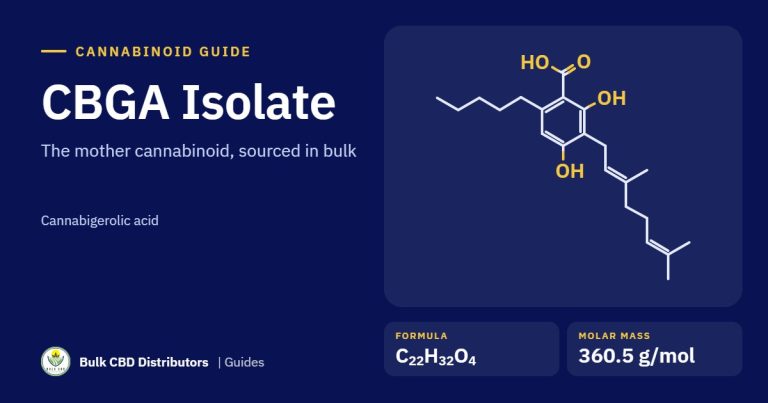
CBDA stands for cannabidiolic acid. It is the acidic precursor to CBD, and in raw, unheated hemp it is the main form in which the plant stores the compound. According to PubChem, CBDA has the molecular formula C22H30O4 and a molecular weight of about 358.47 g/mol. CBD is C21H30O2 at about 314.46 g/mol. The difference is a carboxylic acid group (-COOH) on the CBDA molecule.
When heat, time or sunlight removes that group, CBDA becomes CBD. The reaction is called decarboxylation, and it releases the acid group as carbon dioxide. This is why most finished CBD products are made from material that has already been heated: the CBDA was converted along the way. CBDA isolate keeps the cannabinoid in its acid form, so a manufacturer can put CBDA into a finished product without it converting during processing, provided the process stays gentle.
CBDA does not convert to THC. Decarboxylation of CBDA produces CBD, and that is the only conversion that matters for this ingredient.
CBDA Isolate vs. CBD Isolate: What Is Different?
| Spec | CBDA isolate | CBD isolate |
|---|---|---|
| Compound | Cannabidiolic acid, acid form | Cannabidiol, neutral form |
| Formula and weight | C22H30O4, 358.47 g/mol | C21H30O2, 314.46 g/mol |
| Typical purity | 99%+ CBDA (see lot COA) | 99%+ CBD (see lot COA) |
| Form | White to off-white crystalline powder | White crystalline powder |
| Heat sensitivity | High: converts to CBD with heat, time or light | Stable at normal processing temperatures |
| Storage | Refrigerated, 2 to 8 C, opaque and airtight | Cool, dry, away from light |
| Typical shelf life sealed | 12 months refrigerated; less at ambient temperature | Longer; see the CBD isolate page |
| Solubility | Insoluble in water; soluble in ethanol, MCT oil and lipid carriers | Insoluble in water; soluble in ethanol, MCT oil and lipid carriers |
| Typical price position | Premium (cold-process production) | Standard |
The figures are typical ranges; the batch COA for your lot is the controlling document. You can review the full specs on the CBDA isolate product page.
How Does Heat Affect CBDA?
Temperature is the main variable. CBDA does not flip to CBD at one fixed point; it converts at a rate that depends on both temperature and time. The ranges below are typical guidance for CBDA isolate.
| Condition | What to expect |
|---|---|
| Refrigerated, 2 to 8 C | Recommended storage; typical 12 month shelf life sealed |
| Room temperature | Gradual conversion to CBD over time; avoid for long-term inventory |
| Above 30 C (86 F) | Avoid at any point in the supply chain, including transit |
| About 80 to 95 C | Conversion to CBD is slow but real over a processing run |
| 110 C (230 F) and above | Conversion to CBD is fast |
The practical rule is to treat CBDA like any heat-sensitive ingredient: keep it cold until you need it, keep the process cool, and test the finished lot.
Where Is CBDA Isolate Used?
These are common application areas for CBDA isolate. Use levels are typical figures; set your own from the lot COA.
| Product format | How CBDA is used | Typical use level |
|---|---|---|
| Raw and cold-process tinctures | Primary cannabinoid, dissolved in carrier oil | 10 to 50 mg/mL CBDA |
| Soft gels and capsules | Made under cold-process conditions, often paired with CBD | 5 to 25 mg CBDA per unit |
| Topicals and skincare | Where the finished-product heat profile stays low | 0.5 to 2% CBDA by weight |
| Cold-fill beverages and shots | Needs an emulsification system because CBDA is lipid soluble | Depends on emulsion |
| Gummies and edibles | Only with temperature-controlled manufacturing | Set from lot potency |
| Multi-acid blends | CBDA combined with other acid-form cannabinoids | Set from lot potency |
| Pet products | Tinctures and treats for raw-positioned lines | Set from lot potency |
| Lab reference material | Potency testing standard | Lab dependent |
Pairing CBDA with CBGA and similar acid forms is a common concept for raw-positioned lines. If you are building one, see our guide to minor cannabinoids for how the acids and neutral forms relate.
How Do You Handle CBDA Isolate in a Cold-Process Formula?
This is the workflow most formulators follow to keep CBDA in its acid form from the warehouse to the finished lot:
- Keep sealed stock refrigerated. Hold unopened containers at 2 to 8 C in opaque, airtight packaging until the batch is scheduled.
- Plan the process temperature. Set every step as low as the formula allows. Conversion is slow from about 80 C and fast from 110 C, so anything near those ranges needs a decision before you start.
- Let the container reach room temperature before opening. This avoids condensation on the powder.
- Weigh promptly with clean, dry tools. Move any unused powder into airtight, light-protective storage and return it to refrigeration right away, because degradation speeds up once a container is opened.
- Dissolve with gentle mixing, not heat. CBDA dissolves in ethanol, MCT oil and other lipid carriers. Use agitation and time rather than warming.
- Test the finished lot. Confirm the CBDA content and the CBD content so you know how much acid form survived processing.
How Do You Read a CBDA Isolate COA?
A CBDA COA follows the same structure as any hemp extract COA, with checks that matter specifically for an acid-form ingredient:
- Header and lot match. Product name, lot number and test date, with the lot number matching the container label.
- Lab credentials. The lab should be ISO 17025 accredited and independent of the seller. Many buyers also require a DEA-registered third-party laboratory.
- CBDA purity. Find CBDA first. Typical CBDA isolate tests at 99% or more.
- Residual CBD. Some CBD is usually present from minor conversion during production. The CBD line is a direct measure of how gently the lot was handled, so compare it across lots.
- Total CBD, if you label it. Total CBD is calculated as CBD plus CBDA multiplied by 0.877, the weight ratio of the two molecules. Check the math yourself.
- THC and THCA. Total THC is Delta-9 THC plus THCA multiplied by 0.877, plus Delta-8 and other THC isomers that Section 781 of P.L. 119-37 counts. CBDA does not turn into THC, but your COA still needs to show low THC and THCA.
- Contaminants. Residual solvents within USP 467 limits, heavy metals, pesticides, mycotoxins and microbials, each reported and marked pass.
The representative COA for CBDA isolate is posted on our CBDA isolate lab results page. Whatever the source, ask for the batch COA for your specific lot. For a section-by-section walk-through, see How to Read a Hemp COA.
How Should CBDA Isolate Be Stored?
- Refrigerate. Store sealed containers at 2 to 8 C (36 to 46 F), away from direct light and air. Room-temperature storage speeds conversion to CBD and should be avoided for long-term inventory.
- Use opaque, airtight packaging. Once a container is opened, degradation accelerates, so reseal and refrigerate quickly.
- Watch the whole chain. Avoid temperatures above 30 C (86 F) at any point, including receiving docks and delivery trucks in warm weather. Ask your supplier how packaging handles transit.
- Plan inventory around shelf life. Typical shelf life is 12 months sealed and refrigerated, and shorter at ambient temperature, so buy for your production calendar rather than stockpiling.
- Record keeping. File the batch COA with production records and match lot numbers on every container.
Typical Order Sizes, Lead Times and Pricing Factors
Bulk CBDA isolate is usually sold from 100g to 1kg upward, with common sizes such as 500g, 1kg and 5kg and larger volumes priced by quote. Per-kilogram pricing usually falls at higher volume, and buyers with recurring needs often set up standing orders. Pricing moves with volume tier, so this guide does not quote fixed numbers.
Lead time depends mostly on lot availability, volume and shipping conditions. Because CBDA is temperature sensitive, share your receiving conditions with your supplier so the packaging and delivery timing suit them.
CBDA isolate costs more than CBD isolate. The reason is the production method: cold extraction, low-temperature separation and refrigerated handling all add cost compared with standard CBD isolate.
How Should You Vet a CBDA Supplier?
- Lot-specific COAs. Ask for the COA tied to the lot you will receive, not a generic sheet.
- Residual CBD history. Request COAs from two or three recent lots and compare the CBD line. A rising CBD number points to rough handling.
- Cold-process production. Ask whether extraction and separation are done at controlled low temperatures, and get the answer in writing.
- Storage and shipping. Ask how the material is stored before shipping and how it is packed for warm weather.
- Independent testing. Confirm the lab is ISO 17025 accredited and independent of the seller. A DEA-registered third-party laboratory adds another layer of assurance.
- Plant-derived material. Section 781 of P.L. 119-37 excludes cannabinoids that are synthesized or manufactured outside the plant, starting November 12, 2026. Ask how the CBDA is made.
- Clear terms. Look for written MOQ, lead time and payment terms, and be cautious of prices far below market.
Our guide to vetting a legitimate B2B supplier covers the broader process.
Is CBDA Affected by Section 781?
CBDA is a non-intoxicating cannabinoid that stays within the federal hemp definition when it is plant derived and total THC, including THCA, is at or below 0.3% on a dry weight basis. Section 781 of P.L. 119-37 takes effect on December 11, 2026 for most provisions, and finished consumer products face a 0.4 mg per container cap on total THC and similar cannabinoids. State rules for finished products vary, so confirm registration and labeling requirements for your market. Our overview, What the 2026 Hemp Law Means for Bulk CBD and Non-Intoxicating Cannabinoid Buyers, covers the dates in detail. This is general information, not legal advice.
What This Means for Your Business
CBDA isolate is a specialty acid-form ingredient, and its value depends on keeping it intact. Buy it for a specific raw-positioned or cold-process program, plan refrigerated storage before it arrives, keep your process temperatures low, and test finished lots for both CBDA and CBD. Read every batch COA in full, with extra attention to the residual CBD line. If your formula does not need the acid form, CBD isolate is the simpler and more stable choice.
Compare Current CBDA Isolate Specs and COAs
Current sizes and a representative COA from an ISO 17025-accredited third-party laboratory are on the CBDA isolate page. At BCD, the batch COA ships with every order, MOQs are 100g to 1kg depending on the product, and most orders ship within a few days. If you have questions about cold-process handling or receiving conditions, we are glad to help.
Frequently Asked Questions
What is CBDA?
CBDA is cannabidiolic acid, the acid form of CBD found in raw, unheated hemp. Heat, time or light removes its acid group and converts it to CBD.
What is the difference between CBDA and CBD?
CBDA has an extra carboxylic acid group, giving it the formula C22H30O4 versus C21H30O2 for CBD. CBDA is heat sensitive and converts to CBD, while CBD is stable at normal processing temperatures.
Is CBDA sold as an oil?
CBDA is usually sold as an isolate, a 99%+ crystalline powder. Manufacturers make CBDA oil by dissolving the isolate in a carrier such as MCT oil, typically at 10 to 50 mg/mL for tinctures.
How pure is CBDA isolate?
CBDA isolate typically tests at 99% or more CBDA. The exact figure for each lot is on its batch COA.
Why does CBDA isolate contain some CBD?
Small amounts of CBD can form during production or storage as CBDA slowly converts. The residual CBD line on the COA shows how much, and it is a useful quality indicator.
How should I store CBDA isolate?
Refrigerate sealed containers at 2 to 8 C in opaque, airtight packaging, away from light. Avoid temperatures above 30 C at any point. Typical shelf life is 12 months refrigerated.
Can I heat CBDA in my formula?
Heat converts CBDA to CBD. Conversion is slow from about 80 C and fast from 110 C and above, so keep process temperatures as low as your formula allows if you want to preserve the acid form.
Does CBDA convert to THC?
No. Decarboxylating CBDA produces CBD. Your finished product still has to meet federal and state limits on total THC and THCA.
What is the minimum order for CBDA isolate?
BCD minimums run 100g to 1kg depending on the product. CBDA isolate is listed online in 500g, 1kg and 5kg sizes, and larger volumes are available by bulk quote.
What affects CBDA isolate lead time?
Mostly lot availability, volume and shipping conditions. Because CBDA is temperature sensitive, plan delivery so the material is not held above 30 C in transit or on a receiving dock.