Broad-spectrum CBD oil is hemp-derived extract containing cannabidiol as the dominant cannabinoid, with minor cannabinoids and some terpenes from the source plant retained and THC reduced to 0.3% Delta-9 THC or less (some lots non-detect), or to non-detect across all three fractions (delta-9, delta-8 and THCA) on the Non-Detect THC option. For manufacturers, brand formulators, and bulk buyers building multi-cannabinoid product lines, it occupies a specific position between full-spectrum and isolate, offering the formulation richness of a whole-plant extract without the compliance exposure that comes with detectable THC. This guide covers what makes an oil broad-spectrum, how to verify three-fraction non-detect on a COA, typical specs, formulation applications, and what to confirm before committing to a supplier or a volume purchase.

What Makes CBD Oil Broad Spectrum
The term broad-spectrum refers to a cannabinoid extract that has undergone selective THC removal while preserving the rest of the plant's cannabinoid and terpene composition. In practice this is accomplished through a secondary processing step after initial extraction, typically chromatographic separation, applied to an otherwise full-spectrum crude or distillate base.
The result retains CBD as the primary cannabinoid, along with meaningful concentrations of minor cannabinoids such as CBG, CBN, and CBC, plus the terpene fraction that contributes to the extract's character. What it does not retain is most of the THC: Standard lots test at 0.3% Delta-9 THC or less (some lots non-detect), and the Non-Detect THC option tests non-detect. When you need non-detect, the standard for confirming it is more demanding than a single-fraction test panel. For the full three-way breakdown, see Full Spectrum vs. Broad Spectrum vs. CBD Isolate.
Broad Spectrum vs. Full Spectrum: The Practical Difference for Formulators
The distinction between broad-spectrum and full-spectrum CBD oil is compliance posture as much as chemistry. Full-spectrum oil carries the plant's natural THC (the Compliant version at 0.3% Delta-9 THC or less), which means a finished consumer product containing it must be carefully dosed and labeled to remain compliant under Section 781 of P.L. 119-37. Broad-spectrum reduces that variable by removing most of the THC before it reaches your production floor, and the Non-Detect THC option removes it to non-detect.
For formulators producing finished goods for national retail distribution, for brands marketing to consumers who actively avoid THC, and for any manufacturer whose customers apply independent third-party testing to incoming ingredients, broad-spectrum is the cleaner specification. The tradeoff is that the secondary processing step adds cost relative to full-spectrum distillate, and some terpene and minor cannabinoid content is reduced during THC removal depending on the method. A well-sourced broad-spectrum oil holds the minor cannabinoid profile reasonably intact. A poorly processed one looks closer to enriched isolate. The COA tells you which you are buying.
| Factor | Broad-Spectrum CBD Oil | Full-Spectrum | Isolate |
|---|---|---|---|
| CBD content | 80 to 95% | 75 to 85%+ | 99%+ |
| THC status | Standard: 0.3% or less, some lots non-detect. Non-Detect THC: all 3 fractions | Standard: typically above 0.3%. Compliant: 0.3% or less | Non-detect |
| Minor cannabinoids | Retained | Retained | None |
| Section 781 finished-product exposure | Run the math on Standard; minimal on Non-Detect | Calculate per container | Non-detect (confirm the reporting limit) |
| Best for | Low-THC and non-detect THC multi-cannabinoid lines | Whole-plant positioning | Precision, flavor-neutral |
How to Read a Broad Spectrum COA for THC Non-Detect
Non-detect on a broad-spectrum COA is only meaningful when it covers all three THC fractions. Delta-9 THC, delta-8 THC, and THCA each have distinct extraction and detection profiles. A supplier who reports delta-9 as non-detect while omitting delta-8 and THCA from the panel has not confirmed full non-detect; they have confirmed that one fraction was below detection limits. That is a material difference if your finished product is subject to total THC testing by your customer's quality team or a state regulator.
When reviewing a broad-spectrum COA, confirm that all three lines appear on the cannabinoid panel and that each shows a confirmed non-detect value, not a blank cell. A blank cell means the analyte was not tested. A confirmed non-detect value (ND, below the laboratory's limit of detection) means the test was run and THC was not detected; a result reported as below the LOQ means THC was detected at a low level. For the complete panel walkthrough, see How to Read a Hemp COA. For Standard lots, ask for each THC fraction to be reported so you can run the per-container math; for Non-Detect THC lots, ask for three-fraction non-detect confirmation before the order is released.
Regulatory Reference
The federal hemp program defines total THC as delta-9 THC plus the THC that THCA yields on decarboxylation: Total THC = (0.877 × THCA) + THC. That formula is the reason a broad-spectrum COA reporting only delta-9 is incomplete: a lot can show non-detect delta-9 while still carrying THCA that converts on heating. A complete non-detect determination confirms delta-9, delta-8, and THCA each below the laboratory's limit of detection.
Typical Cannabinoid Profile and Potency Specs
Quality broad-spectrum CBD oil typically carries CBD concentrations in the 80 to 95% range by weight, with total cannabinoid content typically 75 to 95% depending on source material and processing approach. Minor cannabinoids, primarily CBG, CBN, CBC, and trace CBDA, account for the balance of the cannabinoid fraction. The terpene fraction, when preserved through careful low-temperature processing, can add a small percentage by weight and contributes formulation character beyond what isolate-based formulations achieve.
Potency should be treated as a lot-specific data point rather than a static product specification. Broad-spectrum oil derived from a high-CBG source plant carries a different minor cannabinoid ratio than oil derived from a standard CBD-dominant cultivar. When CBD potency is the primary formulation target, the minor cannabinoid distribution matters less than total cannabinoid yield and three-fraction THC non-detect confirmation. When the full profile is part of a product's formulation story, ask for the complete minor cannabinoid breakdown by percentage for the specific lot being quoted.
Formulation Applications by Product Category
Broad-spectrum CBD oil is a workable ingredient across a wide range of finished product formats. The most common applications:
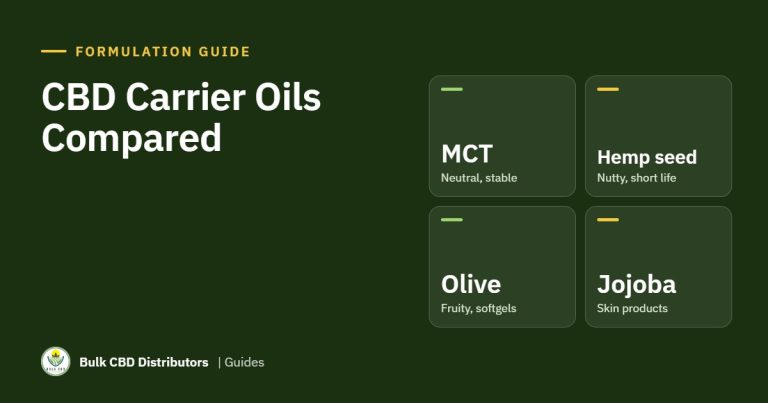
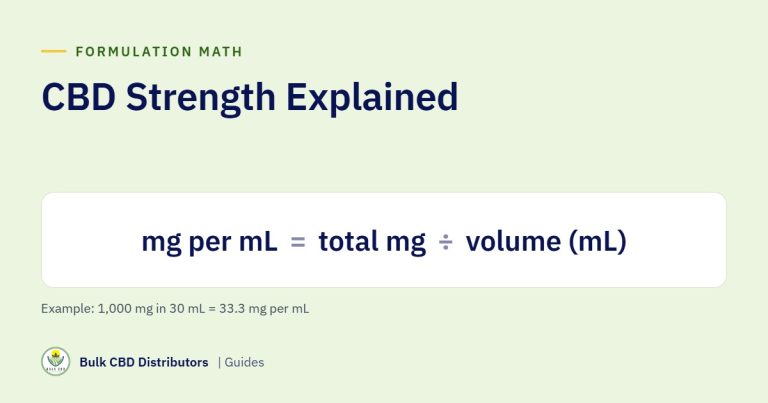
Tinctures and sublingual drops: The most direct application. Broad-spectrum oil in MCT, hemp seed, or fractionated coconut oil produces a tincture with the multi-cannabinoid character educated consumers associate with whole-plant extracts, with little or no THC. Dosing math is straightforward from a known CBD potency percentage.
Softgels and capsules: Broad-spectrum oil encapsulated in gelatin or vegan shell formats. Shelf life is favorable when stored below 25 degrees Celsius in sealed containers, and the format avoids the carrier oil selection questions that come with tinctures.
Topicals: Broad-spectrum oil adds cannabinoid complexity to salves, creams, and balms for formulators who want a whole-plant profile with little or no THC. Emulsification requirements are the same as for other oil-phase CBD ingredients.
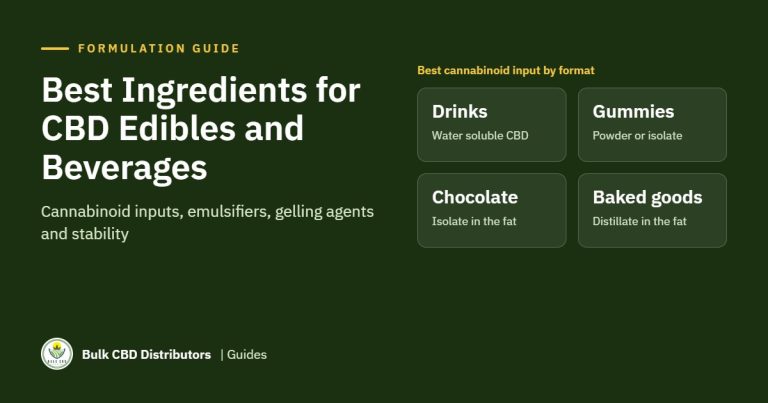
Gummies and edibles: Where crystal-resistant distillate is preferred for processing consistency, broad-spectrum oil may need additional formulation attention if it shows crystallization tendency at production temperatures. Confirm the oil's behavior with a small test batch before committing to production volume. For flavor-neutral edibles, CBD isolate is the alternative.
Sourcing Checklist: What to Confirm Before You Buy
When evaluating a wholesale broad-spectrum CBD oil supplier, the following questions produce the most useful qualification data:
- COA completeness: Full-panel cannabinoid testing with all three THC fractions listed, from an ISO 17025-accredited, DEA-registered third-party laboratory whose accreditation scope specifically covers cannabinoid potency.
- Lot-specific vs. spec-sheet documentation: A spec sheet describes a category; a COA documents a specific production lot. Confirm the batch number on the COA matches the material being quoted.
- Minor cannabinoid retention: Ask for the full cannabinoid panel, not just the CBD percentage. If the supplier cannot state the CBG, CBN, and CBC concentrations in the lot you are buying, they may not be testing for them.
- Availability and lead time: Broad-spectrum oil is a processed ingredient, not a commodity raw material. Confirm lot availability at the time of order, not in general.
For the full supplier-vetting framework, see How to Source Wholesale CBD: The B2B Buyer's Complete 2026 Guide. Federal hemp program guidance is published by the USDA AMS Hemp Program.
Section 781 Compliance and Broad Spectrum CBD Oil
Section 781 of P.L. 119-37 restructures the federal hemp definition around intoxicating potential. Non-Detect THC broad-spectrum CBD oil adds negligible THC to the container cap; Standard lots at 0.3% or less still need the per-container calculation. Section 781 applies to CBD extracts the same way it applies to every hemp ingredient: synthetic cannabinoids that cannot be naturally produced by the plant are excluded from November 12, 2026, and total THC (THCA counts) and the 0.4 mg total THC per container cap take effect December 11, 2026. For formulators building product lines for the post-Section 781 market, see what the 2026 hemp law means for bulk CBD buyers.
What This Means for Your Business
If your product line needs the multi-cannabinoid character of a whole-plant extract but cannot carry THC into the finished product, broad-spectrum CBD oil is the default starting point: Non-Detect THC lots make the Section 781 per-container calculation a formality (Standard lots still need it) while keeping the minor cannabinoid and terpene profile that supports multi-cannabinoid positioning. The one thing that separates a reliable broad-spectrum source from a risky one is a current, lot-specific COA that reports every THC fraction, with three-fraction non-detect confirmation when you specify Non-Detect THC.
Compare Current Broad-Spectrum CBD Distillate Specs and COAs
Standard and Non-Detect THC options, current sizes and the representative COA are on the broad-spectrum CBD distillate page, and other grades are listed under CBD distillate. Minimums run 100g to 1kg depending on the product, and most orders ship within a few days.
Frequently Asked Questions
What is broad-spectrum CBD oil?
Broad-spectrum CBD oil is hemp-derived extract containing CBD as the dominant cannabinoid alongside minor cannabinoids and terpenes from the source plant, with THC reduced to 0.3% or less, or to non-detect on the Non-Detect THC option. It differs from full-spectrum oil in that most of the THC is removed, and from isolate in that the minor cannabinoid and terpene profile is retained.
How does broad-spectrum CBD oil differ from full-spectrum CBD oil?
Full-spectrum CBD oil keeps the plant's natural THC: typically above 0.3% Delta-9 THC in the Standard version and 0.3% or less in the Compliant version. Broad-spectrum oil has undergone an additional THC removal step, producing a multi-cannabinoid extract at 0.3% Delta-9 THC or less, or non-detect on the Non-Detect THC option. The practical implication is that broad-spectrum reduces THC-related compliance exposure in finished consumer products, and the Non-Detect THC option makes the per-container math a formality.
What does non-detect THC mean on a broad-spectrum COA?
Non-detect means the analyte was tested and the result fell below the laboratory's limit of detection (LOD). For broad-spectrum oil, a complete non-detect confirmation covers all three THC fractions: delta-9, delta-8, and THCA. A COA that reports only delta-9 has not provided a full non-detect determination.
What is the typical CBD potency in wholesale broad-spectrum CBD oil?
Broad-spectrum CBD oil typically contains 80 to 95% CBD by weight, with total cannabinoid content typically 75 to 95% depending on source material and processing. Minor cannabinoids, primarily CBG, CBN, and CBC, account for the remaining cannabinoid fraction. Always review the lot-specific COA for the material being quoted.
What is the MOQ for bulk broad-spectrum CBD oil at BCD?
Minimums run 100g to 1kg depending on the product, and larger volumes are quoted by order size. Most orders ship within a few days.
Is broad-spectrum CBD oil compliant under Section 781 of P.L. 119-37?
Yes. Non-Detect THC broad-spectrum CBD oil, with non-detect results across all fractions, has minimal exposure under Section 781 of P.L. 119-37. Section 781 still applies to broad spectrum the same way it applies to every hemp ingredient: total THC counts toward the hemp definition, and from December 11, 2026 finished products are capped at 0.4 mg total THC per container. Non-Detect THC lots make that cap easy to meet; Standard lots at 0.3% or less need the per-container math.
What certifications should a wholesale broad-spectrum CBD supplier have?
Look for lot-specific COAs from an ISO 17025-accredited, DEA-registered third-party laboratory with accreditation scope covering cannabinoid potency. Additional documentation worth requesting includes Good Manufacturing Practice compliance records and a certificate of origin for the source hemp.
What packaging formats are available for bulk broad-spectrum CBD oil?
Bulk broad-spectrum CBD oil is typically available in aluminum containers, HDPE drums, or fiber drums depending on order volume. Smaller quantities ship in sealed amber containers. Confirm packaging format and container sizing with your supplier at the time of order.
What affects lead time for bulk broad-spectrum CBD oil?
Lead time depends on whether the lot is already tested and packed and on the volume. Ask for the lead time and the current-lot COA together, so the material you receive matches the document you reviewed.
How is broad-spectrum CBD oil used in product formulation?
Broad-spectrum CBD oil is an oil-phase ingredient used as the cannabinoid component in tinctures, softgels, topicals, and edibles. It provides the multi-cannabinoid character of a whole-plant extract with little or no detectable THC (non-detect on the Non-Detect THC option), making it suitable for formulations targeting a low or non-detect THC profile. Carrier oil selection, potency calculations, and emulsification follow the same parameters as other concentrated CBD oil formats.