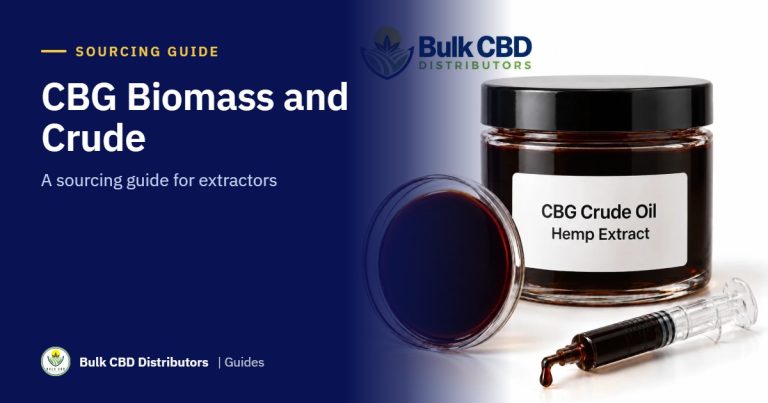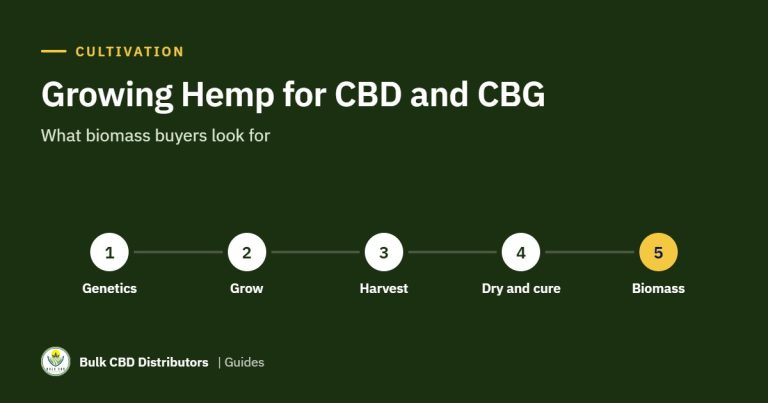
Hemp biomass is the raw plant material harvested from hemp cultivation (stems, leaves, stalks, and flower material) used as feedstock for cannabinoid extraction. For extraction labs, toll processors, and manufacturers who produce their own CBD crude or distillate, biomass is the starting point of the supply chain. For B2B buyers who have not operated in the biomass market before, it is also the category that requires the most careful sourcing discipline, because the economics of large-volume biomass deals attract the same fraud dynamics that affect crude oil purchasing. Sourcing biomass carelessly creates downstream problems that no amount of processing can correct, so this guide covers the checks to run before you buy. For current lots, see hemp biomass.
| Topic | What to know |
|---|---|
| Typical potency | Standard CBD biomass is typically about 3% to 8% total CBD by dry weight when total THC stays at or below 0.3%. CBG biomass from CBG cultivars is typically 10% to 15% CBG. Confirm on the lot COA. |
| Pricing basis | Per pound, on tested cannabinoid content; compare lots on cost per gram of CBD |
| Moisture check | 8% to 12% is standard; confirm from the COA or a moisture test at delivery |
| Order size | Usually sold from 50 lbs upward, with larger volumes case by case depending on lot inventory |
What Hemp Biomass Is and Who Buys It
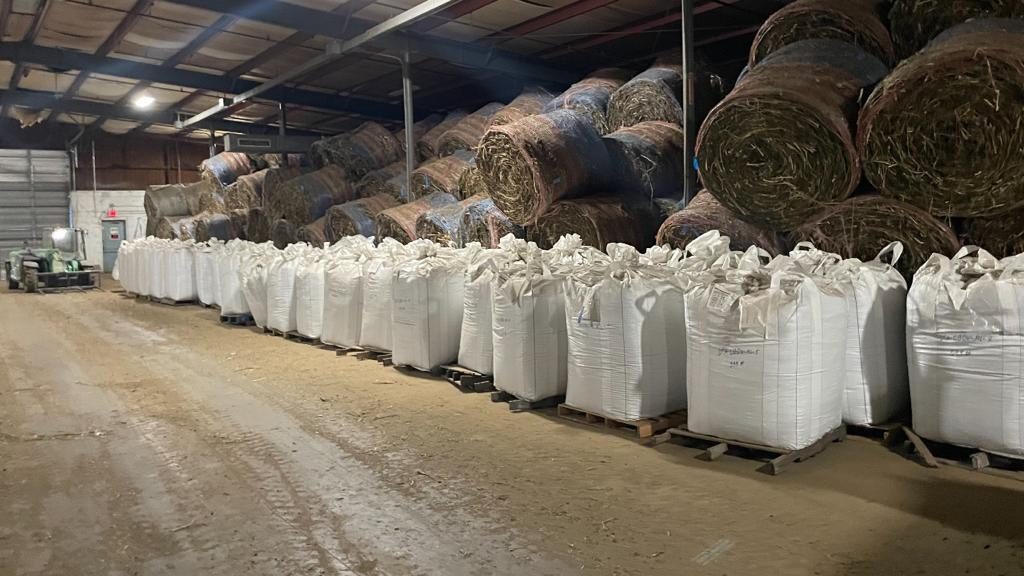
Hemp biomass encompasses all plant material remaining after hemp cultivation and primary processing. In a commercial hemp supply chain, biomass typically means one of two things: whole-plant material including stems, stalks, leaves, and some flower material, or trim-and-flower biomass that contains a higher cannabinoid concentration because it is predominantly the more potent parts of the plant.
The primary buyers of hemp biomass are extraction labs and toll processors who convert it to crude oil using ethanol or CO2 extraction. Secondary buyers include manufacturers who have acquired in-house extraction equipment and are building their own crude-to-distillate pipeline. Both buyer types evaluate biomass primarily on CBD percentage per dry pound and on the cleanliness of the pesticide, heavy metals, and microbial panels, because any contamination in the feedstock concentrates in the extract.
How Hemp Biomass Is Priced
Hemp biomass is priced per pound, with the most important pricing variable being the CBD percentage on the COA. A 5% CBD biomass and a 12% CBD biomass at the same per-pound price are not equivalent: the second delivers 2.4 times as much CBD per pound of input material, which means 2.4 times the extraction yield per dollar of feedstock cost. Normalizing biomass value to a cost-per-gram-of-CBD basis is the correct comparison framework when evaluating competing lots.
Moisture content is the second major pricing variable. Hemp biomass is sold on a dry-weight basis, but moisture manipulation (adding water weight before weighing and delivering) is one of the documented fraud vectors in this market. A biomass delivery that tests at 15% moisture contains 15% water by weight; you are paying biomass price for water. Confirm moisture content from the COA or from an independent moisture test at delivery, and apply it to the dry-weight equivalent before finalizing price comparisons.
| Driver | What to check | Effect on value |
|---|---|---|
| Cannabinoid content | Lot-specific CBD% by dry weight on the COA | Sets the value of the lot; normalize to cost per gram of CBD |
| Moisture | Moisture on the COA or from a test at delivery | Water weight is paid for at biomass price; adjust to dry weight |
| Material type | Whole-plant or trim-and-flower biomass | Trim-and-flower usually tests higher per dry pound |
| Volume | Order size against lot availability | Per-pound pricing decreases at higher volume tiers |
Quality Parameters: What to Evaluate Before Purchase
A complete hemp biomass evaluation covers four parameters:
Cannabinoid potency (lot-specific COA): The CBD percentage by dry weight from a third-party, DEA-registered laboratory. Total THC must be confirmed using the delta-9 plus THCA x 0.877 formula; biomass with detectable THCA at levels that push total THC above 0.3% dry weight is not compliant hemp. Lab accreditation scope verification applies here exactly as it does for processed ingredients: confirm the scope covers cannabinoid potency, not just that the lab holds accreditation.
Pesticide and heavy metals panels: Contamination in biomass concentrates during extraction. A biomass lot with elevated pesticide residuals will produce crude oil with those residuals at higher concentration than the source material. Review both panels with individual analyte results before committing to a volume order.
Moisture content: The 8% to 12% range is the standard for properly dried biomass. Above 14%, the material is susceptible to mold during storage; higher moisture increases microbial risk further. Moisture content is either reported on the COA or measured at delivery. Both methods are acceptable; neither is optional.
Harvest and processing documentation: Chain-of-custody documentation from harvest through delivery confirms that the material in the delivery is the same material tested on the COA. For large-volume biomass orders, this documentation is not a courtesy; it is the primary defense against lot substitution fraud.
| Parameter | What to confirm | Red flag |
|---|---|---|
| Cannabinoid potency | Lot-specific CBD% by dry weight, and total THC = Delta-9 THC + (THCA x 0.877) at or below 0.3% | A lab whose accreditation scope does not cover cannabinoid potency |
| Pesticides and heavy metals | Individual analyte results on both panels | A summary result with no analyte detail |
| Microbials | A microbial panel for the same lot | No microbial results on a high-moisture lot |
| Moisture | 8% to 12% from the COA or a test at delivery | Above 14%, with mold risk in storage |
| Chain of custody | Records from harvest through delivery, with the batch number confirmed with the lab | A COA batch number that does not match the delivery |
Extraction Yield Expectations from Hemp Biomass
Extraction yield from hemp biomass varies by input CBD%, extraction method, and processing efficiency. As a practical planning estimate, ethanol extraction from quality biomass at 6% to 8% CBD delivers crude oil yields in the range of roughly 8% to 12% of input biomass weight, depending on the extraction protocol and the wax and lipid content of the input material. CO2 extraction from the same feedstock will typically come in at the lower end of that range with a cleaner profile.
For extraction labs planning production runs based on biomass feedstock, use the lot-specific CBD% from the COA and a conservative extraction efficiency assumption to estimate crude yield per pound of input material. Do not use the advertised specification range from the supplier; use the actual lot COA value. This prevents the planning errors that occur when a lot tests lower than spec and the production run comes up short.
Section 781 Compliance and Hemp Biomass
Hemp biomass sold as an extraction feedstock is not a finished consumer product, but it must qualify as federally compliant hemp to be legally processed and sold within the framework that Section 781 of P.L. 119-37 establishes. Total THC at or below 0.3% by dry weight is the compliance threshold for hemp plant material. For biomass intended for decarboxylation in the extraction process, confirm the pre-decarb and expected post-decarb THC profile with the supplier to plan the compliance posture of the finished crude.
From the Field
"Hemp biomass is the highest-risk category in this business alongside crude oil, and the reason is the same: the dollar amounts involved in large biomass deals make fraud economically rational for bad actors. We have seen inflated CBD% claims on COAs that turned out to be from non-accredited labs, moisture manipulation to add weight before delivery, and real COAs from one lot attached to a completely different shipment. None of this is theoretical; it has happened to buyers in this market. For every biomass purchase above a few hundred kilograms, we verify the laboratory accreditation scope directly, we require chain-of-custody documentation from harvest through delivery, and we confirm the batch number with the lab before accepting. This adds a few days to the intake process. It is not optional. The buyers who build reliable biomass supply chains are the ones who treat verification as a standard step, not a response to a specific red flag."
John Piccone, Founder, Bulk CBD Distributors
How Biomass Orders Are Sized and Scheduled
Hemp biomass is typically available in quantity increments starting at 50 lbs, with pricing per pound that decreases at higher volume tiers. Because available CBD%, moisture content, and lot size vary by supply cycle, biomass orders are usually handled case by case. In-inventory lots typically ship within a few business days, while larger requirements of 100 kg or more can take a few days to a couple of weeks depending on lot availability. Share your CBD% target, volume requirement, and intended use with the supplier so they can confirm what is currently available.
Frequently Asked Questions
What is hemp biomass?
Hemp biomass is the raw plant material from hemp cultivation, including stems, stalks, leaves, and flower material, used as feedstock for cannabinoid extraction. It is the starting material in the CBD supply chain, converted to crude oil through ethanol or CO2 extraction before further refinement into distillate or isolate.
How is hemp biomass priced?
Hemp biomass is priced per pound, with the key value driver being CBD percentage by dry weight. Normalizing to a cost-per-gram-of-CBD basis is the correct way to compare lots with different potency levels. Moisture content is the second variable: biomass priced per pound on a wet-weight basis delivers less CBD per dollar than the same material priced on a dry-weight basis.
What CBD percentage is typical in wholesale hemp biomass?
Commercial hemp biomass for extraction use typically ranges from about 3% to 8% total CBD by dry weight when total THC stays at or below 0.3%, with the most common wholesale lots in the 5% to 7% range; higher CBD figures usually come with total THC above the limit. Trim-and-flower biomass with a higher flower fraction tends to test higher than whole-plant material. Verify the specific lot CBD% on the COA; do not rely on cultivar averages or supplier specification ranges for production planning.
What documentation is required for a hemp biomass purchase?
A complete hemp biomass documentation set includes a lot-specific COA from a third-party, DEA-registered laboratory covering cannabinoid potency with total THC formula, pesticides with individual analyte results, heavy metals, and microbials. For large-volume orders, chain-of-custody documentation from harvest through delivery is also standard practice to prevent lot substitution.
What is the ideal moisture content for hemp biomass?
Properly dried hemp biomass holds moisture between 8% and 12% by weight. Above 14% moisture, the material is susceptible to mold during storage and transit; above 18%, microbial contamination is probable. Confirm moisture content from the COA or from an independent moisture test at delivery before accepting a large biomass lot.
Is hemp biomass compliant under Section 781 of P.L. 119-37?
Hemp biomass with total THC at or below 0.3% by dry weight qualifies as federally compliant hemp plant material under Section 781 of P.L. 119-37. For decarboxylation-destined biomass, confirm the expected post-decarb THC profile before production planning.
What extraction yield can I expect from hemp biomass?
As a planning estimate, ethanol extraction from quality biomass at 6% to 8% CBD delivers crude oil yields of approximately 8% to 12% of input biomass weight depending on extraction protocol and biomass composition. Use the lot-specific COA CBD% and a conservative efficiency assumption for production planning, not the advertised specification range.
What is the MOQ for hemp biomass at BCD?
BCD handles hemp biomass orders starting at 50 lbs, with larger volumes case by case depending on lot inventory.
Why is hemp biomass a high-fraud-risk category?
The large dollar amounts involved in high-volume biomass transactions make COA fraud, moisture manipulation, and lot substitution financially rational for bad actors. Common fraud types include inflated CBD% on COAs from non-accredited laboratories, added moisture weight before delivery, and COAs from one lot presented for a different shipment. Multi-step verification including direct lab confirmation and chain-of-custody documentation is the standard countermeasure.
What is the difference between whole-plant biomass and trim-and-flower biomass?
Whole-plant biomass includes all parts of the hemp plant, with cannabinoid content reflecting the average across stems, stalks, leaves, and flower. Trim-and-flower biomass contains a higher proportion of the more potent parts of the plant and typically tests at a higher CBD% per dry pound. Trim-and-flower is more appropriate as extraction feedstock for higher-quality crude production; whole-plant biomass is viable for bulk crude at lower per-pound cost.
Compare current hemp biomass lots and COAs
Current lots and their COAs are listed under hemp biomass. If you are planning an extraction run, send us your CBD% target, volume and intended use, and we will tell you honestly what fits.