To start a CBD product line under Section 781, choose a non-detect or low-THC ingredient that keeps each finished container within the new limits, source it with lot-specific COAs, calculate your formulation precisely, label the product honestly, and test every finished batch. The ingredient decision now carries more weight than it used to, because Section 781 of P.L. 119-37 measures hemp by total THC and adds a 0.4 mg total THC cap per finished container. This guide walks brand founders, formulators and private label buyers through each step to start a CBD product line that will hold up when Section 781 takes effect.
Which Cannabinoid and Format Should You Start With?
Start with the finished product, then work back to the ingredient. A tincture, gummy, topical, capsule or beverage each places different demands on solubility, flavor and THC content. Under Section 781, THC content is the first filter. The law excludes finished hemp-derived cannabinoid products that contain more than 0.4 mg combined total THC per container, according to the Congressional Research Service summary.
That cap changes the math on full-spectrum ingredients. Compliant full-spectrum distillate can carry up to 0.3% Delta-9 THC, and Standard full spectrum typically tests higher. A 1,000 mg CBD bottle made with 75% full-spectrum distillate needs about 1,333 mg of distillate, which could contain up to 4 mg of total THC, ten times the per-container cap. For most new brands, a non-detect THC base is the practical starting point.
| Ingredient | Typical CBD content | THC profile | Good first products |
|---|---|---|---|
| CBD isolate | 99%+ | Non-detect THC | Tinctures, gummies, topicals, capsules |
| Broad-spectrum distillate | 80 to 95% | 0.3% or less, or non-detect | Multi-cannabinoid tinctures, gummies |
| Full-spectrum distillate | 75 to 85%+ | Compliant: up to 0.3% Delta-9 THC | Only where the per-container math works |
| Water-soluble CBD | Varies by product | Check each COA | Beverages, drink mixes |
CBD isolate is the simplest starting point: neutral in flavor, easy to weigh and non-detect for THC. Broad-spectrum CBD distillate suits brands that want CBG, CBC and other minor cannabinoids in the formula without THC. For drinks, water-soluble CBD disperses in water-based products where oil would separate.
You do not have to stop at CBD. CBG, CBN and CBC isolates let you build a multi-cannabinoid line once the core product is stable. Keep the first launch narrow: one or two formats and two or three strengths are easier to test, label and reorder than a full catalog.
How Do You Source Ingredients and Verify COAs?
Your finished product can only be as consistent as the raw material behind it. Before you buy, ask each supplier for the current lot's certificate of analysis (COA) and check it against your specification. A useful COA for a CBD ingredient includes:
- Cannabinoid panel with CBD, minor cannabinoids, Delta-9 THC, THCA and a calculated total THC (Delta-9 THC plus THCA x 0.877).
- Residual solvents reported against USP 467 limits.
- Heavy metals: lead, arsenic, cadmium and mercury.
- Pesticides, ideally a panel of 50 or more compounds.
- Microbials, including yeast, mold and pathogenic bacteria.
- Lot number and test date that match the material you will receive.
The COA should come from an ISO 17025-accredited, DEA-registered third-party laboratory. Supplier listings often show a representative COA; ask for the batch COA for your order, and keep it on file alongside your purchase records. Our guide on how to read a hemp COA covers each section in detail.
Buy a small first order before you commit to volume. Many bulk suppliers set minimums in the 100g to 1kg range, which is enough to run pilot batches, check how the ingredient behaves in your base, and confirm the potency on the COA with your own testing.
How Do You Calculate Formulation Math?
Formulation math converts a label claim into a weight of ingredient. The core formula is simple:
Ingredient needed (mg) = target CBD (mg) / purity on the COA (as a decimal)
Worked examples:
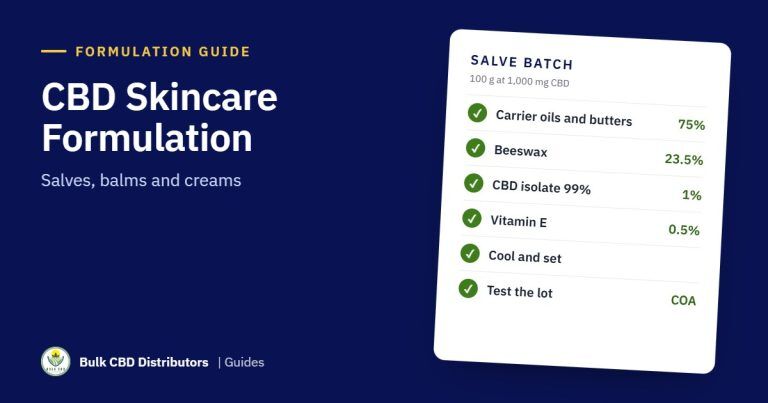
- Tincture, isolate. A 30 mL bottle labeled 1,000 mg CBD, made with 99% isolate, needs about 1,010 mg of isolate per bottle. A 1,000-bottle batch needs about 1.01 kg.
- Tincture, distillate. The same claim with 80% distillate needs 1,250 mg per bottle, or 1.25 kg per 1,000 bottles.
- Gummies. A run of 10,000 gummies at 25 mg CBD each requires 250 g of CBD. With 99% isolate that is about 252.5 g of isolate.
- Per-container THC check. Multiply the ingredient weight per container (mg) by its total THC percentage divided by 100. The result must be at or below 0.4 mg.
Three habits keep formulation math reliable. First, use the purity from the lot you are actually using, because potency varies between lots. Second, account for process losses: some material stays on mixing vessels, filters and depositors. Many manufacturers add a small overage, sized from their own pilot batch results, so finished goods land on the label claim. Third, record every calculation in a batch record so you can trace any result back to a specific ingredient lot.
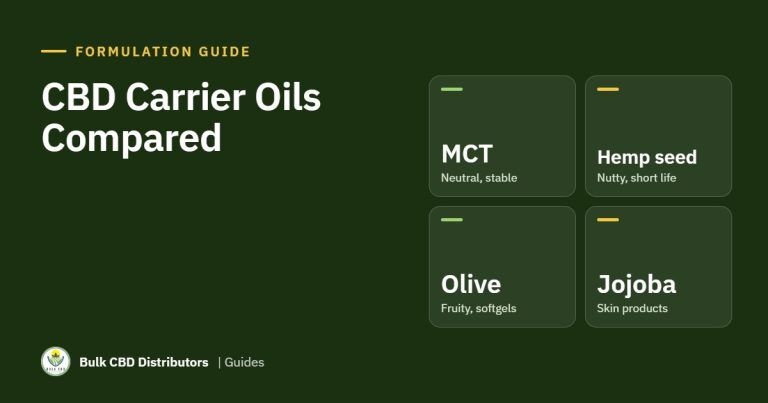
Carrier choice also matters. Isolate dissolves readily in MCT oil at common tincture strengths, while very high-strength formulas may need gentle warming and mixing time. Run a stability check over several weeks at room temperature to confirm the CBD stays in solution.
Packaging and Labeling Basics
Packaging protects the product and carries the information buyers and regulators expect. Amber or opaque glass and light-blocking containers help protect cannabinoids from light. Child-resistant closures are required for some products in some states, so confirm the rules for every state where you sell.
Most CBD labels include the following:
- Product name and format
- Net quantity (mL, g or count)
- CBD per serving and per container, plus serving size
- Total THC statement consistent with the COA
- Ingredient list
- Batch or lot number, and a QR code or URL linking to the finished-goods COA
- Business name and contact information
- Any warnings or statements your state requires
Keep label and marketing copy to composition, format and use directions. Disease or medical claims create regulatory risk. The FDA's published guidance on cannabis-derived products sets out the agency's current position on CBD in foods and supplements, and it is worth reading before you choose your product category.
How Should You Test Finished Goods?
Ingredient COAs do not prove what is in the finished product. Test every finished batch at a third-party lab before release. A standard finished-goods panel covers:
- Potency, confirming CBD per serving and per container against the label claim.
- Total THC per container, confirming it stays at or below 0.4 mg.
- Microbials, especially for water-containing products such as beverages and some gummies.
- Heavy metals and residual solvents, where your state or retail partners require them.
Many states set a tolerance range around the label claim. Learn the figure for each state you sell in, and investigate any batch that drifts toward the edge. Keep a retained sample from every batch so you can retest if a question comes up later.
Working With a Bulk Supplier
A good supplier relationship makes reordering predictable. When you evaluate partners, ask how they handle each of these points:
- Lot consistency. Will purity and minor cannabinoid content stay close from order to order?
- Documentation. Does the batch COA ship with every order, and does it report total THC?
- Minimums and lead times. What is the MOQ, and how quickly do orders ship?
- Ordering process. How are orders confirmed and paid for?
- Section 781 readiness. Does the supplier's catalog fit the total THC measure and the per-container cap?
Many bulk suppliers work on order requests: you submit a request, the supplier confirms availability and the batch, then payment is taken. Ask whether the COAs on product listings are representative, and confirm that the batch COA for your lot ships with the order. For a broader checklist, see how to find and vet a legitimate B2B supplier.
What This Means for Your Business
Starting a CBD product line is now as much a compliance project as a creative one. The total THC measure and the 0.4 mg per container cap push most new brands toward non-detect THC bases such as CBD isolate and Non-Detect THC broad-spectrum distillate. From there, success depends on discipline: documented ingredient lots, formulation math based on actual COA purity, honest labels, and third-party testing of every finished batch.
Start small. Launch one or two formats, prove consistency across several batches, then add strengths, cannabinoids and formats. Brands that build their process this way can scale volume without rebuilding their documentation from scratch, and they will be ready when Section 781 takes effect.
Comparing Ingredients for Your First Products?
Current specs and representative COAs are on the CBD isolate, broad-spectrum CBD distillate and water-soluble CBD pages. If it helps to talk through which one fits your format, we are happy to send a quote with the batch COA for your order.
Frequently Asked Questions
What is the easiest ingredient to start a CBD product line with?
CBD isolate. It is 99%+ CBD, non-detect for THC and flavor-neutral, so dosing is simple and the per-container THC cap is usually easy to meet.
Can I still use full-spectrum distillate under Section 781?
Only if the total THC per finished container stays at or below 0.4 mg. At typical tincture strengths, full-spectrum distillate usually exceeds that cap.
How do I calculate how much isolate I need?
Divide the target CBD by the purity on the COA. For a 1,000 mg bottle with 99% isolate, that is about 1,010 mg per bottle.
What should I look for on an ingredient COA?
A full cannabinoid panel with total THC, residual solvents, heavy metals, pesticides and microbials, tied to the lot number you are buying.
Do I need to test my finished products if my ingredients have COAs?
Yes. Ingredient COAs do not confirm the finished product. Test every finished batch for potency and total THC per container at a third-party lab.
What minimum order do bulk suppliers usually require?
Minimums vary by supplier. At BCD, MOQs are 100g to 1kg depending on the product, which suits pilot batches.
Should my label include a QR code?
A QR code or URL linking to the finished-goods COA for that batch is common practice and expected by many retailers.
Can I make medical claims on my CBD labels?
Avoid them. Keep labels and marketing to composition, format and directions, and review the FDA's current position before choosing a product category.
How many products should I launch with?
Start narrow, with one or two formats and two or three strengths. Expand once your batches are consistent and your documentation is in place.
How should I plan ingredient timing for a pilot batch?
Confirm availability, the batch COA and the shipping estimate with your supplier before you book production time, and leave room to run your own potency check on arrival.