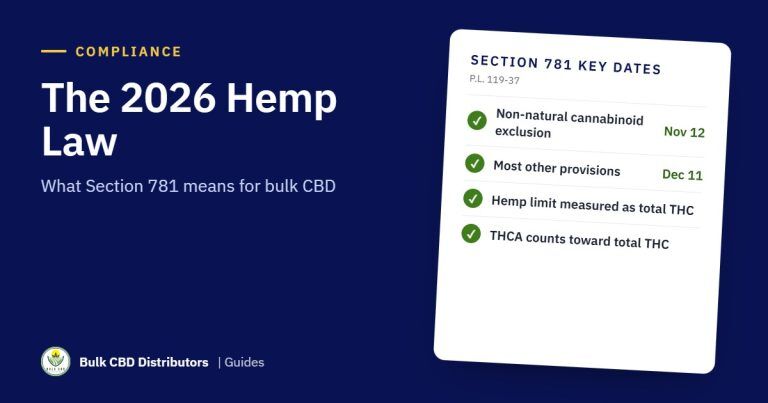
THCA and Section 781 are now linked in every hemp buyer's planning: Section 781 of P.L. 119-37 replaces the old Delta-9-only test with a total THC measure that counts THCA, so most hemp-derived THCA flower and concentrates will fall outside the federal hemp definition when Section 781 takes effect. For buyers and retailers, the practical question is no longer how to source THCA, but how to wind down exposure, document inventory and shift shelf space toward non-intoxicating cannabinoids such as CBD, CBG and CBC (CBN's status is less settled). This guide explains the THCA Section 781 change in plain terms and what to plan for.
What Is THCA and Why Did It Fall Under Section 781?
THCA (tetrahydrocannabinolic acid) is the acidic precursor of Delta-9 THC. In the living plant, cannabinoids are produced in acid form. When THCA is exposed to heat, it loses a carboxyl group (a process called decarboxylation) and converts to Delta-9 THC. The conversion is not one to one by weight: the carbon dioxide released accounts for roughly 12.3% of the THCA molecule's mass, which is why labs multiply THCA by 0.877 when estimating the Delta-9 THC it can yield.
Under the 2018 Farm Bill, hemp was defined by its Delta-9 THC concentration alone, at or below 0.3% on a dry weight basis. Because THCA was not part of that number, flower and concentrates that tested high in THCA but low in Delta-9 THC were sold as hemp. That gap is what Section 781 closes. According to the Congressional Research Service summary of Section 781, the hemp definition now uses "total THC concentration (including tetrahydrocannabinolic acid)" at the same 0.3% threshold.
For a full overview of every change in the law, including how it affects CBD and other cannabinoid categories, see our companion guide, What the 2026 Hemp Law Means for Bulk CBD and Non-Intoxicating Cannabinoid Buyers. This post focuses narrowly on THCA.
How Does the Total THC Measure Work?
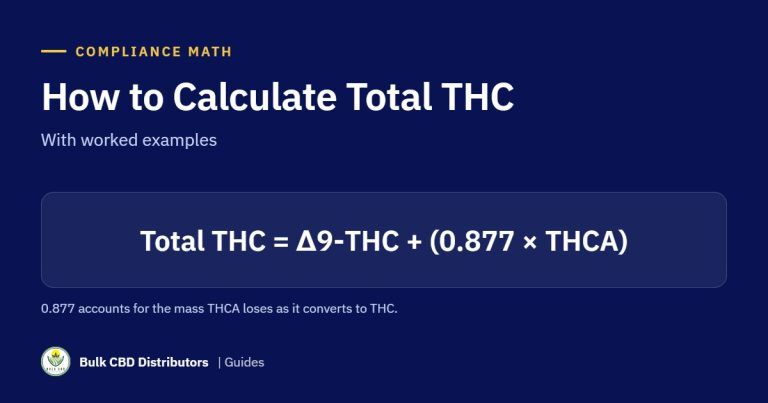
Total THC combines the Delta-9 THC already present with the Delta-9 THC that THCA could produce. The standard formula used on lab certificates of analysis (COAs) is:
Total THC = Delta-9 THC + (THCA x 0.877)
The worked example in the graphic above shows why this matters. A flower sample with 0.10% Delta-9 THC and 0.50% THCA would have passed the old Delta-9 test easily. Under the total THC measure, it calculates to roughly 0.54%, well above the 0.3% limit. Most THCA flower and concentrate products are marketed on THCA content many times higher than 0.5%, so the gap between the old and new test is larger still for those products.
Three practical points follow for anyone reading a COA:
- A Delta-9-only COA is no longer enough. Any certificate used to support hemp status should report THCA and a calculated total THC value.
- The 0.3% limit is measured on a dry weight basis. Moisture content and sample preparation affect results, so ask the lab how the sample was dried and reported.
- Lot-specific results matter. Total THC can vary between batches of the same product, so each lot needs its own certificate.
Our guide on how to read a hemp COA walks through the cannabinoid panel line by line.
What Happens to THCA Flower and Concentrates?
When Section 781 takes effect, hemp-derived THCA products are judged by total THC like every other hemp product. The comparison below summarizes how common THCA formats line up against the new measure. It describes the federal hemp definition only; state rules can be stricter and should be checked separately.
| Product type | Old test (Delta-9 only) | New test (total THC incl. THCA) | Planning note |
|---|---|---|---|
| THCA flower | Often passed on low Delta-9 | Most lots exceed 0.3% | Plan sell-through before the change |
| THCA concentrates (diamonds, isolate) | Marketed as hemp-derived | Far above 0.3% | Outside the hemp definition |
| Finished products with THCA | Delta-9 per dry weight | Total THC plus 0.4 mg per container cap | Review every SKU |
| CBD, CBG, CBC ingredients (CBN status less settled) | Compliant at 0.3% Delta-9 | Compliant at 0.3% total THC | Confirm total THC on each COA |
The key shift is that "hemp-derived" no longer describes a product on its own. Status depends on the total THC number on the COA, not on the plant the material came from.
The 0.4 mg Per Container Limit
Section 781 also adds a limit at the finished product level. The CRS summary explains that final hemp-derived cannabinoid products containing more than 0.4 milligrams combined total per container of total THC and cannabinoids with similar effects are excluded from the hemp definition. For a retailer, this is a second filter on top of the 0.3% dry weight test.
The cap is measured per container, not per serving. A multi-serving package is assessed on its total contents. Even a product built mainly on CBD or CBG can be affected if its formula carries enough residual THC to push the container total past 0.4 mg. That is one reason non-detect THC ingredients such as CBD isolate and Non-Detect THC broad-spectrum distillate have become the default choice for many finished goods.
The law also directs the FDA to publish lists of naturally occurring cannabinoids and of cannabinoids with effects similar to THC within 90 days. As of this writing, those lists have not been published. Buyers should watch for them, because they will shape how some minor cannabinoids are classified.
What Should Buyers and Retailers Plan For?
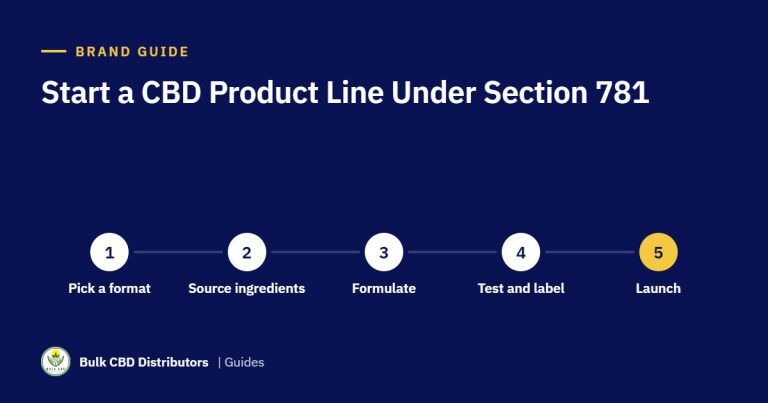
Because the change is federal and definitional, the safest approach is to plan in stages rather than wait for the last week. The steps below apply to brands, distributors and retail buyers alike.
1. Inventory every THCA-containing SKU
List each product that contains THCA, its total THC per the current COA, its container size and the quantity on hand. Include finished goods and raw materials. Many operators find THCA in more places than expected, including pre-rolls, blended flower and multi-cannabinoid concentrates.
2. Recalculate total THC from current COAs
Apply the formula to each lot. Anything above 0.3% total THC on a dry weight basis, or above 0.4 mg total THC per finished container, will not qualify as hemp once Section 781 takes effect. If a COA does not report THCA, request a new one from a third-party lab.
3. Set a sell-through and purchasing cutoff
Stop reordering THCA products well ahead of the change and size remaining orders to what you can realistically sell. Avoid long-term contracts or prepaid volume deals that run past the point when Section 781 takes effect.
4. Check state law and your service providers
State rules may already be stricter than federal law, and some payment processors, marketplaces and carriers set their own policies. Confirm what each partner will accept now and after the change.
5. Update labels, listings and marketing
Remove any claims that a product is federally compliant hemp if it will not meet the total THC test. Keep product descriptions factual and focused on composition and specifications.
6. Build the replacement assortment
Decide which compliant cannabinoids will fill the shelf space and test them with customers before the change, not after. That gives you time to refine formats, pricing and reorder quantities.
Which Compliant Alternatives Can Replace THCA Products?
CBD, CBG and CBC are affected by Section 781 the same way as any hemp ingredient: they qualify as hemp only while total THC, including THCA, stays at or below 0.3%, and finished products must also meet the 0.4 mg per container cap. CBN's status is less settled, as noted below. Each comes in bulk formats suited to different product types.
- CBD (cannabidiol). The largest category, available as CBD isolate at 99%+ purity, distillate at 75 to 95% CBD depending on grade, crude oil and water-soluble forms. CBD isolate and broad-spectrum distillate, with non-detect THC at a low LOQ, are the usual options for finished goods that must clear the per-container cap. See PubChem for its chemical profile.
- CBG (cannabigerol). Available as isolate, distillate, flower and biomass. CBG products give flower retailers a compliant flower format with total THC documented on the COA.
- CBN (cannabinol). Available as CBN isolate and crystal resistant distillate. CBN may remain within the hemp definition, but its status is less settled than CBD's because most commercial CBN is converted from other cannabinoids, and its classification will be confirmed when the FDA publishes its cannabinoid lists.
- CBC (cannabichromene). Available as isolate and distillate. CBC is a non-intoxicating minor cannabinoid often added to multi-cannabinoid formulas.
For flower-focused retailers, CBG flower and compliant CBD flower are the closest format substitutes. For concentrate and vape categories, CBD distillate and minor cannabinoid distillates fill similar formulation roles. Each should be judged on its own COA, not on the category label.
What This Means for Your Business
The THCA Section 781 change is a measurement change with large commercial effects. Products that passed on Delta-9 alone will be judged on total THC, and finished goods face a second test at 0.4 mg per container. For most THCA flower and concentrates, that means they will not qualify as hemp when Section 781 takes effect.
The businesses best placed for the transition are those that start now: inventory THCA exposure, recalculate total THC on every lot, set a purchasing cutoff, and build a replacement assortment around CBD, CBG, CBN and CBC. Every one of those steps depends on good documentation, so make complete, lot-specific COAs a condition of every purchase.
When you compare replacement ingredients, review the representative COA on the product page, ask for the batch COA for the lot you receive, and confirm both report THCA and a calculated total THC value.
Comparing Replacement Cannabinoids?
Current specs and representative COAs are on the CBD isolate, CBN isolate and CBG products pages. If it helps to plan the shift, we are happy to send a quote with the batch COA for your lot.
Frequently Asked Questions
Does Section 781 count THCA toward the 0.3% THC limit?
Yes. Section 781 measures hemp by total THC, including THCA, at or below 0.3% on a dry weight basis. The usual calculation is Delta-9 THC plus THCA multiplied by 0.877.
Will THCA flower still qualify as hemp when Section 781 takes effect?
Most THCA flower will not. Once THCA is counted, typical THCA flower lots calculate well above 0.3% total THC and fall outside the federal hemp definition.
Why is THCA multiplied by 0.877?
When THCA converts to Delta-9 THC it releases carbon dioxide, about 12.3% of its mass. Multiplying by 0.877 estimates how much Delta-9 THC the THCA can yield.
Does the 0.4 mg cap apply per serving or per container?
Per container. The CRS summary describes the limit as 0.4 milligrams combined total per container of total THC and cannabinoids with similar effects.
Are CBD, CBG, CBN and CBC affected by the THCA change?
Yes, in the same way as every other hemp product. Total THC, including THCA, must be at or below 0.3%, and finished products must stay within the 0.4 mg total THC per container cap. CBN's status is less settled and will be clarified when the FDA publishes its cannabinoid lists.
What should I do with THCA inventory I already hold?
Document each SKU and lot, recalculate total THC from current COAs, plan sell-through before the change, and check state law. Speak with qualified legal counsel for your specific situation.
Is a COA that only shows Delta-9 THC still acceptable?
No. To show hemp status under Section 781, a COA should report THCA and a calculated total THC value, and it should be specific to the lot you are buying.
Can state law be stricter than Section 781?
Yes. States can set tighter rules on THCA and other cannabinoids. Check the rules in each state where you sell or ship.
What is the closest compliant substitute for THCA flower?
CBG flower and compliant CBD flower are the closest format matches for flower retailers. Each lot should carry a COA showing total THC at or below 0.3%.
When does Section 781 take effect?
Synthetic cannabinoids that cannot be naturally produced by the plant are excluded from November 12, 2026. Most other provisions, including the total THC measure that counts THCA and the 0.4 mg per container cap, take effect December 11, 2026. Check current USDA and CRS guidance for any later changes before setting deadlines.