Learning how to sell CBD in a retail store comes down to five decisions: a focused product mix, sensible case quantities, pricing that leaves room for margin, a compliance routine built around certificates of analysis (COAs), and staff who can explain the products accurately. Retailers who get those basics right can add CBD and other hemp products to an existing store without heavy upfront inventory. This guide walks through each step for convenience stores, smoke shops, natural grocers, gift shops and specialty retailers.
Why Are Retailers Adding CBD and Hemp Products?
CBD and other hemp products give many stores a category that fits beside items they already carry, from snacks and drinks to personal care and smoke shop goods. Products are compact, shelf-stable in most formats and available in case quantities that suit small stores. For retailers with foot traffic but limited floor space, a single countertop display or one shelf section is often enough to test demand.
The category also rewards preparation. Federal and state rules on hemp products continue to change, and customers ask detailed questions. Stores that set up a clear buying and documentation process from the start tend to avoid the problems that come from stocking whatever a sales rep brings in.
What Product Mix Should a Store Start With?
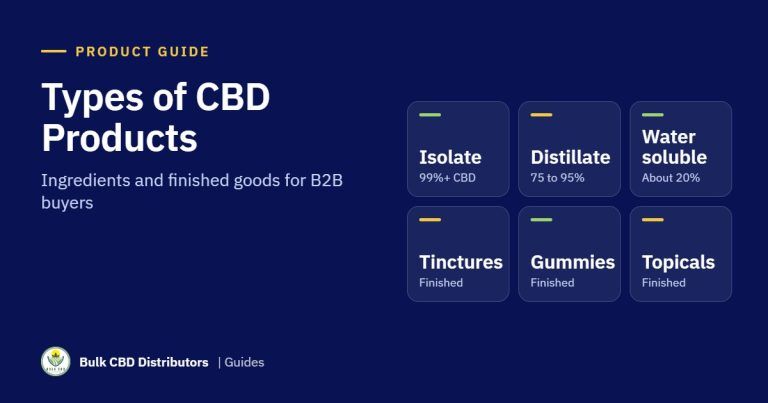
Start with formats your customers already understand. For most stores, that means a small set of CBD products across two or three formats, with one or two strengths in each. A focused opening range of 3 to 5 SKUs is easier to merchandise and track than a full wall of products.
| Format | Shelf needs | Customer questions to expect | Good fit for |
|---|---|---|---|
| Gummies | Countertop or shelf | Strength per piece, count per jar | Convenience, grocery, gift |
| Tinctures | Small shelf space | Total mg, serving size, spectrum | Natural grocers, specialty |
| Topicals and roll-ons | Shelf or personal care aisle | Ingredients, scent, size | Gyms, spas, personal care |
| Beverages | Cooler space | mg per can, flavor | Convenience, cafes |
| Flower and pre-rolls | Behind counter | Cannabinoid content, COA | Smoke shops |
CBD is the anchor for most starter ranges. Products built on CBG and CBN let you widen the assortment once the first products are selling. The Retail Ready section groups finished products by format, including gummies, tinctures, topicals, beverages, chocolates, pet products and smokeables, which makes it easier to compare brands and formats side by side.
Some hemp-derived product types are directly affected by Section 781 of P.L. 119-37. When Section 781 takes effect, hemp is measured by total THC including THCA, and finished products above 0.4 mg total THC per container fall outside the federal hemp definition, according to the Congressional Research Service. Build the core of your range on products whose COAs show they fit those limits, and check state rules for every category you carry.
Case Quantities and Opening Orders
Retail products are usually sold by the case. Case sizes vary by brand and format, so check the case quantity on each product listing before you plan shelf space. A few rules of thumb help size an opening order:
- Order one case per SKU to start. It gives you enough to fill a facing without tying up cash in slow movers.
- Mix formats in the first order. Two or three formats show you quickly what your customers prefer.
- Plan a 4 to 8 week test window. That is usually long enough to see which SKUs sell through and which sit.
- Reorder winners before they run out. Empty facings cost sales and make the display look abandoned.
Mixing brands within one order is a practical way to test the category. Many wholesale suppliers let retailers combine products from several brands in one order. Ask how orders are confirmed and paid for and what the usual ship time is, so you can plan display setup and staff training around the delivery.
How Should You Price CBD for Margin?
Pricing starts with your landed cost: the case price divided by units per case, plus your share of shipping. From there, most retailers work from a target margin rather than a fixed markup.
- Typical benchmark: keystone pricing. Many retailers start from keystone, a retail price about double the wholesale unit cost, which equals a gross margin of roughly 50%. Use it as a typical starting point, not a rule.
- Check the suggested retail price. Many brands publish an MSRP. Pricing far above it slows sales; pricing far below it can undercut nearby stores carrying the same brand.
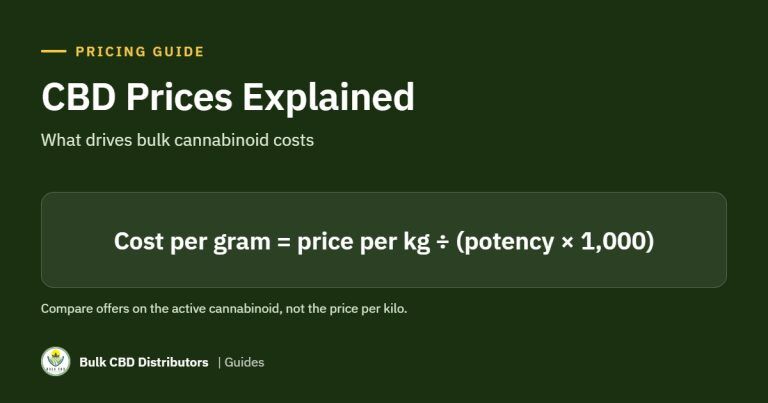
- Compare price per mg. Customers increasingly compare products on cost per mg of CBD. A higher-strength product can look expensive on the shelf but offer better value per mg.
- Watch total margin, not just percentage. A product with a lower margin percentage that sells three times as fast can earn more per foot of shelf.
Review prices after the first test window. Sell-through data from your own register is a better guide than any general benchmark.
Which Compliance and COA Checks Do Retailers Need?
A retailer's compliance routine should be simple enough to follow on every delivery. Start with these checks:
- Know your state and local rules. Some states require registration or a license to sell hemp products, restrict certain formats, or set labeling and age rules. Check with your state agency and local authority before you stock.
- Read the COA for each batch. Confirm the product name and batch number match the package, that cannabinoid content matches the label claim, and that THC results are reported. Our guide on how to read a hemp COA explains each section.
- Keep COAs on file. Store a copy of each batch COA, digitally or in a binder, so you can answer customer and inspector questions.
- Check labels. Look for a batch number, net quantity, cannabinoid content per serving and per package, and a QR code or link to the COA.
- Avoid medical claims in your store. Signs, shelf talkers and staff conversations should describe products by format, ingredients and cannabinoid content only.
Many suppliers post a representative COA on each product page. Ask for the batch COA for the lot you receive, and use that one, not the representative one, for your records.
Merchandising and Staff Basics
Merchandising
Group products by format first, then by strength. Customers looking for gummies want to compare gummies, not hunt across three displays. Place price-per-unit and total mg on shelf tags so customers can compare without asking. Keep higher-value items near the register or in a locked case if theft is a concern, and keep flower and pre-rolls behind the counter where state rules or store policy require it.
Use simple, factual signage: what the product is, the cannabinoid content and how to find the COA. A small sign explaining that each product has a COA available by QR code builds confidence without making claims.
Staff training
Staff do not need to be experts, but they need to give consistent, accurate answers. A short training sheet should cover:
- The difference between CBD isolate, broad-spectrum and full-spectrum products
- How to read the strength on a label, per serving and per package
- How to pull up a product's COA
- What not to say: no medical claims, no promises about effects
- Your store's age and ID policy for each category
Refresh the training sheet whenever you add a new format or when state or federal rules change.
What This Means for Your Business
Selling CBD in a retail store works best as a measured test, not a big bet. Start with a focused mix of 3 to 5 SKUs in formats your customers already buy, order by the case, price from your landed cost with a typical keystone benchmark in mind, and track sell-through for 4 to 8 weeks. Build a simple COA routine into every delivery and give staff a clear script that sticks to facts.
Plan for Section 781 as part of your assortment. Products that fit the total THC measure and the 0.4 mg per container limit will be the stable core of a hemp category, while affected product types may need to be phased out depending on federal timing and your state's rules. Retailers who build that core now will have fewer surprises later.
Comparing Formats for Your Store?
The Retail Ready section and the full shop list current formats and case quantities, with a representative COA on each product page. If it helps to plan a first mixed-case order, we are happy to send a quote, and the batch COA ships with every order.
Frequently Asked Questions
Do I need a license to sell CBD in my store?
It depends on your state and city. Some require registration or a license for hemp products, and some restrict certain formats. Check with your state agency and local authority before you stock.
How many CBD products should a store start with?
A focused opening range of 3 to 5 SKUs across two or three formats is easier to merchandise and track than a full wall of products.
What is a typical retail margin on CBD products?
Many retailers use keystone pricing as a typical benchmark: a retail price about double the unit cost, roughly a 50% gross margin. Actual margins vary by brand, format and market.
Can I mix brands in one wholesale order?
Yes. BCD's Retail Ready section lets retailers combine products from multiple brands and formats in one order.
How should I time a first retail order?
Ask the supplier how orders are confirmed and paid for and what the usual ship time is, then schedule display setup and staff training around the delivery date.
What should I check on a product's COA?
Confirm the product name and batch number match the package, that cannabinoid content matches the label, and that THC results are reported. Keep the batch COA on file.
Where should I find the COA for a retail product?
Most reputable brands link the batch COA by QR code on the label, and many suppliers post a representative COA on the product page. Ask for the batch COA for the lot you receive and keep it on file.
Which CBD formats sell best in convenience stores?
Gummies and beverages usually suit convenience stores because they are familiar, easy to display and quick to explain. Test two or three formats and let sell-through decide.
How does Section 781 affect what I can stock?
When Section 781 takes effect, hemp is measured by total THC including THCA, and finished products above 0.4 mg total THC per container fall outside the federal hemp definition. Review each product's COA and your state rules.
What should my staff avoid saying about CBD?
Staff should avoid medical claims and promises about effects. Keep answers to format, ingredients, strength and where to find the COA.